“When food is passed around a table, something softens, and insecurity is removed,” says Ruth Kramer, director of hospitality, concept, and design at WildLand, a collection of boutique homes and hotels on rewilded estates in northern Scotland. “In a world that can sometimes feel lonely, these evenings rank among the most memorable parts of many guests’ stays.”
At two of WildLand’s existing properties, as well as the upcoming Hope (a hunting lodge turned hotel, launching this summer), guests are encouraged to dine en masse at shared tables. “Historically in the Highlands people gathered around one table — neighbors, travelers, and those working the land — sharing food and stories at the end of the day,” says Kramer. “In many ways we are simply continuing that tradition.”
At Gordon Ramsay High, ten guests sit around one table, overlooking the London skyline
While communal dining might come with valid concerns around privacy, security, or just being stuck next to a bore trying to befriend you — or worse, selling you something — the trend is nevertheless growing. WildLand is just one high-end venture leaning toward shared tables. In Italy, Puglia’s art-filled Palazzo Daniele emerged last summer from a careful restoration with an airy new common area where residents can meet over dinner. At boutique hotel Off Grid Girona, launched last September in a 17th-century farmhouse in Spain’s Pyrenean foothills, guests dine together at a poolside table. As at WildLand’s bases, they can opt out, yet few do.
“We’ve had brilliant feedback,” says Off Grid’s founder, the travel entrepreneur Gerard Greene. “My vision was for more of a home than a hotel; in replicating a family dinner, this experience allows guests to connect and share local food in an authentic, sincere way.” Other hotels arrange communal dining as part of pop-ups involving guest chefs or immersive gastronomic experiences alongside traditional restaurants. At Thailand’s forthcoming KAIA Koh Phangan, for instance, groups might sign up for open-fire beachside cooking experiences.
Dinner at WildLand’s Lundies House
The offering is visible, too, at new restaurants such as Corridor 109 in Los Angeles, where Brian Baik lays on his seafood-centric creations at a 10-seat counter, or Restaurant Gordon Ramsay High, which sees just a dozen diners occupy one table on the 60th floor of a London skyscraper. Back in the supper-club world, upper-echelon chefs have begun providing haute cuisine in their homes. Examples include Otaku by North London-based Max Posener, previously of Michelin-starred establishments; Haawm in Bangkok, whose daring menus by Dylan Eitharong have enticed popstar Dua Lipa; Robz’ Chef’s Table, where hotly tipped German maestro Robin Höfer serves 13 courses in his Dubai apartment; and California’s Between the Vines initiative.
Launched last summer and set to continue this fall, the latter’s ticketed events see the renowned Napa Valley restaurant Press host long-table dinners amid the vines of prestigious wineries. “By gathering everyone around one table,” says Justin Williams, Press’s managing partner, “we can connect diners with the farmers, vintners, and chefs behind each course — creating a more story-driven experience.” Philip Tessier, the restaurant’s chef partner, adds: “Communal dining brings the opportunity to meet new people. The energy naturally builds, evolving from a more reserved start into something celebratory rarely seen in a traditional dining room. Time and again, our guests arrive as strangers and leave as friends.”
We speak to the experts to separate fact from fiction on stem cell beauty treatments, exosomes, and regenerative aesthetics.
For years, aesthetic treatments have been largely concerned with correction. Fill the wrinkle, soften the line, restore the volume. The goal was visible change, delivered quickly and with increasingly dramatic results.
But the beauty standard has since shifted, and rather than asking how to look younger, many patients are asking how to age better. Skin quality, longevity, and regeneration have become some of the industry’s biggest buzzwords, giving rise to a new category of treatments marketed under the banner of regenerative aesthetics.
Alongside terms such as exosomes, growth factors, and cellular rejuvenation, one phrase appears again and again: stem cell therapy. But as interest grows, so too does confusion. What exactly are stem cell beauty treatments, and how much of what is being advertised is grounded in science?
What are stem cell beauty treatments?
At their simplest, stem cell restorative treatments are designed to encourage the skin to repair and rejuvenate itself rather than simply altering its appearance.
«The term ‘stem cell restorative’ generally refers to therapies that aim to stimulate the body’s natural healing and regeneration pathways, encouraging collagen production, tissue repair, and improved skin quality over time,» explains aesthetic doctor and surgeon Dr Jonquille Chantrey.
Stem cell-based treatments can take several forms depending on the clinic and technology being used. In aesthetics, they are most commonly delivered through injections, microneedling, or topical applications designed to introduce growth factors, exosomes, or other regenerative compounds into the skin to improve its texture, elasticity, and collagen production over time.
Regenerative therapies are also increasingly being used to support hair restoration, with some treatments designed to stimulate the scalp and encourage healthier hair growth.
The important caveat is that most aesthetic treatments marketed as stem cell therapies do not actually involve stem cells themselves. «Patients are not actually receiving living stem cells,» says Chantrey. «Instead, they’re usually receiving ingredients, growth factors, signalling molecules, or laboratory-derived products that are intended to mimic some of the regenerative effects associated with stem cells.»
This distinction is often lost in beauty marketing, where the term has become something of a catch-all phrase for a wide range of regenerative treatments.
Stem cells, exosomes, and growth factors: what’s the difference?
Much of the confusion surrounding stem cell treatments stems from the terminology itself. Exosomes, growth factors, and stem cells are often discussed together, despite referring to very different things.
«Exosomes are not stem cells,» says plastic surgeon Professor Tunc Tiryaki. «This is one of the biggest misconceptions in regenerative aesthetics.» As the plastic surgeon explains, stem cells are living cells capable of self-renewal and developing into other cell types. Exosomes, by contrast, are tiny extracellular vesicles released by cells that act as biological messengers, carrying proteins, growth factors, and other signals between cells.
«A useful analogy is that stem cells are the factories, while exosomes are the messages sent out by those factories,» says Tiryaki.
Part of the appeal lies in what regenerative treatments promise: healthier-looking skin rather than a dramatically altered appearance.
«Many patients now want healthier, fresher-looking skin rather than obvious aesthetic intervention,» says Nina Prisk, founder of Update Aesthetics Clinics. «There is much more interest in treatments that improve skin texture, elasticity, and overall tissue quality over time.»
Social media has undoubtedly played a significant role in accelerating awareness. Treatments once confined to specialist clinics are now widely discussed online, often promoted alongside concepts such as longevity, biohacking, and preventative aging.
The downside, experts warn, is that social media can sometimes outpace the science. «Celebrity endorsements and social media have played a major role in popularising regenerative aesthetics,» says Chantrey. «The challenge is that social media tends to highlight dramatic before-and-after results while rarely discussing limitations, evidence quality, or appropriate patient selection.»
Do stem cell treatments actually work?
For all the excitement surrounding regenerative aesthetics, the science remains a work in progress. «The honest answer is: genuinely promising, but it’s still developing,» says aesthetics specialist Dr Liesel Holler. She notes that some of the strongest evidence currently exists for exosome-based treatments combined with microneedling, where studies have demonstrated improvements in skin texture, hydration, tone, and collagen production.
However, many of the studies remain relatively small, use different treatment protocols, and lack long-term follow-up. «We do not yet have the large, long-term, rigorously controlled trials that we would want before making definitive claims,» she cautions.
As with most aesthetic procedures, pricing varies significantly depending on the treatment itself, the clinic, and the number of sessions required. One reason regenerative aesthetics has attracted attention is the wide range of options now available. For example, according to Prisk, microneedling typically costs between £150 and £350 ($150 to $467) per session, while PRP generally ranges from around £300 to £700 ($400 to $935). Regenerative treatments sit at the higher end of the spectrum, with prices usually starting at around £300 ($400) and reaching £2,000 ($2,668) or more per session.
Treatments marketed as «stem cell-influenced» therapies tend to fall within a similar price bracket, typically costing between £500 ($667) and £2,000 ($2,668) or more per session, depending on the technology being used and the treatment area. For comparison, dermal fillers generally cost between £250 ($335) and £600 ($800) per syringe.
As regenerative treatments move from science papers to specialist clinics and into the mainstream, experts say patients should pay as much attention to the provider and the product as they do the promised results. «As with any aesthetic treatment, there are risks that patients need to be aware of,» says Prisk. Depending on the treatment, these may include inflammation, swelling, irritation, and infection.
But the greatest risk that the experts caution against lies not necessarily in the treatments themselves, but in the marketing that surrounds them. Many products and procedures are promoted using the language of stem cells despite having limited clinical evidence or little transparency about what they actually contain.
Regenerative aesthetics may well represent the future of cosmetic medicine, but for now, experts say patients should focus less on the marketing language and more on the evidence behind a treatment. As Chantrey puts it, «‘stem cell-derived technology’ is often a far more accurate description than simply saying ‘stem cell treatment’.»
The distillery also reported sales numbers that are outperforming a few similar brands. The distillery also reported sales numbers that are outperforming a few similar brands.
One of 300 examples comprising the most powerful version of the model made, it will be offered through RM Sotheby’s in August. One of 300 examples comprising the most powerful version of the model made, it will be offered through RM Sotheby’s in August.
«Four Seasons II» is the same length as the newly launched «Four Seasons I,» but features 79 suites rather than 95. «Four Seasons II» is the same length as the newly launched «Four Seasons I,» but features 79 suites rather than 95.
Opera star Pretty Yende discusses her role as Dior’s first opera ambassador, performing at the world’s top houses, and blending fashion with classical music.
It’s tempting to frame Pretty Yende’s story as a modern fairy tale – the small-town girl who stumbled across opera via a television commercial and, within a few years, became an internationally acclaimed soprano on the stages of Teatro alla Scala and the Metropolitan Opera. But that version misses the point. Yende’s rise was less about luck than sheer momentum – a force that reverberates beyond her musical endeavors. She has been embraced by the world of high fashion, notably as Dior’s first opera ambassador. Yende, 51, is from South Africa, lives in Milan, and has upcoming performances in Paris, Rotterdam, and Naples.
What sparked your opera obsession?
I was 16 years old, watching TV with my family, when an ad for British Airways came on – it had a supernatural melody, [The Flower Duet from Léo Delibes’ opera Lakmé]. I couldn’t believe that humans could create such sounds. I grew up with music at home – my grandmother taught me hymns from the church – but this was something different. I thought, “If someone can teach me how to [sing like] this, I can do it.” That’s how my journey began. Every time I would fly from Johannesburg to Cape Town, I’d try to fly British Airways so that I could hear that advert again.
I have grown up in the biggest opera houses in the world. My career started where everybody wants to arrive – I’ve sung in Milan at Teatro alla Scala, and in Paris, London, New York, Spain, Germany. Architecturally, each house has a distinct individuality, but what connects me to them most is what happens on the stage. Acoustically, I have a few favorites – the Metropolitan Opera House, where I first performed in 2013, felt like it was hugging my voice. To experience such acoustics is something that I treasure, and that [performance] gave my career direction. I love knowing that prestigious singers sang in these opera houses in the past, and that I’m following in those footsteps. Maria Callas sang in Houston and I’m going to make my Houston debut soon as Marguerite [in Gounod’s Faust].
I try not to look up to one person because it’s dangerous – you end up being a bad copy of them. Maria Callas is someone I admire in terms of how she could tell a story. And the beauty of Montserrat Caballé’s voice – her sound was like velvet. Or Mariella Devia, who you cannot take your eyes off when she’s on stage. There’s also a humility in seeing great artists still learning and perfecting their art.
What music do you listen to?
I love gospel and jazz – Ella Fitzgerald and Nina Simone are two of my favorite artists. I’m going through a huge shift in my personal life with both of my parents passing. I’m in a moment of being present, so I’m grateful for music because it gives me healing and an escape.
I have always thought that fashion and opera should be one. But I try not to overpower my voice with the outfits I wear on stage – I like to use color to make myself feel comfortable. A career highlight was singing at the coronation of King Charles III in 2023, where I was dressed by Stéphane Rolland. I always dreamed of being dressed by Dior, so it was huge to become its first ever opera ambassador. I always want to be elegant – that’s why Dior works for me, because of the simplicity of its pieces.
Every time I go to a hotel, I buy a pen. I’ve been collecting them for the past 20 years – I probably have more than 300. They’re kept in a special memory box, and I use them to sign [opera] contracts. The reason I like pens is because my mom loved them – she passed that down to me.
Do you have any hidden talents?
Before I fell in love with opera, I loved cooking. If singing didn’t work out, I would have become a chef. My dishes are influenced by the places I’ve lived – South Africa, where I was born, and Italy, where I live now. [Italian cuisine] uses pure ingredients; it’s simple and healthy.
Your favorite places to travel?
I like to go to places that have the sun. South Africa is number one, because home is home. But I also love going to islands – the Maldives is one of my favorite destinations.
How do you define happiness?
There’s a difference between happiness and joy – happiness is subjective, whereas joy is not attached to something; it’s just there, like love. It’s like being rich and being wealthy – they’re two different things. I find joy when I sing and from the characters that I play on stage, whether it’s a sad story or a comedy. My songs always come from joy.
The Reservation: The Italian-inspired London hotspot has re-created a magic formula.
English weather is famously unpredictable but still, top dogs at Public House Group – the hospitality trio behind the likes of The Hero, The Pelican, and The Bull in Charlbury – likely thought that the first week of June was a safe bet for its newest opening.
They were wrong, and England was in the midst of a week-long downpour when Canteen Cotswolds – a sister to the Italian-inspired London hotspot – opened in the Old Coal Yard, just outside of postcard-pretty Chipping Norton.
But, fortunately for Public House founders Phil Winser, James Gummer, and Olivier van Themsche, the group’s reputation precedes it. On the restaurant’s first Saturday, amid the rain, the place is packed and the buzz spills out of the doors. There are groups of friends; older couples sharing carafes of red; new parents holding baby toys in one hand and glasses of fizz in the other. The car park is nicely dotted with Range Rovers.
Like Canteen 1.0, the menu looks directly at Italy. “Everything is designed to share,” we’re told as we order. Focaccia arrives nearly as soon as you sit down – crunchy enough to cut the roof of your mouth but subdued with peppery olive oil. Then there’s hunks of sweet charentais melon, wrapped up in prosciutto; doughy white-base pizza with fennel salami; and steaming bowls of pasta, coated in a rich sausage ragu. Like at the London original, chicken cooked in sage-infused milk is a secondi star. Mop up the last of that fragrant, earthy sauce with the piping hot, crispy-edged Tuscan roast potatoes.
Keep the doctor happy with a side order of salad – go for the baby gem lettuce, swimming in a silky dressing, mustardy enough to feel it in your nostrils. Eating Italian-style – with a whole pizza and bowl of pasta polished off before you get to the entrees – means dessert can often be neglected. No such problem here – every table around us orders at least one plate of the chocolate mousse (again, already made famous at Big Sister Canteen), devilishly drizzled with olive oil and sprinkled with salt.
Like the food, the drinks list isn’t trying too hard to challenge the status quo, and does classics excellently: the martini (vodka, slice; unless requested otherwise) is crisp and ice-cold, and the negroni is fragrant and un-fussy. Bar a single Provence rosé, the wine menu sticks entirely to Italy, and covers the length and breadth of the country.
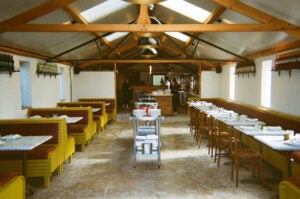
As you might surmise from the name, this new Canteen isn’t fine dining, so don’t come anticipating that: there are no pressed white tablecloths, nor designer cutlery. Some seats sit along the windows, others are picnic benches that have been carted inside; the odd dog hides under a table. Service is affable, cheery, and genuine, but without airs and graces. It’s prompt, too – mains might arrive while you’re still finishing the last of your pasta course.
I have my fingers crossed for a sunnier summer for the Canteen Cotswolds team, but even if it’s storms only from here on out, Public House seems to have another success on its roster.
Project Zero is set to be the first all-electric superyacht to hit the seas. Project Zero is set to be the first all-electric superyacht to hit the seas.