In England’s Lake District, Michelin-starred restaurants are turning garden harvests into remarkable drinks.
I’ve just returned from the Lake District in the north of England, one of my favorite places on earth. My family have lived and vacationed there, in the same house, for four generations. It’s a part of the world famous for beautiful landscapes – dry stone walls, woods, lakes, and fells. But what’s less well-known is it also boasts the most Michelin stars of any UK county outside of London.
The restaurant that does a lot of the heavy lifting is Simon Rogan’s three Michelin-starred L’Enclume, which sits in the heart of the ridiculously picturesque village of Cartmel. Reams have been written about the food at this restaurant, but I wanted to highlight the drinks, because they serve as a wonderful showcase for British producers and locally grown vegetables, fruit, and flowers.
Most of this produce comes from Our Farm, Rogan’s 12-acre smallholding just a mile outside Cartmel. Between June and September, it hosts pop-up dinners among the fruit and vegetable beds, and tours of the farm with the gardeners and chefs. (An overnight stay at one of the smart B&B rooms they have dotted around Cartmel can also be arranged).
If you, as I do, love gardening – as well as good food and drink – this is an experience not to be missed; a chance to smell, touch, taste, and explore a whole array of new ingredients.
I was shown around by head grower Adam Frickel and Our Farm chef Liam Fitzpatrick (and a very friendly greyhound). They explained how Our Farm helped them to create menus that weren’t just more delicious, but also more sustainable. Instead of using imported lemons, they use lemon verbena, lemongrass, and oaxalis (also known as the butterfly plant) to give their drinks a citrus kick; and make a tropical-tasting kombucha from pineapple weed. I picked juicy Japanese wineberries, raspberries, and gooseberries in an array of hues, pinched rose-scented geraniums and anise hyssop, which has hints of Parma violet, and walked through polytunnels bursting with rhubarb, tomatoes, grapes, and edible flowers all destined for drinks in Rogan’s five restaurants.
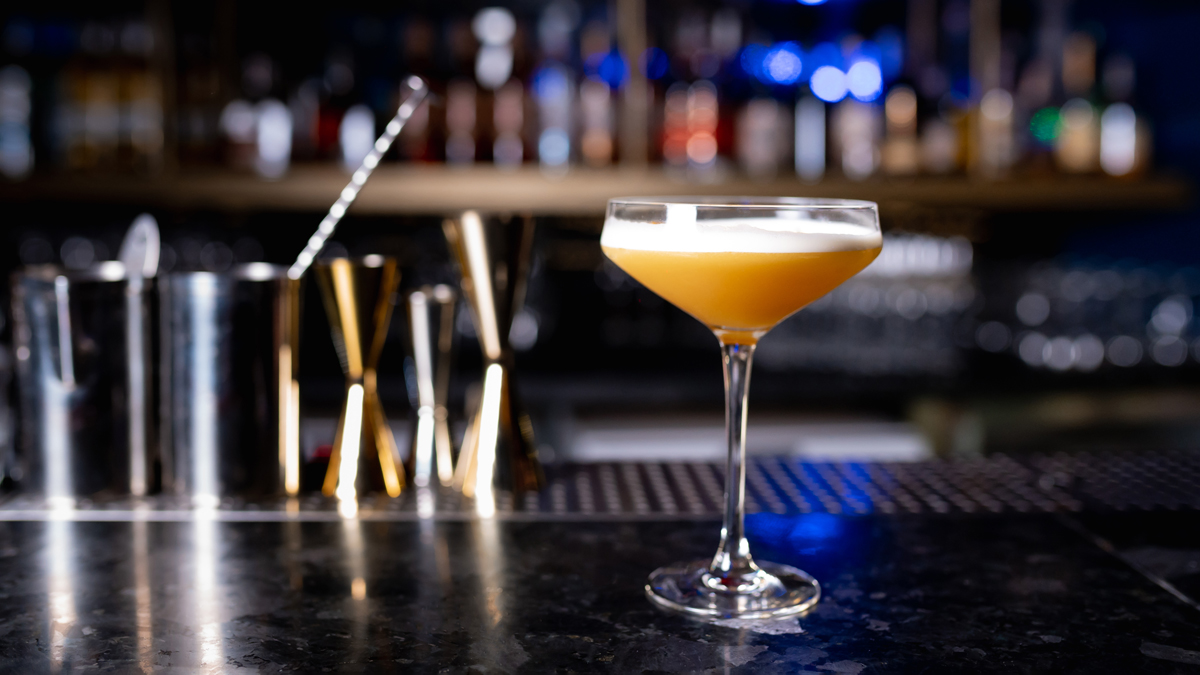
At L’Enclume you can sip an Espresso Martini sweetened with vanilla-scented woodruff syrup, and a Dark ‘n Stormy infused with fruity apple marigold. At the more informal Rogan & Co, also in Cartmel, there’s a highball of spruce and coriander seeds topped up with Lakeland sparkling water. At Henrock, in Windermere, non-alcoholic options include a fizz made with Our Farm plums and perilla (aka shiso) and a Virgin Mary made with their own kimchi. There’s also a housemade blackthorn vermouth, fig leaf cordial, and a house tea blend featuring several types of mint including apple, pineapple, chocolate, and yakima (which was a new one on me).
“To reflect our ethos of sustainability, we always aim to produce as much as possible ourselves,” says Rogan, “or to work with suppliers or share our ideas and vision.” To that end, he also serves gin from Shed 1 distillery in nearby Ulverston, a range of local beers and coffee from Dark Woods Coffee, a community-focused roastery in West Yorkshire.
English wine is also a focus. At L’Enclume they list more than a dozen still and sparkling cuvées from standout producers including Hundred Hills in Oxfordshire, Kent’s Gusbourne, Langham in Dorset, and the biodynamic Domaine Hugo. The house sparkler is a pale pink rosé made in collaboration with Sussex’s Wiston winery. Just the ticket for sipping in the garden on a long summer evening.
To find out more, and enquire about by-appointment farm tours visit here.
The second unit in Sanlorenzo’s 74Steel series is full to the brim with extravagant features. The second unit in Sanlorenzo’s 74Steel series is full to the brim with extravagant features.
In South Africa, wellness isn’t confined to the spa. But it’s found in open skies, unstructured afternoons, and the gentle cadence of life in the wild.
From the savanna to the Cape Winelands, South Africa offers a grounded approach to wellbeing. Here, wellness extends beyond the spa, shaped by time outdoors, varied landscapes, and a slower daily rhythm.
For your next mindful escape – whether with friends looking to get off grid in a vineyard setting or a family reunion discovering remote reserves – these lodges and camps offer a gentler take on safari life.
Singita Ebony Lodge, Sabi Sand
Singita Ebony Lodge remains one of Africa’s most influential pioneers of conservation-led luxury. Positioned along the banks of the Sand River, this lodge sits among enormous trees and provides guests with access to 45,000 acres of private reserve. Lion sightings are frequent, as are glimpses of the more elusive leopard.
Singita’s design is inspired by the Adobe architecture of North and West Africa
Singita’s intuitive hosting and understanding of ecotourism (it has a 100-year purpose to preserve and protect the African wilderness for future generations) are peerless. The lodge’s design, inspired by the Adobe architecture of North and West Africa, is a refined interpretation of classic tented safari. Earthen tones of ecru and ochre match with antiques and African art. My glass-fronted suite, one of just 12, opened onto a private plunge pool from where I spent afternoons watching families of elephants bathing in the river below.
During game drives, my driver Piet and tracker King were experts at spotting the big game lurking in the bush, as well as indigenous flowers, wildlife tracks in the sand, and ripe marula fruits, just calling for a taste.
Each of Singita’s 12 glass-fronted suites opened onto a private plunge pool
Singita integrates wellness at nearly every touchpoint. During my visit, I tried a barefoot sound bath in an ancient riverbed and the time between game drives was intentionally unstructured, allowing for rest and relaxation. Guided meditation and outdoor yoga can also be arranged. Evenings are low-key, spent around the fire under open skies to the joyful sound of the Singita family choir performing traditional song and dance.
Few places showcase the restorative power of nature quite as eloquently as Babylonstoren (the South African sister property to The Newt in Somerset). The property is especially recognized for its formal gardens, which include rows of espaliered fruit trees, colorful vegetable plots, and calming water features. Set against the dramatic backdrop of the Simonsberg mountain, Babylonstoren is one of the Cape’s best-known farm estates and really feels like home – even down to the hotel’s two cats that dutifully visited my cottage each morning.
The gardens supply much of the produce used across the property’s restaurants. Particular highlights during were the carnivore and Italian themed dining evenings, both of which were immersive and entertaining.
Babylonstoren’s Garden Spa is set within a dense bamboo grove
Another Babylonstoren highlight is Garden Spa: set within a dense bamboo grove, it really is a ‘living’ spa in every sense. It aims to offer an entire sensory immersion, from the mineral-rich stillness of the Himalayan salt room to the cooling purity of the former farm reservoir, now reimagined as a swimming pool.
Treatments draw on both ancient ritual and modern innovation, including hammam honey and salt scrubs, and traditional Arabian-inspired Rasul cleansing. The warm bamboo massage and probiotic facial were both delivered with exceptional expertise. My sunrise yoga session was followed by produce-led breakfasts that reinforce the connection between wellbeing and the land, with stand-outs including freshly baked loaves, local honeycomb, and prickly pear juice.
Arriving at Mount Nelson, away from the concrete jungle that is Cape Town, an immediate sense of calm reverberates. This iconic hotel opened in 1899 to much acclaim and is locally known as ‘The Pink Lady,’ thanks to its blush exterior. Guests relaxing beside the palm-fringed pool will find themselves sharing the space with local ibis birds, showing off their long, curved beaks and pearlescent feathers.
Accommodation spans elegant historic rooms with views of Table Mountain, quaint pastel-hued cottage suites complete with fireplaces, and a brand-new contemporary suite designed in collaboration with critically acclaimed South African designer Thebe Magugu.
The Colonial-style Mount Nelson is known as ‘The Pink Lady’ thanks to its blush exterior
Alongside the famed afternoon tea, the hotel boasts a new gastronomic offering: Amura is a marine-inspired fine dining restaurant by internationally acclaimed Spanish chef Ángel León. Vibrant, colorful dishes of yellow tail sashimi in a green herb escabeche and plankton risotto both surprised and delighted.
My experience at the Librisa spa, set in three beautifully restored Victorian heritage homes amongst a lush herb garden, stands as one of the best I’ve had. Signature treatments include a range of soothing body wraps and facials, as well as African wood massages inspired by the rhythmic movements of traditional local dance using specially designed wooden implements. Being invited to blend my own bespoke salt scrub using fragrant botanicals from the gardens was especially memorable.
The hotel’s Librisa spa is set in three beautifully restored Victorian heritage homes
Set within one of the world’s rare sand forests, Phinda Forest Lodge is a pioneer of eco-luxury. Less than 5,000 acres of heavily protected sand forest remain globally, and Phinda is set across around 1,290 of those. This fragile ecosystem is home to endemic flora and elusive wildlife such as the red duiker and suni.
In partnership with eco-friendly skincare brand Healing Earth, the spa experience is rooted in African botanical knowledge and traditional healing practices. Options include Himalayan rock and sea salt-based therapies, infused halotherapy, and the contemplative ‘Quiet Mind Journey,’ all of which are designed to help guests transition from safari activity to a more restful state. At Phinda, the shift from the exhilaration of the wild to the stillness of the spa is seamless.
The spa offers treatments rooted in African botanical knowledge and traditional healing practices
Sterrekopje Farm, Franschhoek Valley
Cradled in the foothills of the Franschhoek mountains, this biodiverse farm and soulful sanctuary of healing rest is a hidden gem. Its ‘soil-to-soul’ ethos encourages guests to engage with the land from the outset. At sunrise, residents are invited to join in the daily harvest to the sound of bird song and crickets chirping.
Sterrekopje’s 120-acre farm is found in the foothills of the Franschhoek mountains
Scattered across Sterrekopje’s 120-acre farm are 11 sanctuaries and suites, each a private retreat, and each carefully designed to emphasize comfort, natural materials, and quiet.
There are wild swimming spots, shaded olive groves for repose, and evenings are softened by candlelight. In the Bath House, treatments range from meridian alignment (a traditional Chinese medicine practice) and pranayama breathwork (the yogic practice of controlling the breath) to wildflower baths and deeply nurturing botanical oil therapies.
The hotel’s Mongolian yurt serves as a gathering space for various wellness practices and rituals
A Mongolian yurt serves as a gathering space for yoga, ceremonial cacao rituals, and full moon celebrations, while the apothecary transforms on-site botanicals into teas, oils, and tinctures.
The sprawling property, which offers six bedrooms across two buildings, is located in the exclusive Martis Camp enclave. The sprawling property, which offers six bedrooms across two buildings, is located in the exclusive Martis Camp enclave.
The West’s curiosity with Chinese-inspired design didn’t start online; instead, today’s fascination with Chinese aesthetics has deep and surprisingly familiar roots.
Scroll through social media right now and you’ll find a steady stream of Chinese aesthetics repackaged for global consumption. Whether it’s the power of Shanghai Fashion Week, the viral appeal of plush collectibles like Labubu dolls, or starting the day with a mug of warm apple-boiled water and qigong stretches: this is what the internet has dubbed ‘Chinamaxxing’.
Once dismissed as old-fashioned or niche, these aesthetics have suddenly found themselves in vogue amongst those in the West with a TikTok account. All the while, offline (read: the real world), China dominates as a global superpower. And it’s this omnipresence in news and culture, together with the ever-shifting perceptions that the US and China hold on one another, that has sharpened the West’s fascination with the country today.
Like most online movements, Chinamaxxing offers only a partial view, packaging fragments of a vast culture into something digestible and highly shareable. But the impulse and fascination with a stylized, curated version of Chinese culture is far from new.
The Banqueting Room at the Royal Pavilion in Brighton from John Nash’s »Views of the Royal Pavilion» (1826)
In fact, you only have to look back to the 17th and 18th centuries, when Europe fell hard for what it understood (or misunderstood) to be ‘the East.’ Increased trade with China during the High Qing era brought an influx of porcelain, silk, and lacquerware into European homes – luxury goods that quickly became markers of taste and status.
From this grew chinoiserie, a decorative style that translated cultural admiration into interiors, architecture, and the curation of objects that were less about accuracy and more about creating an atmosphere. Chinoiserie wasn’t interested in faithfully reproducing China. Instead, it thrived on interpretation. Despite its name deriving from the French chinois (meaning ‘Chinese’), designers borrowed freely from across Asia, frequently collapsing Chinese, Japanese, and even Indian motifs into a single aesthetic.
Hand-painted wallpapers filled with fantastical landscapes, pagoda-style rooflines, delicate fretwork, lacquered furniture, and an entire cast of dragons, exotic birds, and improbable gardens created an escapist vision of a distant, harmonious world.
Royal patronage helped accelerate the trend. George III’s fascination with all things Chinese saw him encourage a scholarly exchange of sorts, where British architects, academics, and scientists were sent out with trading companies in order to bring back as many ideas as possible. London’s Kew Gardens opened shortly after in 1759, housing hundreds of new species of flora clippings from China and the Western New World. The Great Pagoda was completed in 1762 as a gift for Princess Augusta, as one of several Chinese buildings designed for Kew by Sir William Chambers.
The Brighton Pavillion, commissioned in 1787, takes a more Middle Eastern-inspired architectural approach for its exteriors
In 1787, the Prince Regent, who would later be crowned King George IV, commissioned Brighton Pavilion as his newest holiday retreat. Despite lying on England’s south coast, the architecture ditched notions of nautical design for something more Middle Eastern-inspired – an onion-domed, bamboo-lined, lantern-lit Chinese palace like no other of its time.
Nowhere was this more apparent than in the rise of the ‘China Room.’ By the mid-18th century, having one had become a quiet flex among Europe’s upper classes. At Harewood House, the late-18th-century interiors incorporated Chinese wallpapers and porcelain as part of a broader display of global taste, while Burton Constable Hall and Claydon House leaned more heavily into decorative fantasy, with intricate fretwork, lacquered surfaces, and densely layered ornamentation.
These rooms were designed to entertain, lined with imported (or import-inspired) porcelain, cabinets filled with curiosities, and walls covered in hand-painted wallpapers. Crucially, they were less a reflection of real Chinese interiors and more a staged illusion: most of the objects, while sometimes made in China, were created specifically for export or interpreted through European design. The result was an imagined version of China, assembled for display, conversation, and status.
Even without the unifying force of the internet, this aesthetic wasn’t confined to Britain. The Chinese House in Sanssouci Park is a gilded, playful interpretation of Eastern design, while Russia’s Chinese Village, commissioned by Catherine the Great in the late 18th century, turned the idea into a full architectural experiment – proof that chinoiserie was becoming a continent-wide fixation.
But for all its beauty, chinoiserie came with complications. Brighton Pavilion’s architects, John Nash and Fredrick Crace, had never been to China, which might explain why the palace’s decorative palm tree columns, hybrid dragons and gibberish Chinese characters were inaccurate. William Chambers, the architect behind Kew Gardens’ Great Pagoda, did visit China, yet his rendition was still built with an inauspicious number of floors.
At its core was imitation: an aesthetic built on what Europeans thought China looked like, rather than what it actually was. Many objects in these interiors were made specifically for export, tailored to Western tastes rather than reflecting authentic Chinese design. Others were produced entirely in Europe, filtered through imagination and second-hand references. The result was something visually rich but culturally distorted: a version of China that existed largely in the European mind.
Some saw chinoiserie as frivolous and illogical; others viewed it as a sign of cultural confusion, or worse, a superficial engagement with a complex civilization. With hindsight, it’s difficult to separate the aesthetic from the broader context of empire, trade, and exploitation that made these objects – and crucially this fascination – possible in the first place.
Which brings us back to now. The current wave of Chinese-inspired trends may be faster, more digital and more self-aware, but the pattern feels oh-so familiar. Then, as now, elements of a culture are selected, stylized, and circulated for consumption. The difference is the medium. The instinct, it seems, hasn’t changed much at all.
The rock and roll royals bought the 100-year-old Hancock Park mansion in 2015 and first tried to sell it about four years ago. The rock and roll royals bought the 100-year-old Hancock Park mansion in 2015 and first tried to sell it about four years ago.
Each Titan Noir model features two physical iris modules that control light output. Each Titan Noir model features two physical iris modules that control light output.
Why eating with the clock may be the simplest ‘biohack’ in the book.
We’ve been told that longevity lives in the details of what we eat. But the bigger lever might be when we eat.
Misaligned meal-times – especially late‑night eating – can throw your internal clock out of sync, with ripple effects on sleep, metabolism, and even blood pressure. The fix? A simple 10-to-12 hour eating window that tracks with your circadian rhythm.
“The circadian rhythm is the body’s internal 24-hour clock, regulating everything from sleep and hormone release to digestion and energy levels,” explains Dr Mariel Silva, director of medical services at SHA Spain, the global pioneer in integrative health. While this rhythm is centrally controlled in the brain, it also runs through “peripheral clocks” located in most organs – and food plays a surprisingly powerful role in keeping the entire system in sync.
“Alongside light exposure, when we eat is a key signal that helps regulate these internal clocks – particularly those linked to metabolism,” explains the doctor, who holds a masters in anti-aging medicine. Eating by the clock drives more efficient digestion, blood‑sugar regulation, and energy use, with recent studies showing it can lower blood pressure and support heart health, too. Conversely, irregular eating habits can lead to circadian misalignment. “Over time, this may interfere with hormones such as melatonin, affect sleep quality, and increase the risk of metabolic issues, including weight gain,” Dr Silva continues.
Rather than limiting what you consume, “circadian fasting is about synchronizing restriction with one’s environment,” explains nutritional therapist Mark Bennett, lead nutritional scientist at wellness coaching platform Wilding Tribe. Quite simply, it means intentionally eating “between sunrise and sunset.»
For famed human biologist and founder of The Ultimate Human Wellness, Gary Brecka, circadian fasting “calms late‑day cravings, improves sleep, and makes recovery more predictable with better HRV” (or heart rate variability – a window into the body’s stress and recovery systems). “I front‑load calories earlier in the day,” he says; “keep my eating window to roughly eight-to-10 hours in daylight, and stop eating two-to-three hours before bed.»
While Brecka may fast for marginally longer than others observing a time-restricted eating plan, the approach is still far from punishing. But what reads like the simplest biohack in the book feels complicated when you consider the logistics of long-haul travel. “In individuals who travel frequently, circadian disruption is common, particularly when crossing multiple time zones,” Dr Silva explains. The solution here is to use food to help the body adjust. “One of the most effective strategies is to shift your mealtimes to match your destination as soon as possible,” Dr Silva says.
Bennett agrees. “Once on the plane, immediately adjust your watch and devices to the current time at your destination and aim to eat your meals from that point onwards as if you were there.” Avoid eating if it’s nighttime at the new location; upon arrival, “aim to get morning, noon, and late‑afternoon sunlight exposure as soon as possible.”
To further support your alignment, Dr Silva advises prioritizing “foods that support alertness and sustained energy” by day, highlighting complex carbohydrates “including oats, brown rice or buckwheat, which can help reinforce the active phase of the circadian cycle”. Then, come evening, lighter meals can help signal to the body that it’s time to unwind. “Foods rich in tryptophan, including bananas, legumes, and nuts, support the production of serotonin and melatonin – both of which play a role in sleep regulation.”
Regardless of time zones, Brecka keeps a consistent morning routine – breathwork, movement, and a few other cues: “Your body learns the routine as a signal for ‘daytime’, so it travels well.” He gets outside for natural light within the first hour of waking, easing into the day instead of “blasting” his brain with blue light. Then, he caps caffeine early, and bookends bedtime in the same way – think “no screens in bed, room cool and dark, cotton sleep mask.»
Consistency is key, he’s learnt. “Those small, repeatable cues are what keep circadian rhythm tight: light early, stimulation paced, a portable morning ritual, caffeine discipline, and a predictable wind-down.”
As Dr Silva adds, “aligning our daily habits with our biological rhythms can significantly improve overall health” – and fasting when it’s dark may be the simplest way to start.
Breitling resuscitated the long-lost brand, and now it’s back with a slew of new watches. Breitling resuscitated the long-lost brand, and now it’s back with a slew of new watches.