Built from 1958 through 1967, and now also available as continuations, the British marque’s convertibles are esteemed by those in the know. Built from 1958 through 1967, and now also available as continuations, the British marque’s convertibles are esteemed by those in the know.
Рубрика: General
-

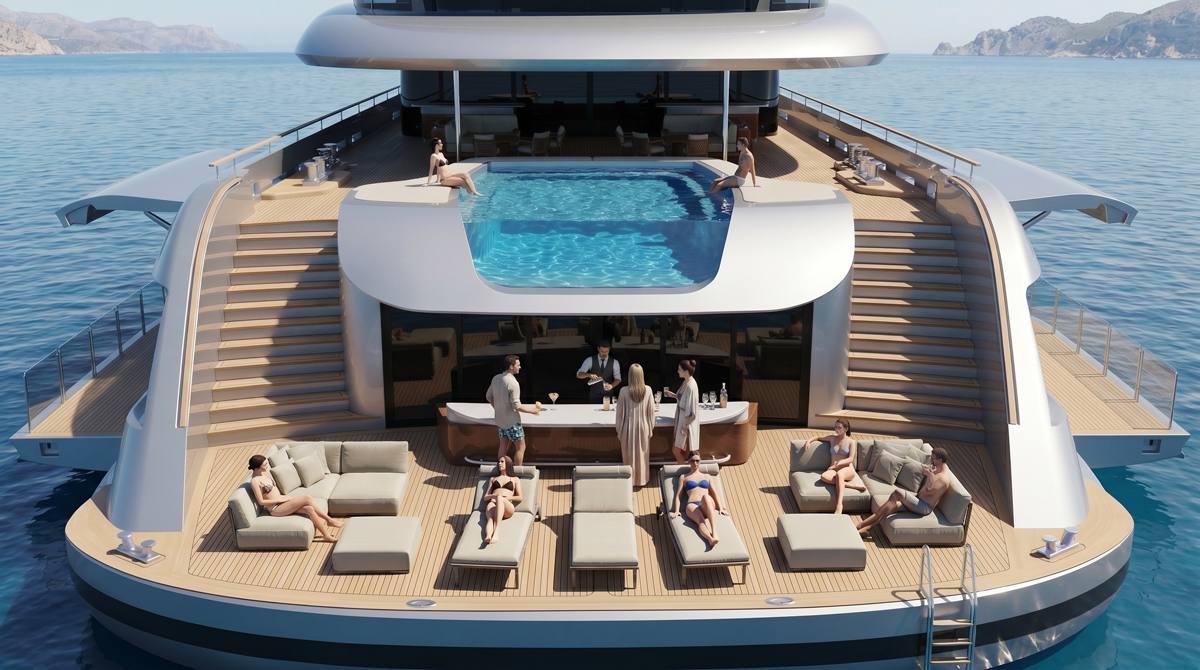
Benetti’s New 131-Foot Hybrid Superyacht Brings Quiet Luxury to the Seas
The B.Neos is a masterclass in restraint. The B.Neos is a masterclass in restraint.
-

Luxury Valentine’s Day Gifts for the Well-Held Gentleman
From rare timepieces to elevated essentials, here’s the gifts to consider.

-

Alpine Chintz is Charming its Way Into Ski Chalet Design
From St. Moritz to Megève, designers are trading alpine minimalism for chintz, color and pattern.

The alpine luxury aesthetic has been whitewashed with bleached timbers, disciplined schemes in varying shades of snow, and bouclé furniture that politely receded into the background – all designed to quiet the senses after a day on the slopes. It was a look that mirrored the landscape outside: serene and elemental. But something more decorative is carving fresh tracks. A new generation of designers is embracing pattern, color and ornament at altitude, with chintz leading the mountain-maximalist charge refreshingly off-piste.
See also: The World’s Most Expensive Ski Resorts
For decades, chintz has lived a double life. Born from hand-printed cottons traded from India to Europe in the 17th century, its lacquered florals and pastoral scenes once signified refinement and a certain domestic confidence. These fabrics migrated easily into European interiors, becoming shorthand for warmth and familiarity. Then came the backlash. As modernism sharpened its edges, chintz was labelled fussy, old-fashioned, even gaudy – something to be stripped away in favor of clean lines and neutral restraint. Few places embraced that pared-back purge more enthusiastically than the Alps’ glitziest ski resorts.

©Kulm Hotel St. Moritz Yet chintzy interiors never entirely lost their footing in the mountains. Traditional Tyrolean and Bavarian interiors long relied on floral prints, ginghams, and folkloric motifs to soften timber-heavy rooms and counter the severity of winter. Pattern is once again making a stylish ascent, with alpine chintz adding texture and personality to the chaletcore world that once relied on neutrality as the default expression of coziness.
Few have helped propel chintz to its peak quite like British creative, Luke Edward Hall. At Amaru, the Peruvian restaurant within Kulm Hotel St. Moritz, Hall has taken what could have been a blank-canvas dining room and turned it into something exuberant and transportive. The space is layered with a bold palette of pink, ochre and olive, and narrative-rich details that speak to the artist’s signature fantastical style. A vaulted ceiling, hand-painted by artist Timna Woollard with oversized wildflowers which grow in the Engadin, draws the eye skyward, while Hall’s own sketches can be found in amongst artworks by Peruvian painter, Ernesto Gutierrez. The result feels like stepping into an imagined alpine world, where storytelling through pattern and palette is given free rein.

Hôtel Saint-Georges @StefanGiftthaler That same eclectic, expressive sensibility carries downhill to Megève, where Hôtel Saint-Georges has recently been reimagined as a technicolor counterpoint to the town’s traditional chalet vernacular. Revived by Chapitre Six – the hospitality force behind cult addresses such as Hôtel La Ponche in Saint-Tropez – in collaboration with Hall, the hotel trades alpine tropes for something more playful. Mod-mountaineers are now greeted by folklore-inflected frescoes and considered clashes of botanical patterns across skirt-wearing beds and vibrantly tiled bathrooms.

Hôtel Saint-Georges @StefanGiftthaler For a more intimate, deeply rooted expression of this decorative shift, look to Berghoferin Fine Hotel & Hideaway in South Tyrol. With just 13 suites, Berghoferin feels closer to a private home than a hotel, its interiors unfolding like a carefully composed cabinet of curiosities. Here, in the foothills of the twin peaks of Corno Bianco and Corno Nero, chintz-adjacent florals ripple against ancient Swiss pine panelling reclaimed from old farmsteads, their colors drawn directly from the surrounding landscape – ink-dark skies, larch-gold autumns, forest greens.

Berghoferin @Kym Grimshaw Pattern plays a starring role: Josef Frank wallpapers – sourced via Swedish design powerhouse, Svenskt Tenn – introduce a joyful tension between modernist thinking and alpine tradition, offset with furnishings from Kvadrat and historic Austrian textile specialist, Backhausen. Mono-color curtains are cinched with printed tiebacks, framing fairytale views across the westernmost Dolomites. Throughout, lighting by Italian design houses casts a soft glow on hand-picked furniture, art, and objects collected over time.
In alpine terms, the rise of chintzy interiors signals a renewed sense of nostalgia for the chocolate-box chalet, recalling a time when mountain retreats were designed to cocoon, enchant, and comfort – and ultimately, bringing some much-needed warmth to cold climates and character to some of nature’s starkest settings, without a borg-fleece blanket in sight.
-

The New Spa Ritual Isn’t a Massage – It’s What You Drink
From ayurvedic teas to adaptogenic elixirs, luxury spas around the world are rethinking what to serve as guests move toward functional wellness drinks.

I just tend to prefer being outside. But then, last year, I stayed at Forestis in the Dolomites – a minimalist Scandi-style retreat with a gorgeous spa that completely changed my mind. I swam inside and out, looking up at the peaks, and tried saunas of several different types. I plunged in ice-cold mountain streams, breathing the scent of clover and pine, and enjoyed the best massage of my life.
Before that memorable pummelling, I was served a stone carafe of the spa’s own stone pine cordial. It was pure, cool, and refreshing, and absolutely captured the sense of place. I resolved to make it my business to find out what other spa drinks would be trending in 2026.
Refreshments informed by the ancient Indian healing system of ayurveda are a big thing for this year.

©Estelle Manor At Eynsham Baths, the spa at Estelle Manor in the English Cotswolds, guests can choose from a range of bespoke ayurvedic teas hand-blended from homegrown herbs and specialist ingredients from India. They’re seasonal and matched to the treatment the guest is receiving, but a typical post-treatment tea might feature coriander, fennel, rose or vetiver, for cooling and hydrating.
Also on offer are elixirs and smoothies laced with adaptogenic ingredients including cordyceps, moringa, shatavari, and ashwagandha – plants favoured by many ancient schools of medicine for their potential mood-boosting and mind-balancing properties.
“We are seeing guests move away from champagne and alcohol towards drinks that help them feel better,” says the spa’s food and beverage manager Vipul Rana. “Our teas and elixirs are designed to aid the body and the moment – calm the nervous system, support digestion, balance hormones, and deeply hydrate – without stimulates, alcohol or additives.”
The drinks at the Amanbagh Spa in Rajasthan, also have ayurveda at their core; they’re considered “part of the overall wellness journey, rather than refreshments alone,” says spa manager Puneet Sharma.
Upon arrival, guests are welcomed with a seasonal traditional drink – it’s currently tamarind and jaggery, a time-honored preparation historically prized for its digestive, cleansing, and energising properties.
Following their treatment, guests are then offered a choice of infusions which includes moon tea, an esoteric tisane of lavender, brahmi (aka water hyssop), and ashwagandha that’s so-named because it’s traditionally prepared by moonlight, and known for promoting emotional balance, mental clarity, and calm.

©Aman “Today, guests coming to the spa are not only looking for relaxation. They want to feel better from inside, both physically and mentally,” says Dr Abby Krishnana, doctor of ayurveda at Six Senses Krabey Island in Cambodia. “Many guests ask about digestion, energy levels, hydration, immunity, joint pain, and overall balance. They are also interested in learning natural ways to take care of themselves, not just during the stay but also after they go home.”
Drinks have become “an important part of the spa experience,” says Krishnana. “Guests are no longer satisfied with sweet or decorative drinks. They are looking to support digestion, reduce fatigue, help with gut health, joint care, and general wellbeing. There is a clear shift towards functional and natural beverages.”
This spring, the Maybourne Riviera’s Surrenne spa is hosting a series of wellness retreats in collaboration with nutritionist and ‘Queen of the Reset,’ Rose Ferguson. Highlights from the tailormade drinks menu include ceremonial grade cacao by Maria Cacao and a liquid gold latte made with almond milk, turmeric, vanilla, ginger and energising MCT oil.
Guests can also pimp their smoothies or juices with a selection of nutrient ‘boosters’. Dirtea mushroom powders include performance-enhancing cordyceps and chaga, a powerful antioxidant. There’s also a choice of protein powders and the option of Willpowder’s Bovine Collagen, reputed to improve hair, skin, and nails.
Elsewhere, hotel spas are embracing CBD – at the Hotel Café Royal in London you can rehydrate with InTune’s all-natural sodas (my favourite is the grapefruit and mint) while at Gleneagles in Scotland they serve an array of adaptogenic drinks including Trip CBD.

©Banyan Tree At the barefoot eco-retreat Buahan by Banyan Tree, in Bali, the spa drinks draw heavily on local plants. The welcome drink is a Secang Wood & Lemongrass Tea, a herbal infusion rooted in Indonesian tradition, that’s known for its calming and grounding properties.
Other refreshments on offer include Jamu Kunyit, a turmeric-based Indonesian wellness drink known for its anti-inflammatory and immunity-supporting benefits, and Loloh Cem-Cem, a traditional Balinese herbal beverage made from cem-cem leaves, that offers a refreshing, slightly sweet-and-sour profile associated with digestion and vitality.
Hippocratic medicine informs the spa drinks list at the Four Seasons in Athens; a speciality there is ‘Greek mountain tea’ or sideritis, which is made from ironwort, a flowering plant traditionally prized for its anti-inflammatory, antioxidant, and immune-supporting properties.
At the Tribe Hotel in Kenya, meanwhile, they serve a range of artisan, African infusions including the Kenyan speciality ‘purple tea’, a high-altitude strain that’s rich in a super-antioxidant called anthocyanin (also found in blueberries) which gives the tea its vibrant color.
At The Rooster wellness retreat in Antiparos, Greece, they take tea service to the next level, with a tea ceremony that riffs on the elements: earth, water, fire, air, and space.
“This meditative session explores the inner experiences of emptiness, fullness, and simplicity while enjoying the healing qualities of tea. Cha means ‘tea’ and Dao means ‘the way,’ emphasizing balance, mindfulness, and harmony with nature,” explains the blurb.
The organic tea is a blend of cannabis leaves, green tea, hibiscus, elderberry, sunflower, and vanilla. It’s served at the end of a CBD body treatment as part of a ‘restorative window-down ritual’.
That’s all well and good – but there are still plenty of people who like to wind down with a glass of fizz, says Katy Brandwood, spa manager at The Newt in Somerset. “They definitely still drink the champagne – we serve more alcoholic drinks than anything else. Wellbeing is certainly evolving and people are more conscious of their choices, but who can resist a glass of chilled Sprankel whilst enjoying the bubbles of the hydrotherapy pool?” I love tea as much as the next man – but that’s what I call a mood-boost.
-

Audemars Piguet Just Opened a New Two-Story Watch Mecca in Atlanta
The AP House in Buckhead is much more than a boutique, according to the Swiss watchmaker. The AP House in Buckhead is much more than a boutique, according to the Swiss watchmaker.
-

How Blazy & Anderson Turned Paris Haute Couture SS26 Into a Fantasy-Filled Dreamscape
From towering mushrooms to whisper-light fabrics, Anna Murphy goes behind Blazy and Anderson’s couture visions.

They’ve been working their way up the designer hierarchy for a couple of decades. But now they are at the very top, ensconced as of last year as creative directors at the two most esteemed fashion houses in the business, they have gone through the looking glass into another world – the world of couture. They are fashion’s Alices, and what a wonderland they have found themselves in.
Couture is something different, as they each admitted to me backstage at their respective shows. They talked with palpable excitement about getting to work with the greatest technicians in fashion; about getting to helm of what amounts to fashion’s version of a Formula 1 racing car. Because that’s the strange thing about couture; it’s built on tradition, but at its best it’s about remarkable innovation, akin to – as Anderson put it to me – “a laboratory that you use to put out ideas.”

Dior Haute Couture Spring Summer 2026 ©Spotlight Both men almost swooned over the technical mastery they were being exposed to for the first time. “These are people who have an expertise I don’t have,” said Blazy, eyes sparkling. “It is such a great adventure for me and I have already learnt so much.”
“There might be a three-hour fitting for one jacket,” said Anderson, at once disbelieving and delighted. “I didn’t learn to make a jacket like that in school. There might,” he continued, “be 12 different toiles,” referring to the calico prototypes that are created in order to finesse a design before it is rendered in the final (expensive) fabric. “It’s such an enjoyable process. It’s all about the make. It reminds you why you went into fashion.”
This is a realm in which everything is produced by hand by highly skilled artisans known as petites mains; in which a dress can take months to deliver and cost a six-figure sum; in which only a few of the most illustrious and – often, though not always – most storied brands take part.
Couture is a prefigurement of the industrialization of fashion, when clothes were made for you and you alone, by someone you paid if you had the money, or by you or someone in your family if you didn’t. Even the clothes on the ready-to-wear runways, with their price tags that start at around four figures and often go far higher, are, in truth, akin to fast fashion in disguise.

Chanel Haute Couture Spring Summer 2026 ©Spotlight “Couture works to its own timings,” is how Blazy put it. “The timings of the atelier.” He paused. “And the air in the room is so joyful.”
“There is no sound in the atelier, no machinery, just people working in silence,” Anderson told me, going on to note that those people have a sense of ownership, of pride, that isn’t found to the same degree elsewhere in fashion. “A dress that took three months… for the person who worked on it to see it finished, that is a big deal.”
From both designers we saw fantasies worthy of Lewis Carroll, not least in their respective Wonderland-ish mise en scènes. At Dior thousands of cyclamen appeared to grow upside down from a mossy ceiling. At Chanel giant pink mushrooms looked positively psychedelic. Theirs were topsy-turvy universes, and they played with gravity – in both senses of the word – with clothes too.

Dior Haute Couture Spring Summer 2026 ©Spotlight Both returned again and again in our conversations to the notion of ‘lightness;’ of how to deliver the specialness of couture without the structures – and indeed strictures – of yore. Both interrogated what could (and couldn’t) be couture. Could a jumper be couture, asked Anderson. Could a pair of jeans be couture, asked Blazy.
Definitively yes. Blazy’s denim was, in fact, blue mousseline, so delicate to be almost immaterial. He used that same whisper of a fabric to riff on the flapper-girl lines first drawn in the early decades of the last century by Gabrielle Chanel. It was the same, but so very, very different. He presented evening wear that seemed to explode like fireworks; little black dresses (and suits) that, as Chanel herself once memorably put it, “wipe out everything else around.” The craftsmanship was breathtaking, from the buttons that looked more like fine jewellery than mere fastenings to the co-ords covered in shaved mother of pearl.
Blazy didn’t put a foot wrong. From the front row it was a unanimous yes. Anderson trod less of a straight path. Was it too difficult to be Dior, some asked. Too challenging? I didn’t think so. There was much that I loved, as he took the language of flowers that lies at the heart of Christian Dior’s creations in the 1940s and ’50s and made it look edgy, even iconoclastic.

Chanel Haute Couture Spring Summer 2026 ©Spotlight Besides, as Anderson himself pointed out, “We think now that what Christian Dior did in the 1940s and 50s was classicism, but at the time people were often confused by it.” It’s easy to forget that the New Look of 1947 caused nothing less than a furore, prompting newspaper headlines across the globe.
In a collection that felt like the essence of spring, there were dresses that presented like a herbaceous border, skirts, and bags like pieces of turf. As well as the red-carpet-ready floorsweepers, there were slouchy layered up separates that came across as grungy, but also beyond chic.
“It’s very intimidating to do a job like this,” said Anderson. “You know you are going up against people who are in the history books.” On this week’s evidence, neither he nor Blazy worry about that.
“The world is harsh,” said his counterpart at Chanel. “I wanted this couture show to be a break, a kind of poetic parenthesis.” It was, Matthieu, it was. And that, more than anything, is what couture is about.
-

The Five Womenswear Brands We’re Watching in 2026
From elevated knitwear to sustainability-led denim, discover the fashion brands worth knowing now – from rising names to heritage labels making a return.

Keeping up with such can be a struggle, even for the most tapped-in enthusiast, and it hardly allows time to form your own opinion. By the time you have, there’s a new thing to be ogling over.
That said, when it comes to labels to have your eye on, there are a few that shouldn’t be dismissed. We’ve listed our favorite below, from covetable knitwear brands to decades-old labels that are back on the up, to help ease the ongoing task of staying in the know.
Soft Goat

©Soft Goat / Selfridges Anyone looking to update their knitwear collection should beeline to Soft Goat – the brand’s name is a playful nod to the source of their cashmere fiber. As suggested, their jumpers and cardigans have a cozy feel that confirm their high quality, yet come in contemporary silhouettes that you’d expect from more trend-led brands that might skimp on their materials. Now they’ve branched out into ready-to-wear, offering silk blouses, fringed skirts, and shearling jackets to see you through any occasion.
Sharon Wauchob

©Sharon Wauchob / Net-A-Porter While this Paris-trained designer is no newcomer, a momentum of new customers and retail support proves that she’s back on the rise. Having launched her eponymous brand fifteen years ago, Wauchob continues to refine what is meant by elegant femininity, crafting clothes that both empower and bolster the modern woman.
Skirts and dresses made of satin or silk voile drape daintily down the body, while a sharp-shouldered coat may sit atop a playful feather-adorned cami. Expect to see her pieces on the high-powered types that go from the office to the opera and whatever fabulous soiree there is after.
Heirlome

©Heirlome / Harvey Nichols Collaborations aren’t a new format within the fashion industry, but Heirlome’s decision to work with different artisans every season could be seen as one. Founded by Stephanie Suberville and Jeffrey Axford, the brand platform’s Mexican and Latin American artisans by inviting them to update their core, somewhat minimalist pieces. For example, the silk satin Lexi skirt features a print by Mexican artist Alex Jurado, whose work is rooted in the cultural heritage of the Paquimé people of Chihuahua, Mexico.
As well as counting Net-A-Porter and Harvey Nichols as stockists, Heirlome has also caught the attention of America’s fashion body, as it was a runner up in last year’s CFDA/Vogue Fashion Fund.
Rùadh

©Rùadh / Net-A-Porter Denim is notoriously harmful to the planet, yet Rùadh (pronounced “roo-ah”) does everything it can to minimise its impact. The B-corp brand produces its pieces in small batches to avoid stockpiling and unnecessary waste, has made sure every element on a garment is traceable, and even produces its own sustainability report.
Even better, the brand’s jeans (as well as the basics it produces to pair nicely with them) are the type that’ll continually return too. Styles like ‘The Quinn’ will soften with each wash and wear, ensuring a perfect fit that can’t be replicated. But if you do grow tired of them, send them back to Rùadh for the brand to upcycle and you’ll receive 20 percent off your next purchase.
Calvin Klein Collection

©Calvin Klein Collection / Mytheresa After six years without a creative director, Veroni Leoni joined the all-American institution with the ambition of bringing it into the luxury realm once again. Previously design director of The Row, Leoni’s expertise in minimalist design had the industry buzzing, and her first runway show, for the autumn/winter 2025 collection, didn’t disappoint.
Immediately, it’s been snapped up by the likes of Net-A-Porter and Mytheresa, and has a growing customer base that see elements of the brand’s nineties heyday within her pieces. Expect neutral colour palettes, sculptural silhouettes, and accessories that take center stage – the type of garms the Olsen twins may see as competition.
-

Ear Cuff or AI Tech Accessory? The Evolution of Wearable Audio
As earbuds evolve beyond pure function, luxury design – from diamond-encrusted editions to modular charms – is redefining wearable audio as jewelry.

For years, innovation in earbuds centered on sound quality, battery life, and noise cancellation, while aesthetics converged on a single in-ear silhouette. Today, designers and brands are challenging that orthodoxy, reimagining earbuds as jewelry-adjacent objects that sit visibly on the ear, more ear cuff than invisible tech.
The idea of elevating earbuds into luxury objects is not new. Over the past decade, bespoke jewelers have produced gold-plated AirPods, diamond-encrusted headphones, and one-off couture audio pieces intended as collector’s items or status symbols. Bose, for example, has collaborated with designers such as Maggi Simpkins, whose commissions incorporate fine metals and gemstones, while jeweler Icebox famously created a diamond-set headphone piece using 365 stones, valued at approximately $20,000.
Luxury fashion houses, too, have tested the waters. Louis Vuitton’s Horizon earbuds marked an early attempt to treat wearable audio as an extension of the House’s accessories universe, incorporating branded charging cases, signature colors, and monogram detailing.

©Maggi Simpkins These products, however, have typically been positioned as collectibles or statement pieces rather than functional everyday wear. Rather than transforming earbuds into untouchable luxury statements, brands like Huawei are exploring modularity and wearability – customization that is accessible, interchangeable, and designed for everyday life. Think less bespoke high jewelry, more the logic of interchangeable watch straps or charm systems. The brand’s latest drop, the FreeClip 2, demonstrates this. A partnership with French jewelry house Les Néréides to produce a series of clip-on accessories designed for aid earbuds allows wearers to treat the device more like jewelry than conventional tech.
At just 5.1g per earbud, it is designed for extended wear while allowing ambient sound through positioning it as a lifestyle-focused alternative to sealed earbuds. The open-ear format is central to its appeal. By allowing environmental sound to remain audible, the earbuds are better suited to traveling, office use, and training where awareness of surroundings matters.

©Maggi Simpkins This shift mirrors a broader movement across luxury and technology. From monogrammed leather goods to configurable smartwatches, consumers increasingly expect products to reflect personal style.
Audio has lagged behind, largely because of technical constraints, but design innovation is now catching up.
As wearable technology continues to evolve, the next phase of innovation may not be about adding more features, but about integrating technology more naturally into how people dress, move, and live. In that sense, the question isn’t whether these earbuds resemble jewelry – but whether wearable audio is finally being designed to belong alongside it.
-

Cadillac’s New Styling Package Costs Almost as Much as an Entire Luxury Car
The CT5-V Blackwing Deep Ocean Package will set you back $26,995. The CT5-V Blackwing Deep Ocean Package will set you back $26,995.