These destinations offer a front-row seat to some of the planet’s most dramatic geological landscapes.


These destinations offer a front-row seat to some of the planet’s most dramatic geological landscapes.
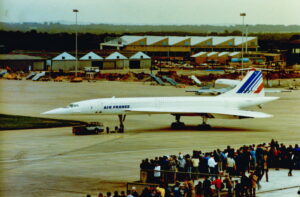
Concorde may be retired, but demand for its memorabilia is stronger than ever.

On a frightfully cold day in London, on February 7, 1996, British Airways Concorde G-BOAD touched down at Heathrow airport in light snow and haze just two hours, 52 minutes, and 59 seconds after it had taken off from New York’s JFK airport. Even today, 50 years after its first commercial flight and 22 years after it was retired, the record for a civilian plane crossing the Atlantic remains unbeaten. But traveling supersonic on Concorde meant more than pure, unbridled speed. It meant rubbing shoulders with rock stars and royalty, adding to the already extraordinary mystique of a pencil-thin plane that could fly on the edge of space at twice the speed of sound.
See also: The Psychology of Why We Collect
‘Regulars’ such as David Frost, Elton John, Mick Jagger, Sean Connery, and Elizabeth Taylor used it for many Atlantic crossings during its 27 years of service, making Concorde one of the most exclusive commuter clubs in the world. In 1985, Phil Collins used it for time travel; playing Live Aid in London, before arriving in Philadelphia to drum for Eric Clapton before the broadcast had ended. Victoria Beckham flew it to New York for dress fittings and Robbie Williams dashed back to London on it to collect two surprise Brit Awards. Even the Queen Mother is rumored to have taken the controls during a test flight, although this hasn’t ever been verified.

Of the 20 Concordes built between 1966 and 1979, only 14 welcomed passengers, with Air France and British Airways operating seven planes each. The remainder were pre-production planes used for development tests and spare parts. The cabin was small inside, cramped even by some standards, with space for just 100 passengers, all receiving a level of service that surpassed first-class. Fillet steak, salmon, lobster, and caviar canapés all frequently appeared on the menu cards, which now, alongside other items like postcards, luggage tags, brochures, and in-flight magazines, fetch anywhere between five and fifty pounds at auction and on online resale sites.
See also: You Could Own One of the Largest T. Rex Fossils Ever Discovered
Sir James Dyson recalls on April 9, 1969 happening to be on the new M4 motoway just beyond the end of the runway near Bristol, on the inaugural Concorde test flight. “I pulled over to watch it fly overhead. I gather from the skillful test pilot Brian Trubshaw that there was a failure of the altimeters on that flight,” he tells Elite Traveler.
“I went on it three times – even once being on the flight deck for landing. It was an intimate fuselage, you couldn’t stand up in the loo,» says Dyson, who has an authentic Concorde Rolls-Royce Olympus 593 turbojet engine at his Dyson campus in Malmesbury, UK. An engine similar to Dyson’s is currently on sale with Concorde Memorabilia for £450,000 (approx. $605,200).

Yet for all its glamour and glory, the life of the Franco-British engineering marvel was cut short in 2003. A tragic disaster involving Air France 4590 in July 2000, soaring running costs and a post 9/11 slump in top-end business travel were enough to force the supersonic airliner into early retirement. The end of the aviation icon is perhaps the most high-profile example of a rare technological step backwards. While the aviation world continues to mourn the loss of a legend, collectors have pounced on particular pieces.
See also: How a 28-Year-Old Collector Built One of the Rarest Vintage Patek Philippe Collections
The Concorde memorabilia market is vast and varied: everything from cabin crockery and menus to seats, signage, and salvaged airframe components, some of which sell for hundreds of thousands. The benchmark came in December 2003, when Bonhams staged a Concorde charity sale, much of it salvaged from a dismantled aircraft. A captain’s seat made £30,550 (approx. $41,000) and a Jaeger machmeter (the device signaling when the plane went supersonic) sold for £32,900 (approx.. $44,200), while even a cabin trolley and a cutlery set fetched £6,462 (approx. $8,690) and £3,760 (approx. $5,000) respectively.
The entry point: Tableware and on-board ephemera
Concorde’s cabin service comprised of Royal Doulton and Wedgwood bone china and Arthur Price cutlery, much of it restyled by Sir Terence Conran for British Airways’ final refit in 1999. These items remain the most affordable way in, with a menu starting from £15 (approx. $20) on eBay and a complete, Conran-designed single place setting recently selling for £150 (approx. $200) with Concorde Memorabilia.

Visit the Brooklands restaurant at the top of The Peninsula London today and you’ll notice steel Concorde napkin clips with the words “honourably pinched from The Peninsula London” engraved on the bottom – a knowing nod to the many small items that were pocketed mid-flight by enthusiastic passengers, so don’t be surprised to see single items for sale. One Conran-designed teaspoon is currently listed on eBay for £21 ($28). By far the most numerous Concorde-related items, there’s a constant turnover of tableware and seemingly no shortage of stock.
The mid-market: Models and watches
For many Concorde connoisseurs, the most coveted category is the scale model, says Tim Bent, founder of Bentleys antique shop. «Living on the River Thames at Putney, I watched Concorde cruise past every day at 5pm on its final approach to Heathrow,» he recalls. «The visual reminder of what I consider the most beautiful aircraft ever designed is the reason I bought, and sold, my first model back in the mid-2000s.»

Today, Bent focuses almost exclusively on models when it comes to Concorde memorabilia. «The models connect customers to a story; memories of a deal struck after hopping on Concorde to complete it face-to-face the same day, or of sitting next to a rock star.» The best examples were made under contract by Space Models and Westway Models, produced for British Airways’ corporate offices and for the network of travel agents. “Size matters, here,” insists Bent. “A model in mint condition would start at about £495 (approx. $665), depending on scale and go up to over £10,000 (approx. $13,450) for a large-scale model. Provenance and history would increase their value.” A 123cm-long ex-travel agent model is currently for sale with Vinterior for £12,030 (approx. $16,180).
See also: Inside Le Mans’ New M24 Motorsport Museum With Landmark F1 Collection

For the wrist, the Breitling Aerospace Concorde is the timepiece to have. In the late 1990s, Jock Lowe, a former Concorde pilot turned commercial officer for the British Airways Concorde program, brokered a deal with Breitling to create 100 examples of the Aerospace with Concorde branding. Very few of the Breitling Aerospace Concordes make it to market but in 2023, one sold at auction for a £5,000 (approx. $6,725) hammer price. In 2018, Bremont launched its Supersonic watch, which contained metal from British Airways-owned G-BOAB Concorde. Of the 500 units issued, 300 were in steel, 100 in white gold and 100 in rose gold. One Rose Gold Bremont Supersonic, made in 2023, is currently for sale with Chrono24.co.uk for £12,536 (approx. $16,860).
The blue-chip pieces: Instruments and components
At the top of the market sit pieces of the aircraft itself. A Concorde nose cone sold at auction in 2018 for £63,000 (approx. $84,700), reportedly the same one that now hangs above the lobby of The Peninsula London. The hotel’s Concorde centerpiece, however, is a 48-ft-long and 2700-lb alloy “speedform” sculpture, created by manufacturer Discommon, which hangs from the ceiling of Brooklands by Claude Bosi.

The public record for a Concorde collector’s item was achieved in the 2003 Bonhams auction, when Ferenc Gaspar, a Hungarian-born businessman, paid £320,000 (approx. $430,400) for a nose cone. With no whole aircraft currently on sale and all remaining 18 accounted for in museums and public collections around the world, the market for Concorde components is finite. With supplies fixed and the aircraft’s mystique only deepening with each passing anniversary, the value of Concorde collectibles can only keep climbing.
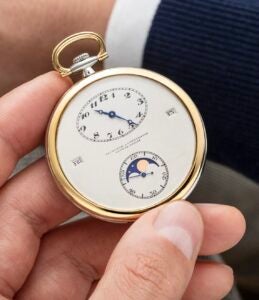
To mark its 270th anniversary, Vacheron Constantin is launching the world’s first watch concours.

How do you celebrate the very best of a watch company’s creations? Easy enough for a young brand, perhaps — but what about the oldest continuously operating watchmaker in Switzerland, which has just celebrated its 270th anniversary? Collectors place a premium on condition, rarity, complexity, and provenance, as well as historical significance for the brand, but the only chance most get to appraise any of these qualities is when watches come up for sale. A better question might simply be: how do you even go about locating the best of the best? A new concept, the world’s first-ever Concours d’Élégance Horlogère, might provide some answers.
Conceived by auctioneer and consultant Aurel Bacs, best known for his work with auction house Phillips (with whom the event is also jointly organized), and focusing exclusively on vintage Vacheron watches, the concours will take place in November 2026. Thanks to that unbroken lineage, Vacheron Constantin has a pretty good record of every watch that has left its doors, but even its leather-backed sales ledgers only tell part of the story. The hope is that through this project, the venerable brand will be able to reconnect with some of its most desirable vintage references — and perhaps discover a few long-forgotten favorites.
See also: The Tiny Watch Trend Continues – These Are The Ones to Know

The word ‘concours’ summons images of manicured lawns strewn with supercars, and Bacs’s concept borrows some elements of the motoring format. While it’s restricted to the work of one maker, it will still involve a panel of expert judges. For its inaugural edition, the Concours d’Élégance Horlogère breaks submissions down into seven categories including ‘chiming watches,’ ‘astronomical complications,’ and one named simply ‘design.’ Entry is free, there is no prize on offer beyond a trophy and the honor of being named the best, and the winning watches will be displayed to the public at a venue in central Geneva.
“It’s really open to anything,” says Morgan Maillard, style and heritage expert at Vacheron Constantin, and one of the members of the concours’ judging panel. “It could be a King Fuad pocket watch with 15 complications [legendary one-off pieces made for the former king of Egypt] or something you bought in a flea market somewhere and have restored with passion.”
“In our collection, we have around 600 timepieces, but in 270 years we have produced many more than this,” he continues. “Most of the Vacheron Constantin collection is in the wild; there are some we don’t know where they are now, so a nice part of this is to reconnect with them.”
See also: How a 28-Year-Old Collector Built One of the Rarest Vintage Patek Philippe Collections

An open call for submissions closed at the end of April, after which the Vacheron team will sift through the hundreds — perhaps even thousands — of candidates to put together a shortlist of five per category. These will be invited to submit their watch for in-person judging, and to be part of the public exhibition.
Already, Maillard says the process has been illuminating. “I’ve seen some surprising design pieces coming in with their box and papers, all the original documents, which means you have more than just a timepiece, you have the story around it. One watch so far has really impressed me: an early-19th-century quarter-repeater pocket watch with a guilloché dial in stunning condition. The movement just looks untouched — it’s so impressive.”
Alongside Maillard, Bacs, and Vacheron style and heritage director Christian Selmoni, the judging panel comprises a mixture of prominent journalists, collectors, retailers, and of course, a watchmaker. Fans of the brand might be surprised to see the latter name on the list, however. Rather than an expert from within Vacheron’s restoration department or its most senior in-house watchmaker, the only hands-on horological talent on the panel is Felix Baumgartner, one half of the duo behind iconoclastic indie watch brand Urwerk. But his perspective, explains Maillard, is invaluable.
See also: The Pocket Watch Comeback You Didn’t See Coming

“Felix was a great pick because, first of all, he’s a young and brilliant watchmaker, but into a completely different type of work to us. Also, he used to do some work on vintage watches when he was younger, and we know that included some Vacheron Constantin pieces,” says Maillard. “He has a great deal of knowledge, and we didn’t just want it to be Vacheron fans, who are going to turn up with a Vacheron on their wrist.”
The idea of judging the ‘best’ vintage watches might seem reductive to some (although one suspects that some collectors may take great pride in winning — and it will do their prized possession’s value no harm either), but for Vacheron the main emphasis is on the educational and exploratory aspects. The company, which already operates a heritage retail program, Les Collectionneurs, says there is no expectation that the submission process will have a commercial upside. The creation of the format also raises the possibility of it becoming a regular fixture in the watchmaking calendar, but no firm commitment has been made.
Emphasizing that for now, all eyes are focused on the debut edition, Maillard agrees that if successful, the idea has potential to expand and improve — maybe even incorporating other brands along the way. “If there are going to be other editions, we have some ideas,” he says.
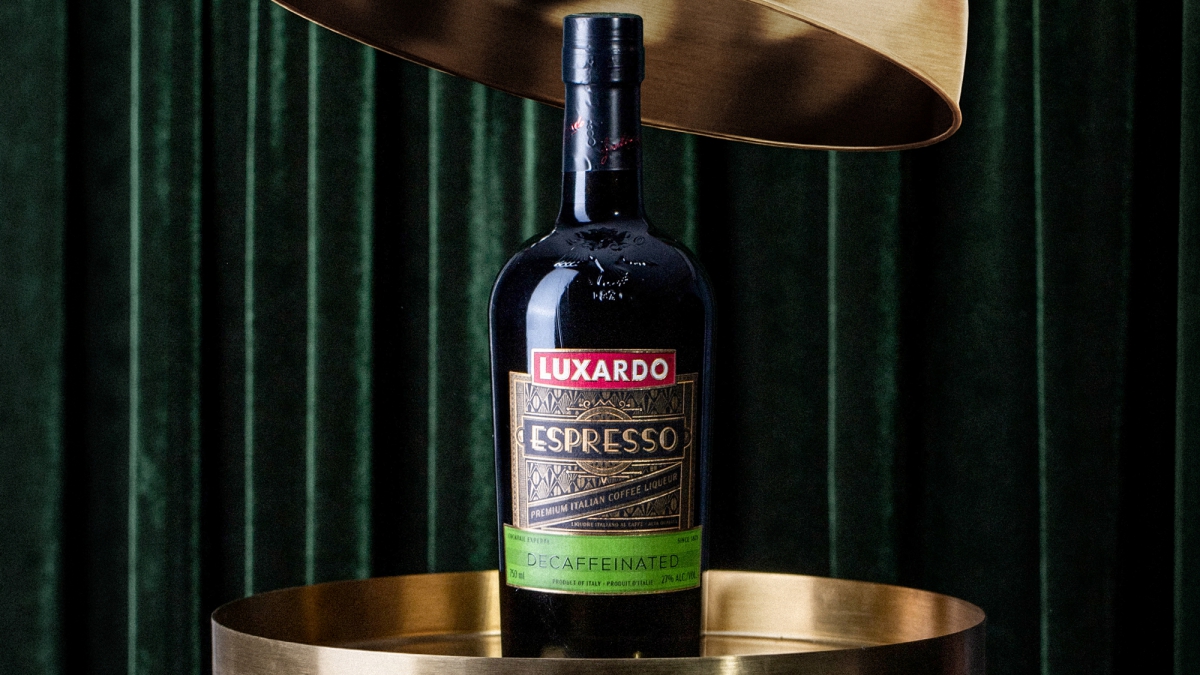
This is the latest release from Italian company Luxardo. This is the latest release from Italian company Luxardo.
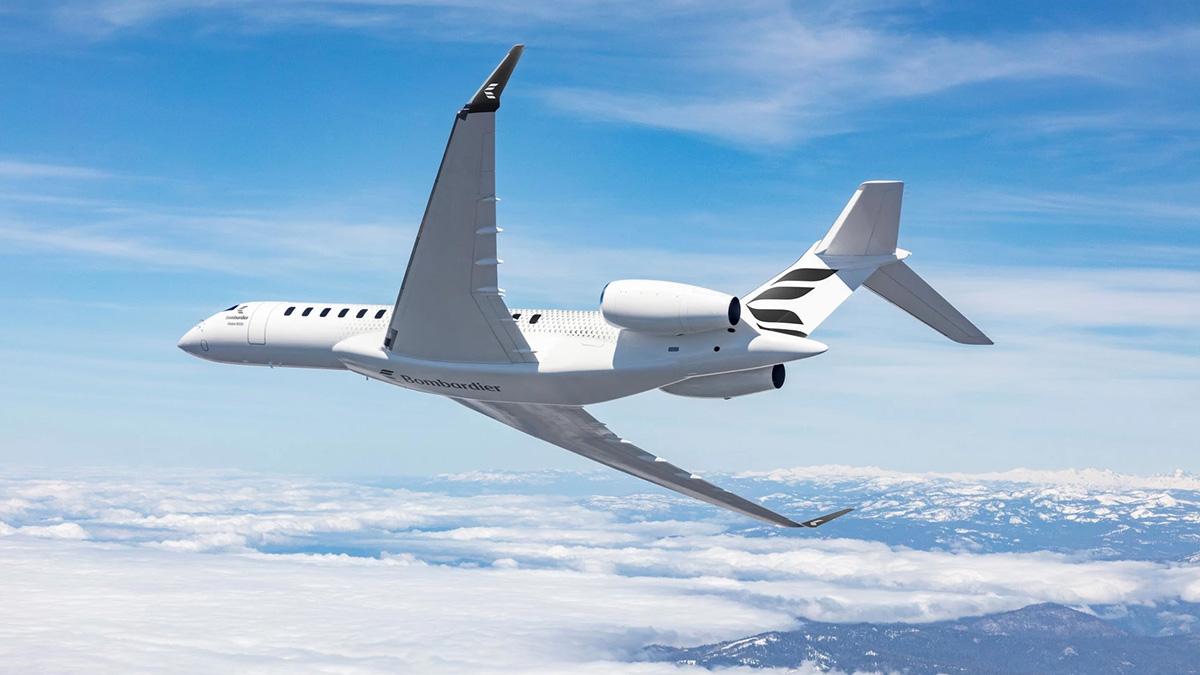
The aircraft completed the flight from Montreal to Nice in just over six hours. The aircraft completed the flight from Montreal to Nice in just over six hours.

In an exclusive interview, Elie Saab Jr. and Bombardier’s CEO explain how a shared clientele inspired one of private aviation’s most ambitious partnerships.

No one is staying in their lane, often to thrilling results. The latest head-turning pairing: aviation leader Bombardier and Elie Saab, the Lebanon-founded brand known for red-carpet moments and regal clientele. “Ours is a mutual customer,” says Elie Saab Jr., CEO of the Elie Saab Group, which first ventured into the interiors world in 2019 and recently debuted a coterie of branded residences. “We want to deliver an experience [to our customers] everywhere they go.”
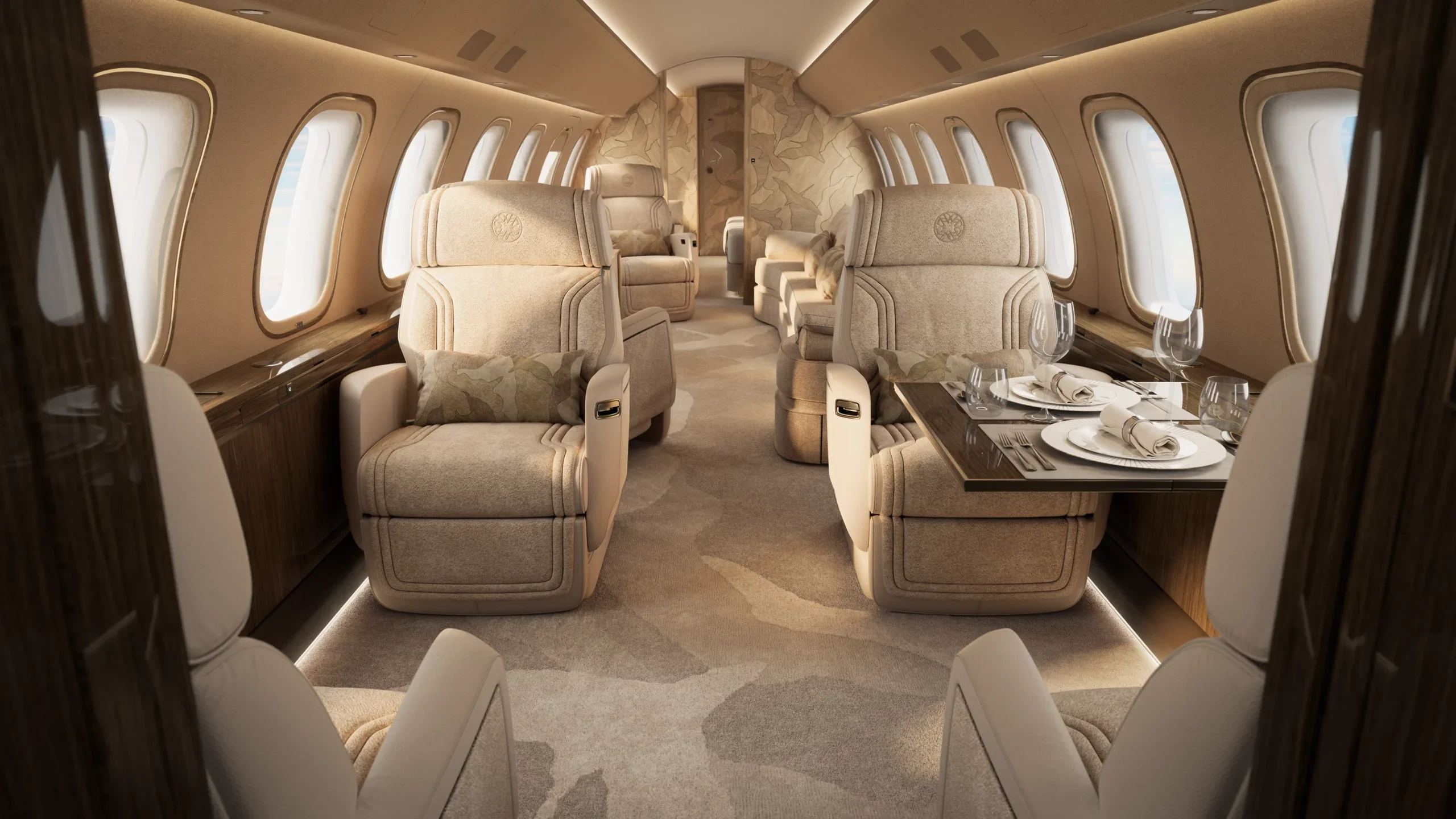
A longtime customer, Saab always wanted to design a jet – a Bombardier, as it’s most distinctly linked to his childhood memories of flying. Yet despite the longstanding relationship, the partnership remains groundbreaking for the private aviation industry. While big-name designers are often tapped by aircraft owners to bring style to the skies in one-off jobs, this is the first time an aircraft manufacturer has offered a high-design interior of this pedigree and caliber as an option – in this case for the extra-large cabins of Bombardier’s superlative Global 8000, first launched in December 2025.
See also: The Best Private Jet Interior Designers You Need to Know
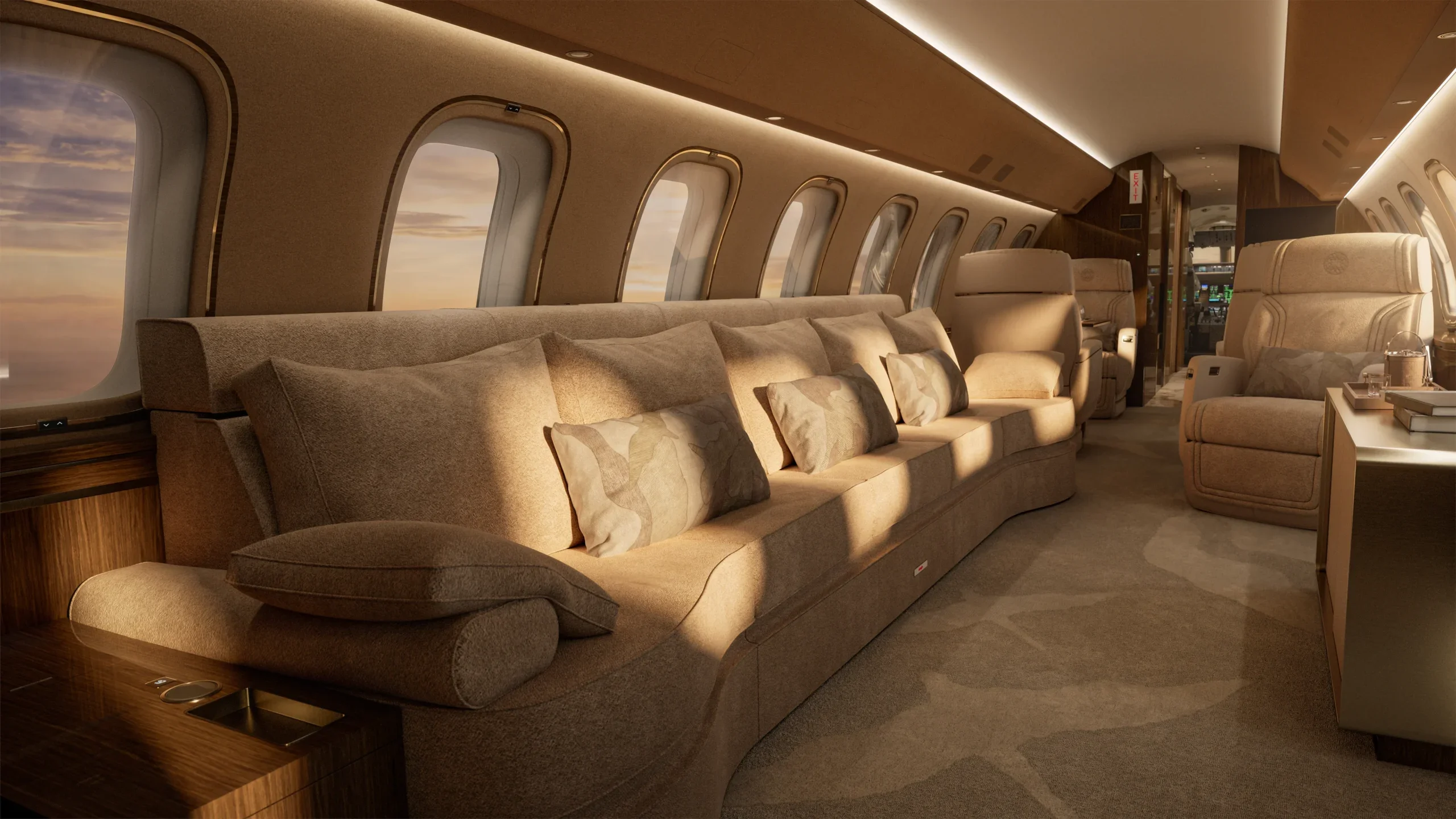
Already billed as the fastest civil aircraft since the Concorde (the latest speed record clocked just over six hours from HQ in Montreal to Nice, France), this best-in-class ultra-long-range aircraft may now also take the title of chicest with a sweeping sand-hued palette; deeply plush tactile fabrics on Bombardier’s signature Nuage (French for ‘cloud’) seats; and outré additions (see: a five-seat divan sofa, his-and-hers walk-in closets, and a dramatic Patagonia stone bathroom).
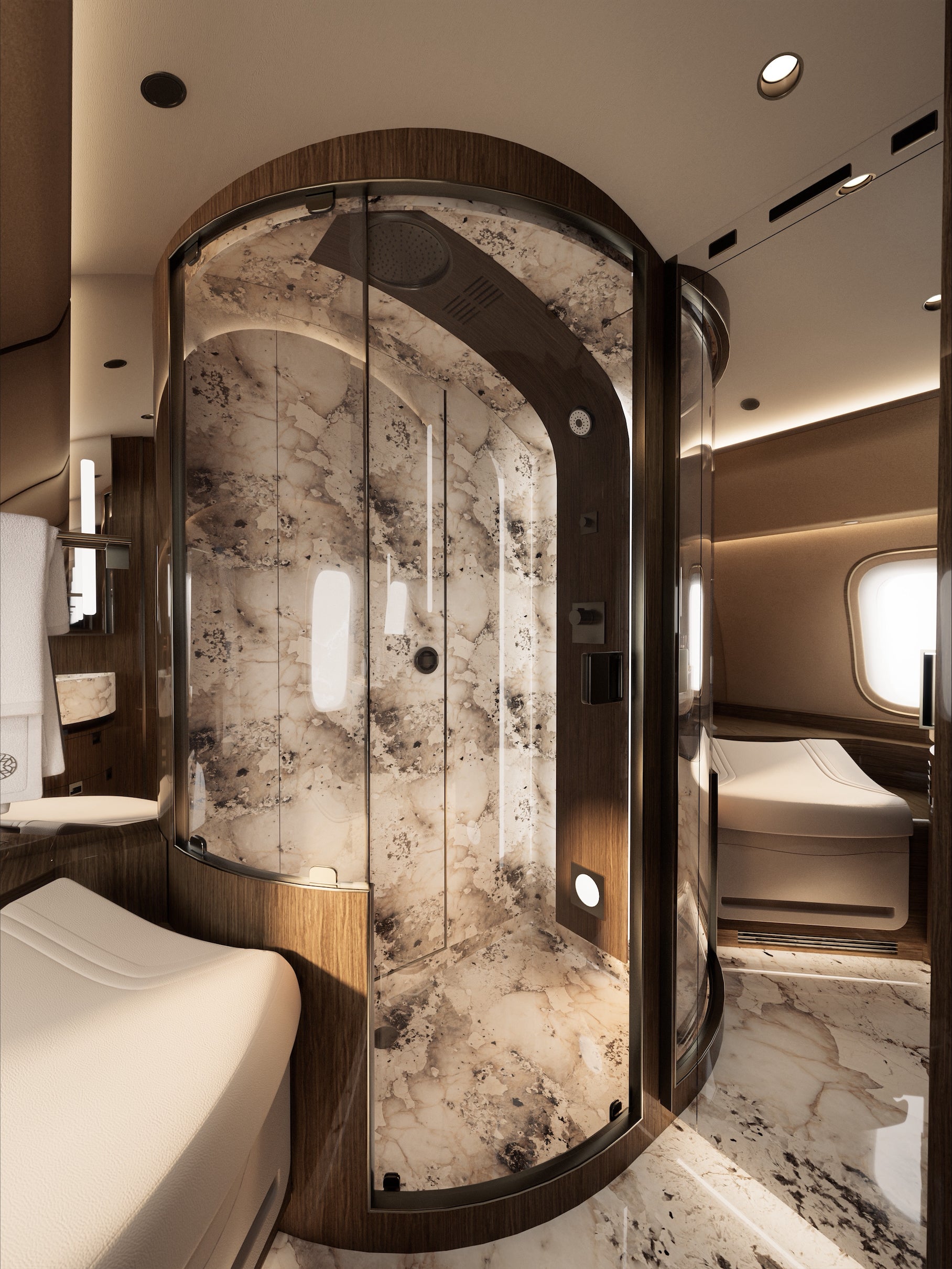
“It comes together like a small coocoon,” says Saab, “like a small universe, where you can feel at peace and where you have that sense of elegance.” It also feels unmistakably residential, with a stateroom that flows into the closet, and finally into the show-stopping bathroom. “We wanted to deliver a configuration that could be an eye-opener for some people who maybe already own a business jet.”
See also: The Greek Aviation Startup Is Bringing On-Demand Helicopter Travel to NYC
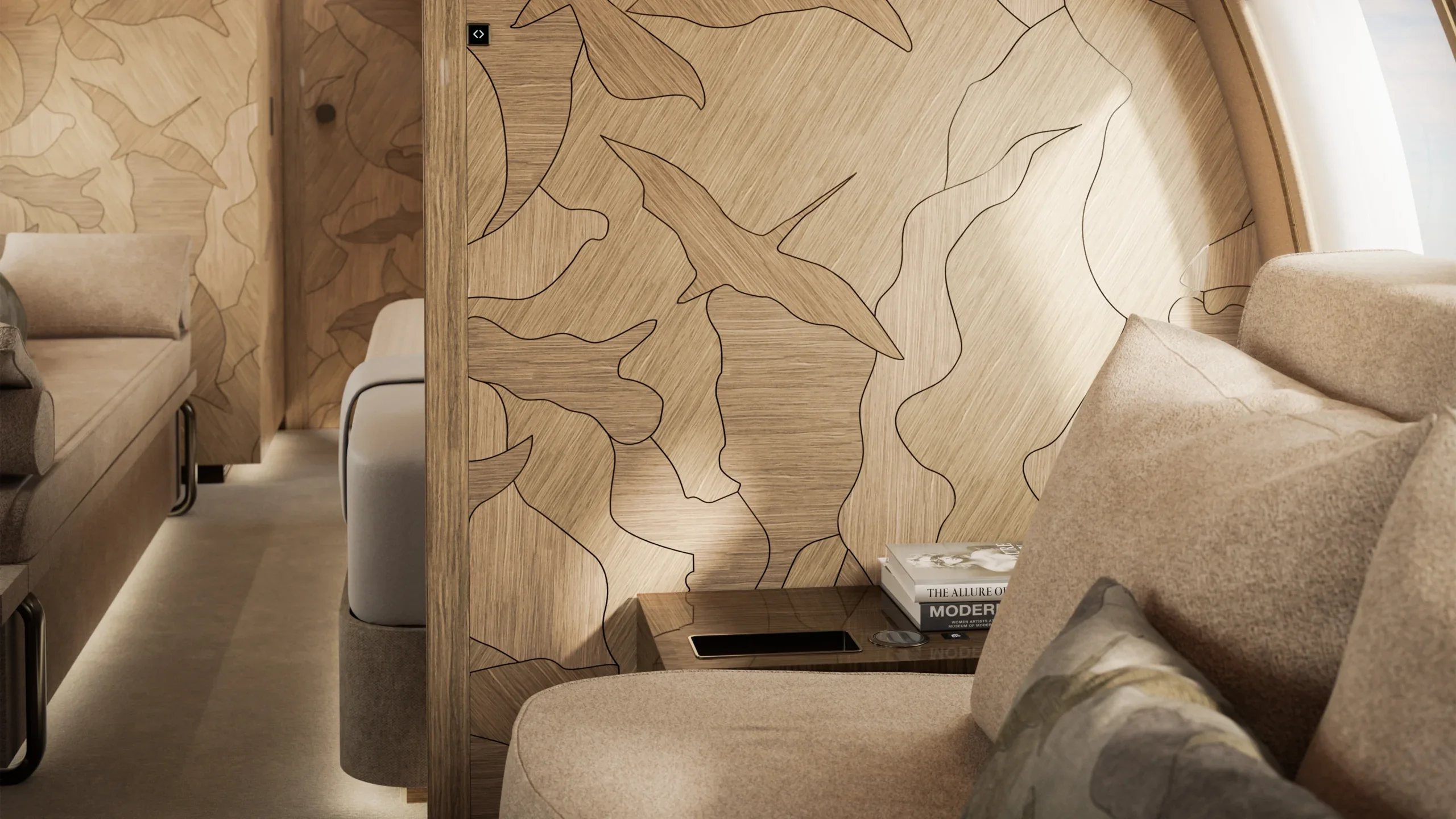
Throughout, a few discreet, almost invisible logos add a whisper of if-you-know-you-know luxury, while a specially developed geometric bird pattern repeating across the bulkhead marquetry, carpets, and cushions serves as a symbolic hat tip to Bombardier’s technical achievements. “The biggest differentiator between a Bombardier plane and any other plane is the wing,” says Bombardier’s president and CEO, Éric Martel of the advanced wing design with leading-edge slats, which grant access to around 30 percent more airports than rival aircraft. “We’ve always pushed to have the best wing because it brings performance and comfort, and that’s the idea of the abstract bird logo.”
With two different configurations (three or four zones), the haute couture Elie Saab interior is now available as an option on all new Global 8000 aircraft, as well as on Global 7500s being upgraded.
A visit to the capital is not complete without a scone and a cup of tea.
The English afternoon tea is that utter rarity of an experience that delights both first-time tourists and the born-and-bred English. A novelty for the former, it is a long-held tradition for the latter, and today no trip to the green and pleasant land would be complete without it. For the best afternoon teas in London, both groups are utterly spoilt for choice.
The nation’s capital, it’s no wonder London is where to source the best afternoon tea. Today, no luxury London hotel experience is complete without an afternoon tea offering, and this is slowly starting to spread into other realms of the hospitality sector, too.
Despite all the offerings the great city of London has to offer, we are yet to find a more charming way to escape the bustle of the city than an afternoon spent inside one of London’s finest establishments, engaging in one of the country’s favorite pastimes: exchanging pleasantries over a pot of tea and sandwiches. Bonus points if you discuss the weather.
[See also: The 15 Best Luxury Hotels in London]
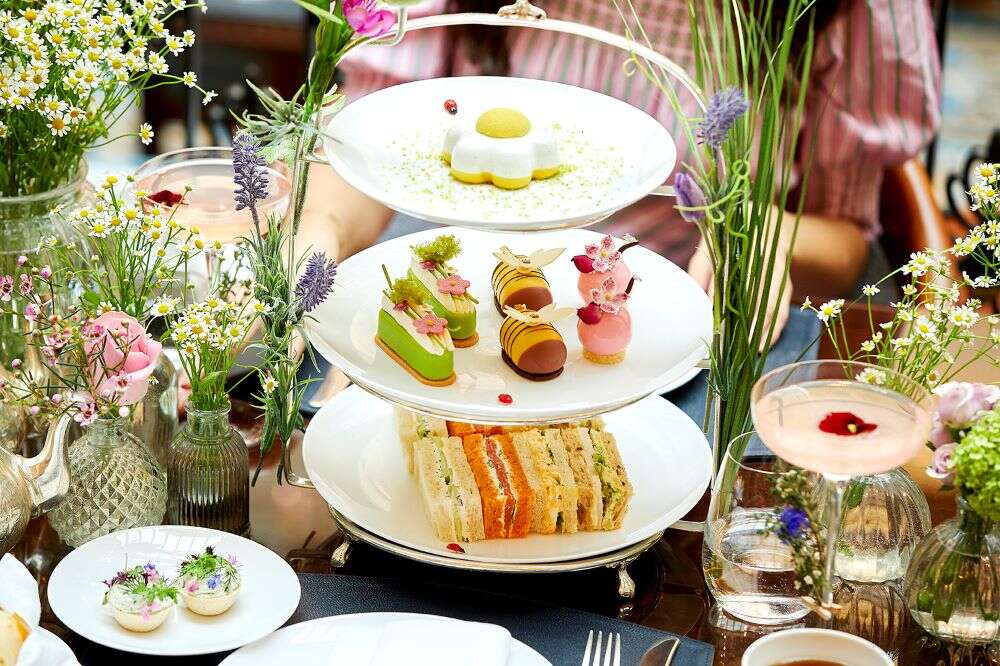
Winter in the capital is grueling, and you’d be hard-pressed to find even the stiffest of upper lip Londoners successfully resist a smile at the dawning of spring. Luckily for us, The Lanesborough ushers in the glorious season early, with the launch of the hotel’s new Meadow Afternoon Tea.
Placing the spotlight on English ingredients, such as chicken from the Cotswold, cheese from Lancashire, and smoked salmon from Scotland (the best in the world, we’d argue), spring is thrust center stage with a pastry collection so gorgeous it feels almost criminal to eat. But do: the apple blossom is divine, and the white chocolate and honey bee is already a new classic.
oektercollection/thelanesborough.com
[See also: The 12 Best Fine Dining Restaurants in London]
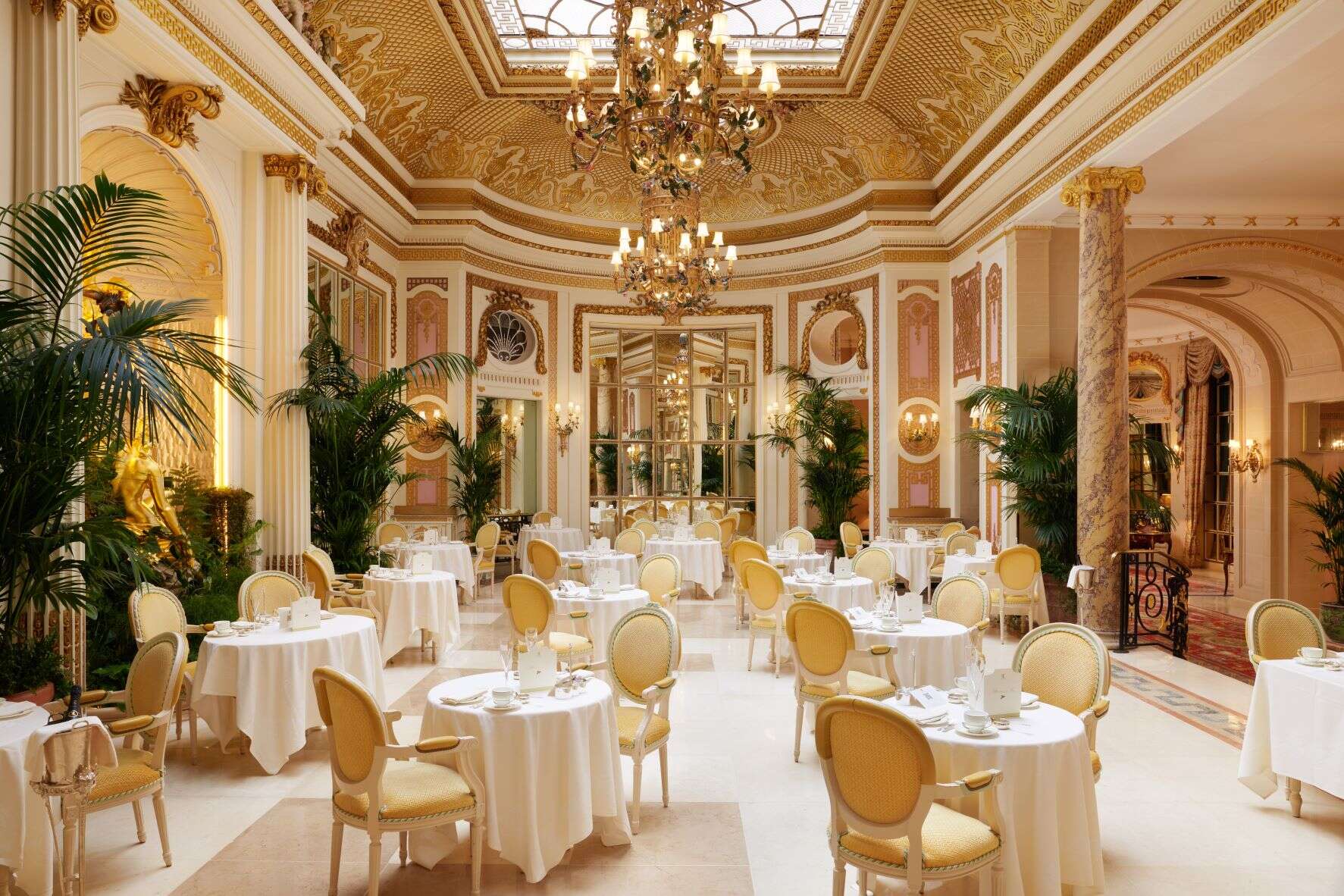
Afternoon tea at The Ritz is such a classic of the genre that we’re not quite sure any best afternoon teas in London round-up has missed it; and lest we be the first.
The Palm Court, where afternoon tea is held, oozes timeless elegance in the most opulent of settings. Featuring all the usual trappings of the afternoon tea affair – finely cut sandwiches, scones and cream – The Ritz London is also the only location across the UK to have a certified Tea Master.
Naturally, there is a dress code; this is The Ritz, after all. As there should be; the Palm Court was the hotel’s original ballroom, and echoes of gowns and jewels of centuries gone by linger as pleasantly as the musical ensemble from The Ritz London’s resident pianist.
[See also: Trivet Restaurant, London: A Post-Pandemic Success Story]
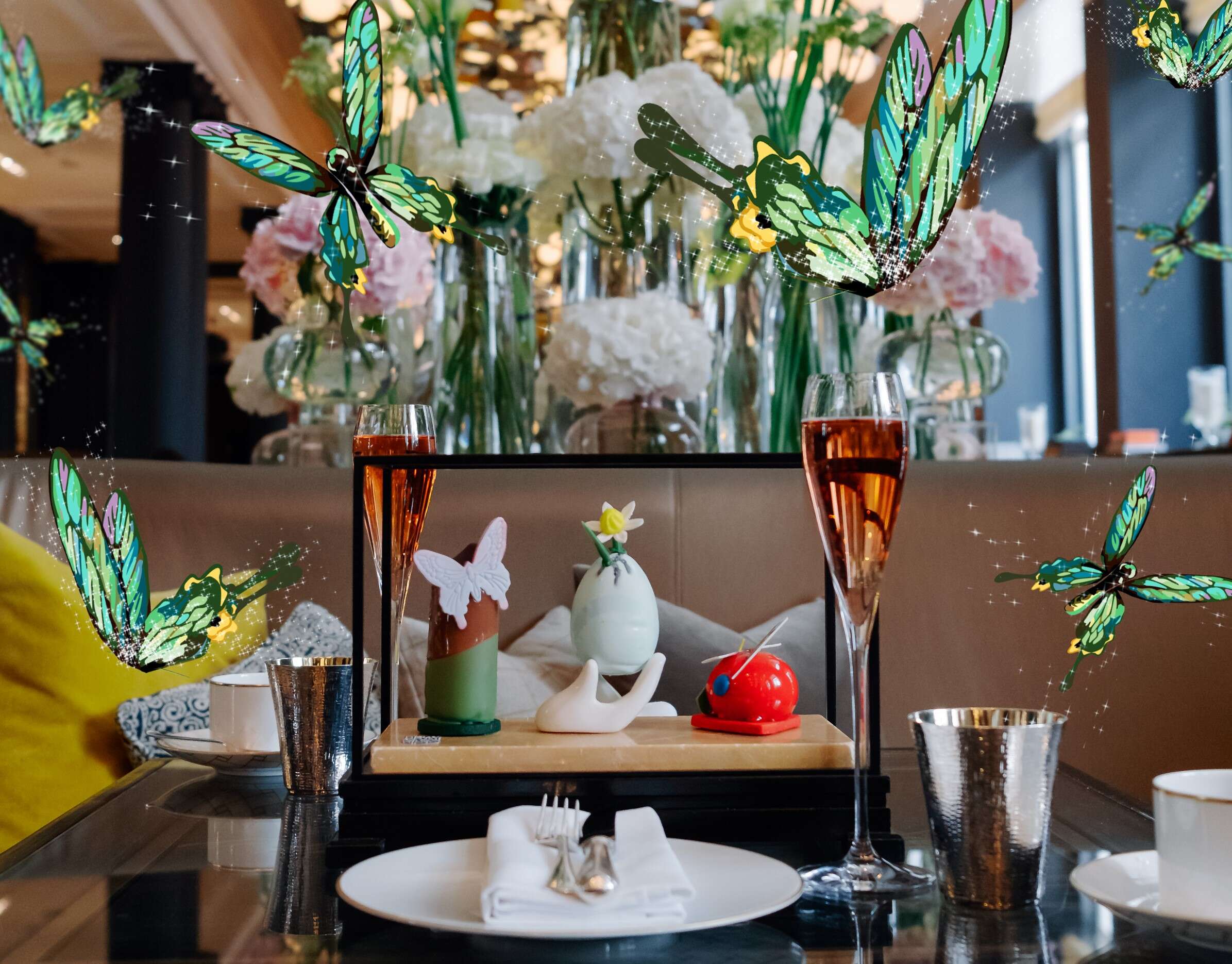
This one goes out to all the artists and art lovers; Rosewood London’s afternoon tea offering, the Dali Art Afternoon Tea, was voted the best contemporary afternoon tea in the UK. The latest in an impressive line of Art Afternoon Teas, executive pastry chef Mark Perkins was inspired by surrealist artist Salvador Dali.
Designed in line with the upcoming Surrealism Beyond Borders exhibition at the Tate Modern, Perkins says of the afternoon tea: “London is a vibrant city with an incredibly energetic art scene. Rosewood London’s quirky interiors reflect the British capital’s history, culture, and sensibilities.”
The pastry designs are magical; keep an eye out for the butterfly windmill, one of Dali’s most memorable designs, which is made using olive oil cake and encased in chocolate mousse.
[See also: The Best Rooftops and Terraces in London]
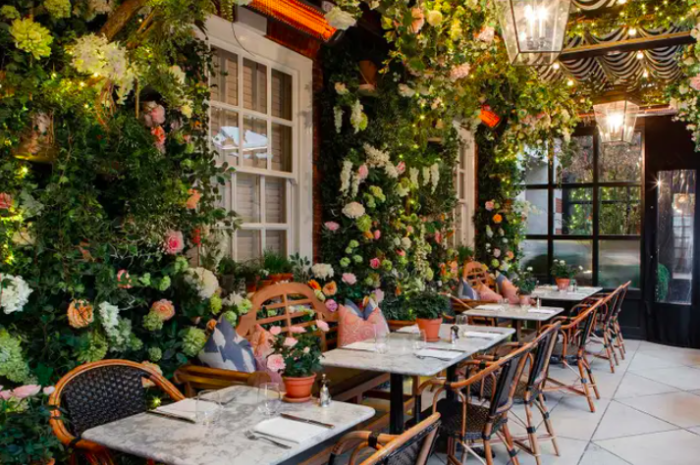
If The Rosewood London’s afternoon tea honors artists, then The Bloomsbury Hotel tips its hat to London’s long established literary scene with afternoon tea hosted at the hotel’s Dalloway Terrace, named after – of course – Virginia Woolf’s most famous character, Mrs. Dalloway.
An unmissable presence in the capital during the spring and summer months due to its open-air space and floral decorations that are reminiscent of the English countryside, in winter it remains fully heated and just as enticing.
There is, of course, so much more going on than just the venue. The terrace’s head pastry chef, Chris Dodd, is an Afternoon Tea of the Year finalist – can it get more quintessentially English than that?
[See also: Experience the Rugged Beauty of Cornwall’s North Coast at Scarlet]
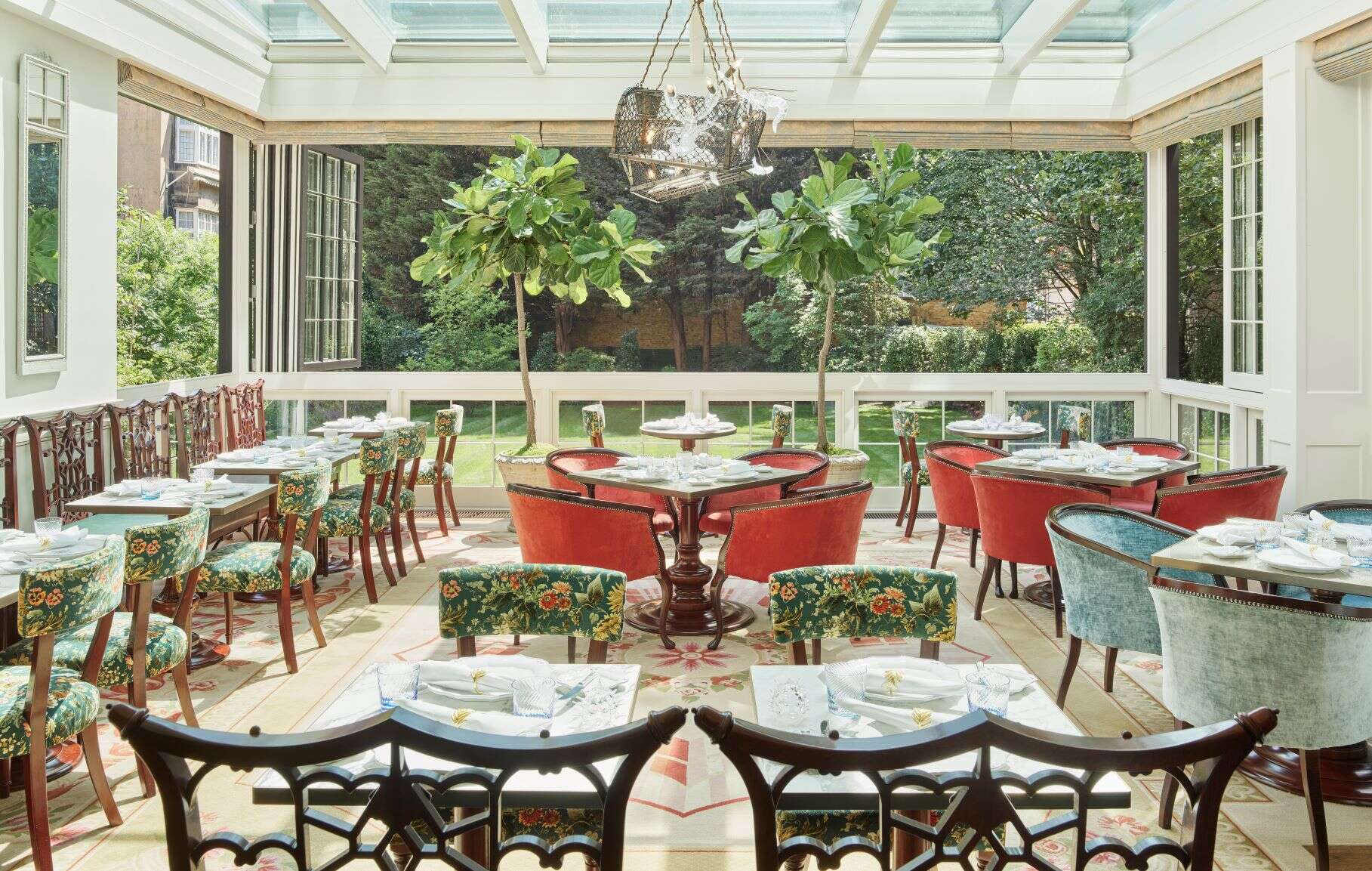
Located right beside Buckingham Palace – the closest luxury hotel to it, in fact – afternoon tea at The Goring is fit for a King. We mean this literally: it is the only hotel with a Royal Warrant for hospitality services and was the venue of choice for King Charles’ birthday celebrations in 2008.
If that’s not enough to assure you of The Goring’s prowess in the afternoon tea scene, further validation can be found in its possession of The British Tea Guild Council’s Top London Afternoon Tea Award. We told you the English take their afternoon tea seriously. Go in the spring months for the Coronation Afternoon Tea, which spotlights the King’s favorite cakes and sandwiches.
They’re not traditional. They are delicious. They’re not traditional. They are delicious.
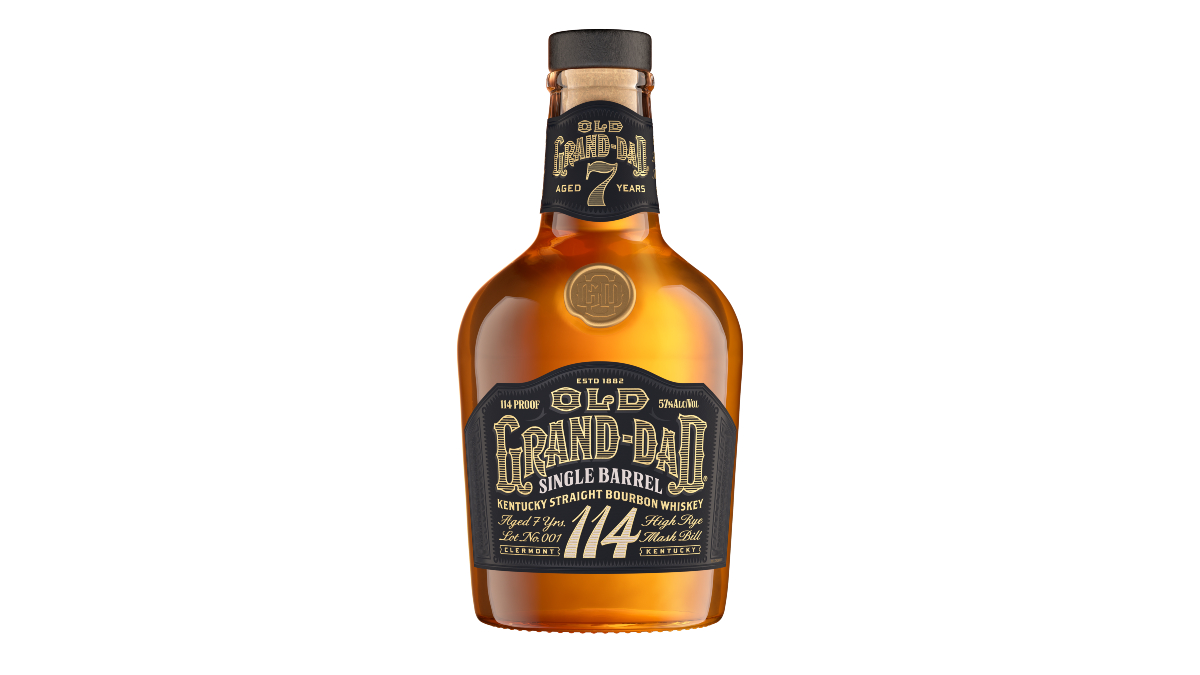
The new version of this whiskey is a seven-year-old single barrel expression. The new version of this whiskey is a seven-year-old single barrel expression.
Designer Alessandro Sartori drew on the Italian tradition of villeggiatura to present a vision of leisure dressing in Malibu.
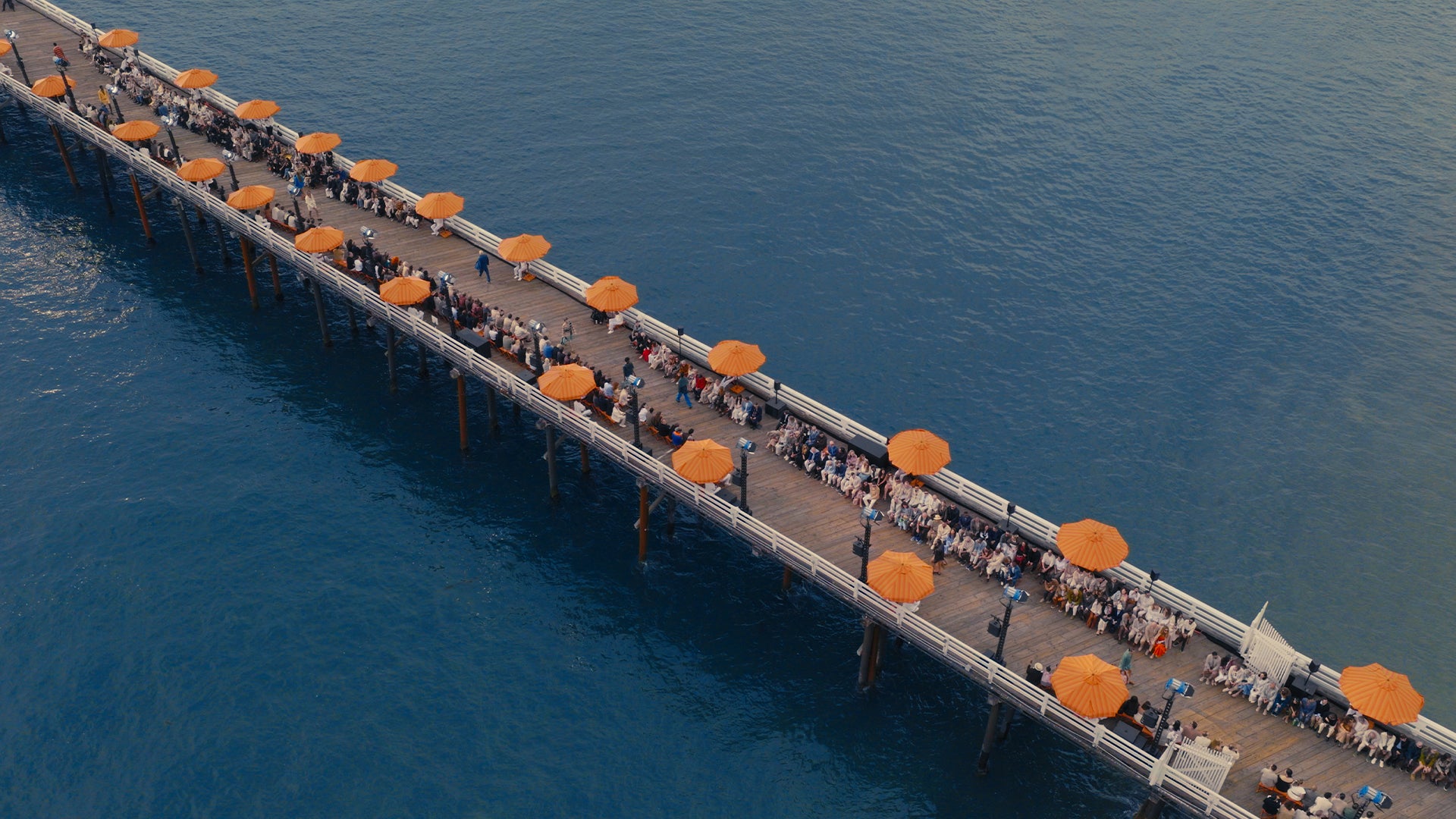
On Friday evening, the Italian menswear giant Zegna staged a brilliant expression of poised panache in a gala show at the Malibu Pier. Built in 1905, the pier has five years on Zegna, which was founded by Ermenegildo Zegna in 1910 in the hills of Piedmont, as a resource of superlative fabrics. Its latest materials were the backbone of this collection staged on a windy evening on the rough-hewn promenade, privatized for the event.
The leitmotif of the collection was creative director Alessandro Sartori’s concept of Villeggiatura, the mid-century Mediterranean concept of seasonal living and cultivated leisure. Then — as now — the act of relocating to a coastal or countryside villa for the summer to escape the oppressive heat of the city and enjoy a slower pace of life led to a different way of dressing, or fresh expressions of saper vivere and saper vestire (knowing how to live and dress, respectively), where the act of dressing gains spontaneity and a sense of easy rhythm.
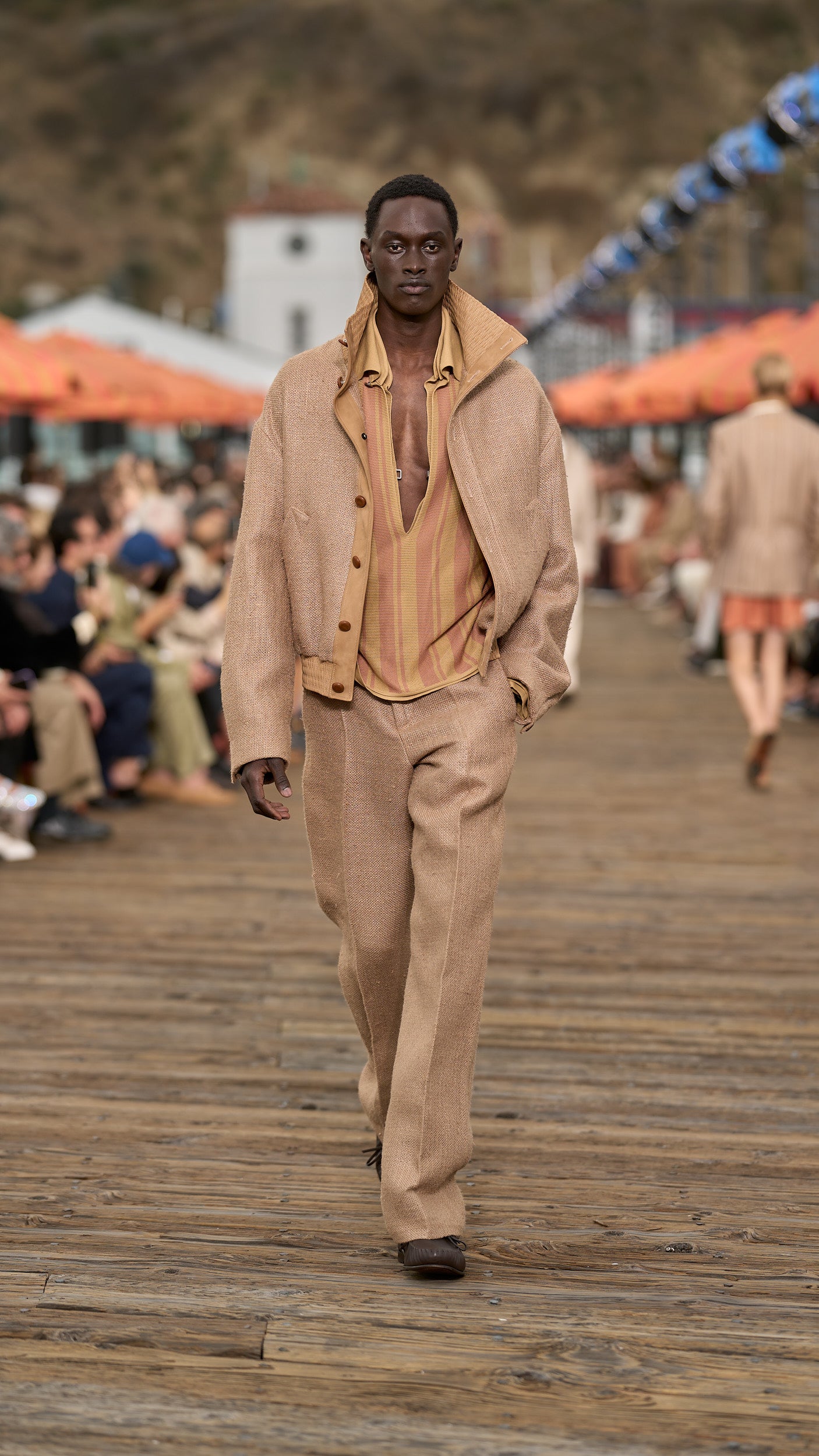
A century ago, trains used to run the length of Malibu Pier to unload cattle hides and walnuts onto ferry boats for export from California. Similar tonal shades appeared in this collection, which riffed on beachside or nautical stripes with hues like aquamarine, algae, sea green, rabbit, dune, teak, and desaturated black — often combined in striped canvas totes and weekend bags.
See also: Gilded Age Meets Keith Haring at the Louis Vuitton 2027 Cruise Show
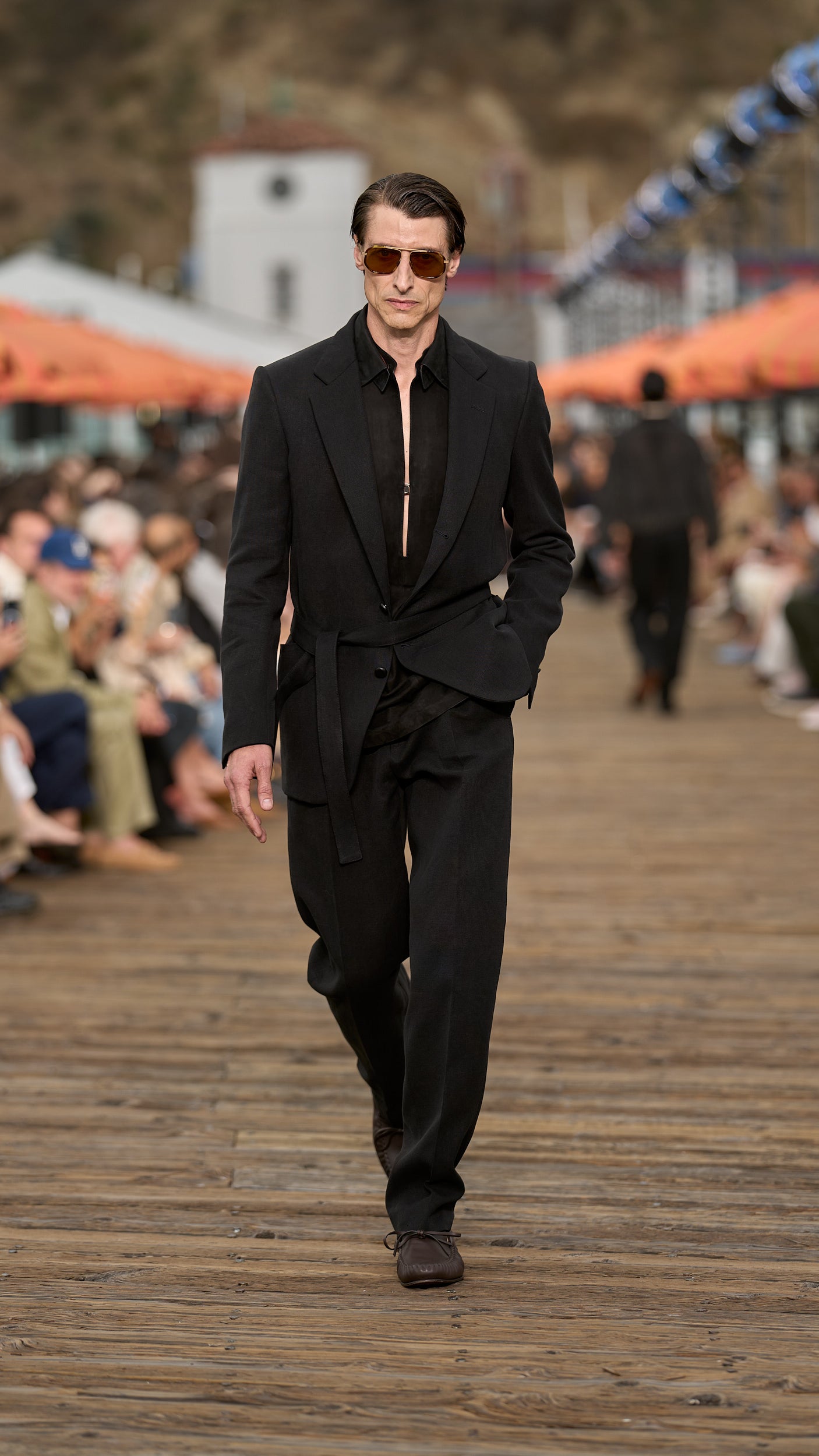
Throughout, the fabrics were superlative — suede crocodile shirt jackets or belted safaris in the softest lambskin. Few designers develop more novel materials than Sartori, who dreamed up remarkable new knitted-leather blousons, where the strands are suede on the exterior, and nubuck inside, giving the garment a slight glimmer in motion. Also featured: washed hemp gabardine or blends of raw silk, wool, and paper.
“Everything here starts from fabrics, which have texture and pattern, and look endlessly renewed by simply twisting and turning the subtlest elements, even just a thread. Constant evolution is what we strive for,” explained Sartori.
His jackets were roomy with broad shoulders and light padding, or narrow and deconstructed on safari looks. With seagulls and drones circling the show, Alessandro showed versions of his pathbreaking three-button blazer, this season in bouclé towelling; his seer-sucker Norfolk jackets with peak lapels worn with tailored shorts were another highlight. Detailing was precise. Pretty much every jacket and shirt had a back vent, or Spacco, to aid with movement and add a soupcon of grandeur.
See also: Fendi Resort 2027 Imagines Clothes Meant to Be Shared
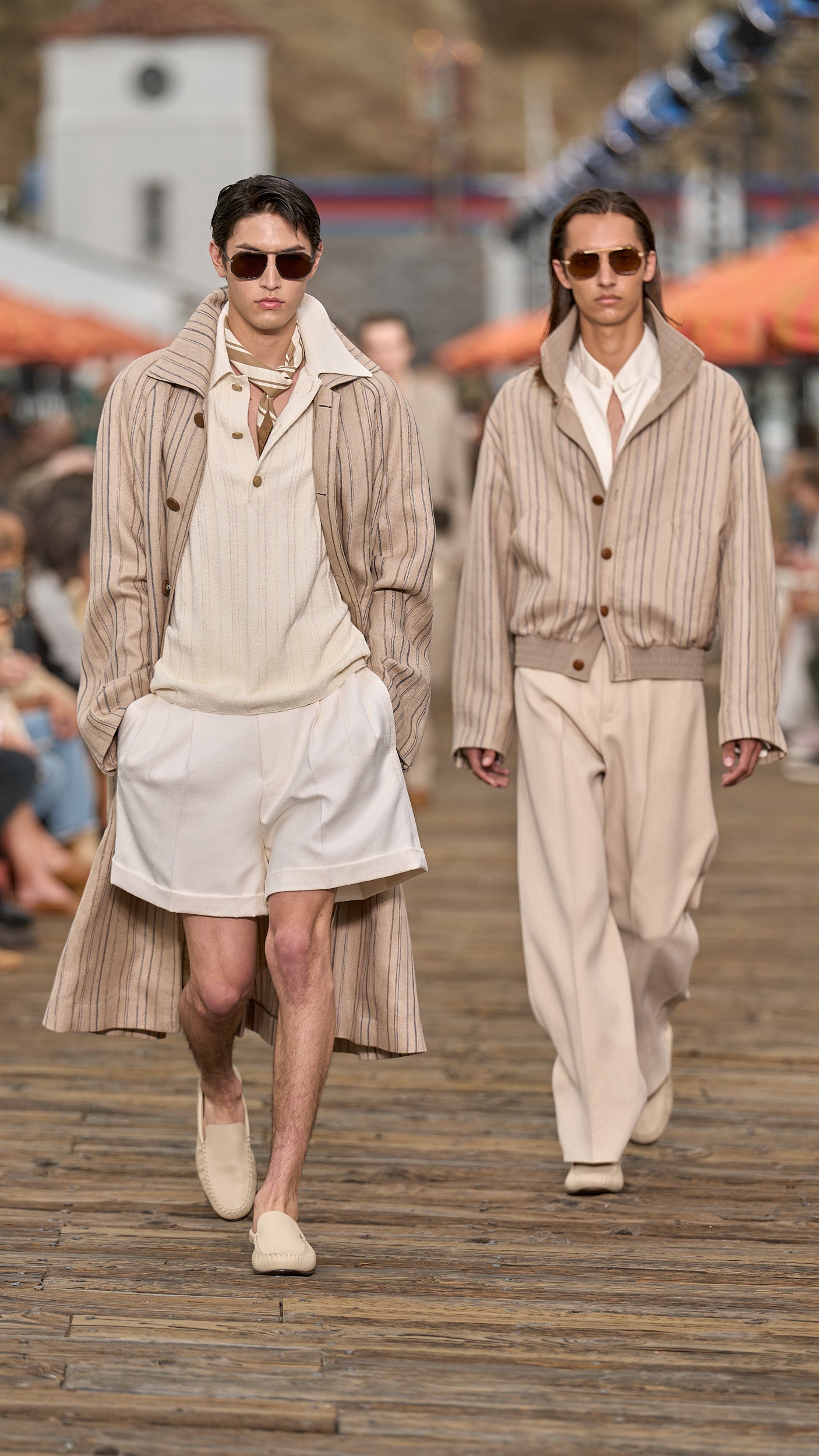
Back in 1996 when I attended my first Zegna show, the collection was almost entirely made up of crisp power-shoulder suits — always worn with ties — targeted at Wall Street and City bankers. But under Sartori’s direction, Zegna has pivoted to create cultivated, casual but always classy luxury. Better than any other designer, he has understood the post-Covid paradigm that successful men want to look at ease with their good fortune.
As Sartori puts it, it’s about “creating new categories, erasing staid ones in an endless quest for styles apt for liquid lives of today,” and developing an “evolving aesthetic that’s rooted in the classics yet freed from outmoded restraints.”
It’s a new cosmopolitan openness that somehow remains profoundly Italian. Over the past 20 years, Sartori has grown into one of the half dozen most influential designers in men’s fashion, as was clear from this display.
See also: Dior’s Star-Studded LA Cruise Show Marks a New Era for the House
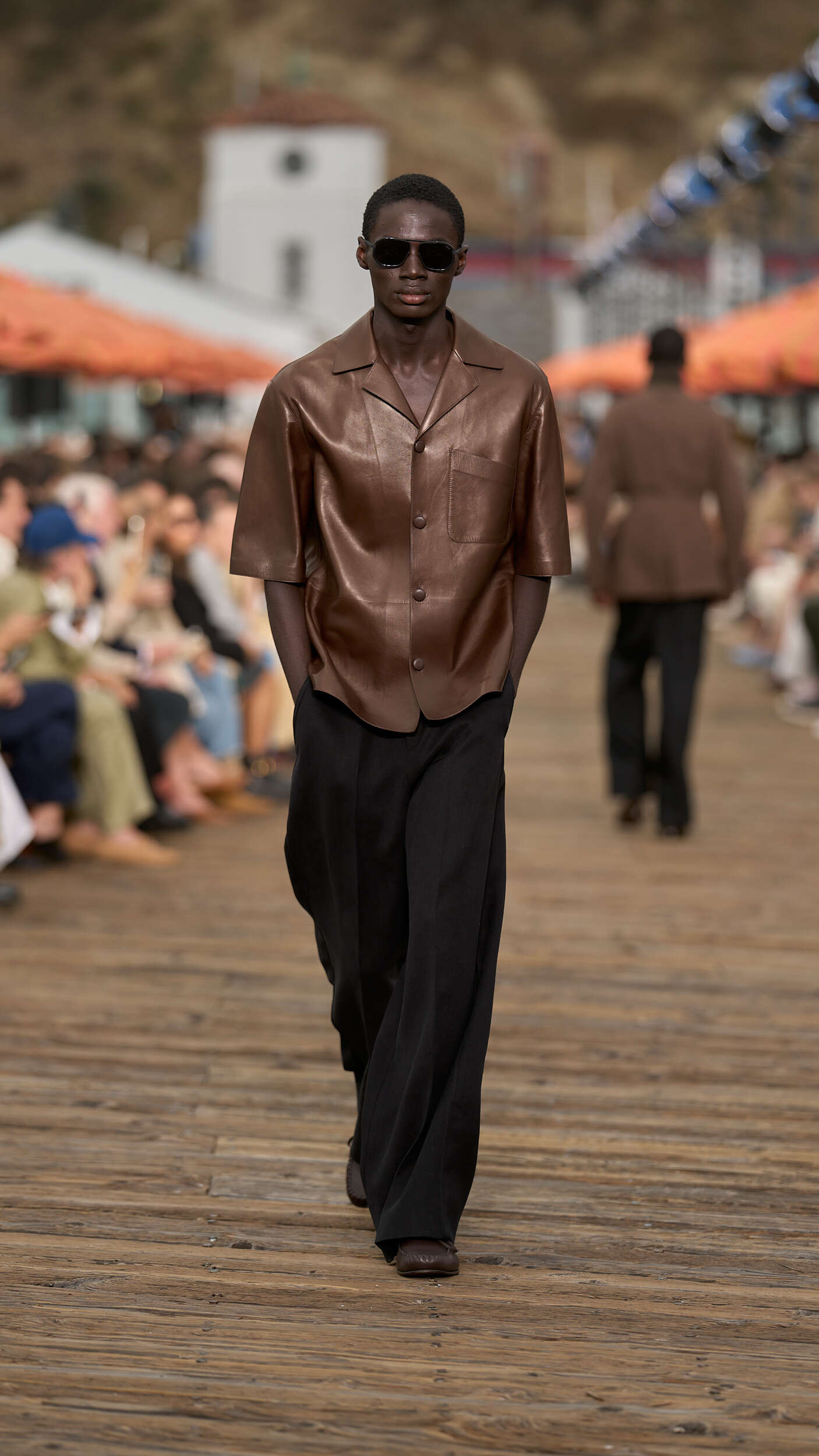
The collection marked the second time Zegna has exited the June Milan menswear season to stage a mammoth show. Last year it transformed the Dubai Opera into a Zegna Oasis referencing Ermenegildo’s private garden, and staged an immersive multi-day immersive pop-up called Villa Zegna – offering bespoke tailoring and couture finishes.
Ale, as he’s known to most, feted the LA show at Chateau Marmont with a performance by acerbic ’70s pop-rock band Sparks, who were first formed in Pacific Palisades. The following morning, the hotel’s famed cottages became the site of Villa Zegna, part set evoking the family’s summer holidays and history, part private salon where for five days VICs can order bespoke or limited-edition looks.
Zegna now follows the example of giant French houses like Chanel, Dior and Hermès by taking its collection to iconic global locations. Dior staged its cruise show underneath the brand-new Los Angeles County Museum of Art in May, while Hermès held a sunset show in the canyons of Bel Air on Thursday night attended primarily by VICs.
Hermès designer Nadège Vanhee showed haute hip Hollywood chic – featuring ballet slipper silhouette gowns; femme fatale film-noir black suits; and bright satin gowns, riffing on California sunsets and graphic city signage. It was a fierce fall winter 2026 collection entitled The Second Chapter that was far from quiet luxury, staged before an audience carrying hundreds of Birkin and Kelly bags.
But back to Malibu Pier, where scores of movie producers and Silicon Valley unicorn founders joined double Oscar winner Mahershala Ali, Paul Dano, Stellan Skarsgard, Roman Coppola, Rami Malek and Korean supermodel and DJ Soo Joo Park on striped canvas fold out chairs. All of them in the easy fluid silhouettes and rich, natural fabrics Sartori has made his signature. Basketball legend Scottie Pippen, wearing a crisp linen jerkin with Zegna’s signature suede neck trim, and composer Ludwig Göransson, who won his third Academy Award in 2025 for the soundtrack of Sinners, were also present, amid a flurry of paparazzi snappers and phone-wielding Italian editors.
Zegna’s soundtrack blended 60s Italian ballads, the Divine Comedy and the roar of breaking ocean waves. Scores of surfers could be seen catching the evening swell to the north of the pier while burned-out seaside villas from last year’s Palisades Fires dotted the landscape to the south. Like the pier, which survived the category five Hurricane Marie of 2014, Zegna has weathered the ups and downs of the market better than nearly any Italian brand.
“You know what, we tend to do best in the years when conditions are tricky. Our quality, consistency and Ale’s creativity appeal even more,” mused Gildo Zegna, the chairman and the third generation to run the namesake brand.
Despite a very tricky 2025 for luxury, the Zegna brand scored a 4.5 percent rise in annual sales to €1.18bn last year, while the Ermenegildo Zegna Group — which includes Thom Browne and Tom Ford’s fashion division — notched a 20 percent rise in net profit to €110 million, earned on a slight dip of 1.5 precent in global sales of €1.917bn.
“An analyst recently called me the prince of patience and I like that,” chuckled Gildo, a twinkle in his eyes amid the last rays of sunset.