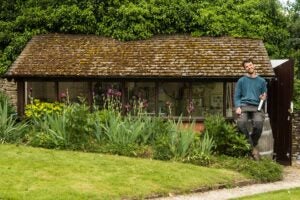
Capreolus Distillery has humble roots, but that hasn’t stopped it from becoming a coveted drinks brand.

Someone else who is finely attuned to the island’s natural state is Barney Wilczak, distiller & owner at Capreolus Distillery. When I call him on a particularly grim February afternoon, he’s been handling quince, pears, and apples to make his cult-loved Capreolus eaux de vie. An often underutilized spirit category, eaux de vie (a fruit brandy) is traditionally found in countries like Germany, France, Switzerland, and Austria. Unaged, double distilled, and designed to capture a single fruit, it is a spirit that has varied in quality and popularity over the centuries. But when Wilczak taught himself to distill a decade ago, England woke up to an exciting new proposition utilizing produce that we can find on hedgerows and trees in our own back yards.
Sign up to the World of Fine Spirits newsletter for more spirit stories.

As is the Wilczak way, his answer to my question of how those fruits were behaving was cerebral and disarming: “All the fruits are so waxy and greasy, because we had so much sunshine. You can feel the weather in your hands.” He goes on to describe the “wall of density” in the spirit run as a result, the waxy low wines and the nuances that come with vintage variation. “Working in this way drives your understanding. I used to want to work with every single piece of fruit I could get my hands on, but we never see the same fruit in each year.”
The conservational photojournalist-turned-distiller, who grew up in the Cotswolds, has always had an affinity with its ancient woodlands, medieval orchards, and neolithic grasslands. After a career away from his roots, travelling to 118 different countries to capture each of their unique environs, he returned home and turned his attention to something which, on the surface, could seem seriously unexotic: English fruit. Ten years later and his eaux de vie – which spans the likes of perry pear, damson, plum, blackberry, and Siegerrebe grape – is the golden egg of the spirits industry’s most dedicated flavor hunters.
Harvesting flavor

When I first visited Wilczak at his distillery in Cirencester five years ago, I was expecting a sprawling countryside operation. Instead, I found him towering outside his small garden-shed-like flavor emporium, his dog Pip lapping at his heels, quietly making magic in what is, effectively, his back garden. What ensued was an afternoon of Starburst-esque flavor, texture and philosophical discovery. We spent hours dissecting how Wilczak sorts the local fruits supplied to him by hand, how he crushes them, the wild fermentation their juice undergoes to heighten their wholeness, his meticulous double-distillation techniques in a 180L copper still (that can hold over three tons of fruit), and that small window he has to capture the essence of every single part of that fruit – skin, juice, pips, stem, leaves – in his hand-labelled and beautifully packed statuesque bottles. Capreolus is the embodiment of a ‘human spirit’ – one in which you can see, taste and feel the humanity behind it.
“You do question your motivation for doing incredibly mad things,” Wilczak admits of his process, but it’s his quest for understanding every millimeter of his raw ingredients that drives him. “When I used to look at plants, I expected I would come to this finite point of knowledge… But with eaux de vie, there is a level beyond it tasting like fruit, moving into those elements that you don’t always see. We think fruit and plants are different entities but they are connected. You’re just elevating lineage and heritage. When we distill apples, for example, you also smell the blossom, the orchard.”

He speaks of his experience of making elderberry eau de vie, from a nine-person, full-day harvest to a five-week fermentation, and how the aromas they experienced “travelling from the canopy through decay, humus, and the forest – it felt like we captured the environment.” This comment catapults me back to sitting, half a decade ago, in his garden in Gloucestershire, and being struck by the irony of it all: I have been flung to every corner of the world – Jamaica to Mexico, Chile to Bali – to taste some of its most revered and culturally important spirits. And yet, here I was, two hours away from London by train, having one of the most revelatory experiences of my career – and it all started with something as familiar as a raspberry.
Wilczak’s enigmatic nature, and the spirits he produces, makes the familiar, unfamiliar. His raspberry eaux di vie tastes more like a raspberry than the fruit itself, and yet there is mint and rose, nuts, and spice layered in there too. The stones in the cherry bring an almond and textural quality, while gooseberry is herbaceous and woody, and quince can be herbal and citrus-leaning too. He describes finding a cured bacon note in the perry pears due to sun exposure. A recent collaboration with Dorest’s Langham Wine saw its pinot noir grapes presenting as mango, bean sprouts, and unripe papaya.
Raising the bar
This palette of aromas and flavors has caught the attention of the noses and palates of sommeliers and chefs at some of the highest imaginable caliber establishments. From three-Michelin-starred restaurants like Simon Rogan’s L’Enclume to Anne Sophie-Pic’s Maison Pic, not only are Wilczak’s eaux de vie being used on drinks lists, but on food lists too. “It’s really strange for me to see these incredibly talented people looking at these things through different lenses,” he admits of this application of his spirits. “But you see other people’s excitement because they are pure, concentrated essences.”
He’s also captured the imagination of some of the best bars and bartenders around the world. An early advocate, and a man whose seal of approval can catapult a brand into the proverbial stratosphere, was Ryan Chetiyawardana, responsible for the Lyan portfolio of bars in London (Lyaness and Seed Library), Washington DC (Silver Lyan), and most recently, New York City (Seed Library NYC). He himself was introduced to Wilczak’s work in 2020 via one of the industry’s most prescient tastemakers, The Whisky Exchange head buyer Dawn Davies MW.

“Dawn knows we’re curious about brilliant liquids and brilliant people, so she made the introduction and Barney and I started chatting,” explains Chetiyawardana. Having been dismissive of eau de vie as a category up until that point, when he sat down to try his first samples, it was a revelatory experience. “I had some context, but I didn’t really fathom what was going on… I tried them and thought ‘Holy shit, what is this?’”
For someone who himself is fanatical about flavor, Chetiyawardana’s discovery of the complexity that lies in these seemingly unassuming spirits opened up an entirely new universe of exploration. “They are rocket flavors: the raspberry is crazy intense raspberry, but also rose, the greenness of the leaf, sharpness. There is so much there, and as you start to dilute them, the textural quality is insane: everything from wax to fullness, an almost silvery note – they transform as they open up.”

Chetiyawardana and his teams now use them across all of the Lyan venues in their mind-bending cocktails. My favorite application is the Silver Apple Martini at Silver Lyan in DC, where Wilczak’s 1,000 Trees Apple eau de vie is combined with Belvedere vodka, apple juice and bisongrass. “One-thousand Trees Apple is what you want an Appletini to be,” he explains of the 90s classic, often let down by bad ingredients. “You get everything from biting into an apple, to feeling like you’re holding it, the grip of the skin, florality – so we use that as the heart of the cocktail.”
When it comes to drinking Wilczak’s eau de vie at home, I’ve been known to drop a teaspoon of raspberry in a glass of champagne, pep a G&T with a dash of quince into a G&T or take a martini on an unexpected course with a touch of perry pear. Drinking them neat is a lesson in how these spirits morph and change with time, perspective and open-mindedness. They take us back to some of our deepest memories and remind us that fruit holds tightly the character of its ever-changing surroundings. “You really taste his philosophy in the spirits,” says Chetiyawardana. “It isn’t just about taking fruits at their peak, it’s looking at them as a plant in their entirety. That’s what I found so beguiling: a real honesty about fruit and a sense of place. It was an attention to detail I hadn’t come across in a long time. Meticulous, fanatical, uncompromising.”
Добавить комментарий