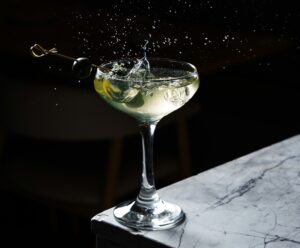
Drinks experts explain why stronger spirits are back.

If you just read the headlines, you’d think everyone was running scared of alcohol; that there was only one way for drink’s strength to head – and that was down. But rather counter-intuitively, high-proof spirits are also on the up – not just in whisky (which has a tradition of cask-strength bottlings) but also gin, rum, and tequila.
Take the new British luxury gin Aureus Vita – it’s bottled at 123.6 proof/61.8 percent abv, which is several degrees higher than most Navy Strength gins. The strength, the packaging, and the design of the still draw inspiration from the ‘Golden Ratio’ 1:1.618, which recurs in art, architecture, music, and nature (the gin’s proof represents a ratio of 1.618 to 1 between alcohol and water). Rich and powerful, in an almost cake-y type way, the gin sells for a punchy $235 per bottle.
See also: Why Runners Are Falling in Love with Wine, Beer, and Whisky Regions
The Botanist gin – which is made by Islay’s Bruichladdich distillery – recently launched a 100 proof/50 percent abv spin-off, The Botanist Distiller’s Strength, which offers an amped-up, but still extremely elegant, platform for its 22 foraged botanicals.

“I was inspired by Bruichladdich Distillery’s long practiced art of bottling whisky at 50% abv,” says head distiller Adam Hannett, “and at this strength, flavorful oils from distillation are enhanced, the viscosity is richer, and it’s this richness that carries the flavor of the spirit.”
Some more high-end aged sipping rums have been upping their proof as well, in a bid to position themselves more like a single malt whisky. The excellent Exception Cask Selection series from Foursquare in Barbados often features cask-strength and high-strength editions around the 120 proof (60 percent abv) mark.
American whiskey has also been hitting the heights. Woodford Reserve recently released its strongest whisky to date, Woodford Reserve Distillery Series Chocolate Whisper Redux which is bottled at a whopping 139.4 proof (69.7 percent abv).
As agave drinkers get more discerning, there has also been a noticeable increase in high-strength tequilas and mezcals.

“The past few years have seen a big increase in high-proof products,” says Grover Sanschagrin, founder of US-based agave spirits recommendation app Tequila Matchmaker. “And we’ve seen higher-than-average ratings for high-proof products […] our users get quite excited to try them.’”
Top performers in a Tequila Matchmaker blind-tasting included Siembra Valles High Proof Tahona (99 proof/49.5 percent abv), Trujillo Manifesto 56 (92.6 proof/46.3 percent abv) and the ‘still-strength’ Santo Fino Blanco 110 (110 proof/55 percent abv) and Amatiteña Tequila Blanco Origen (98 proof/49 percent abv).
Sanschagrin believes “high-proof products, especially still-strength tequilas, are the closest thing to the source, and are often the most expressive of cooked agave […] Aroma and flavor can be muted because of the higher alcohol, but the finish will be a lot longer and evolve on the tongue, and the mouthfeel is often more full-bodied, thick, and oily.”
The Whisky Exchange’s head buyer Dawn Davies MW, however, is at pains to point out that more is not always more.
“There’s this idea among some spirits drinkers that bigger is automatically better. But what matters more is balance; that the spirit is bottled at the strength that’s right for itself. I think for most spirits, the strength that carries flavor really well, but isn’t too alcohol forward, is actually round the 44-48 percent abv (88-96 proof) mark.”

There’s another, more cynical, reason why whiskey producers in particular may be leaning into high-proof, and that’s a simple case of over-supply, says Marten Lodewijks, managing director of drinks analyst IWSR.
“Through the pandemic there was a massive increase in demand, so whisky producers put more whisky into barrels. That demand then plateaued and is now starting to decline. So, there’s a whisky glut – which, for producers, is a challenge.
“If whisky producers can generate interest in higher-abv products then they don’t need to water down the whisky as much before bottling, and they get fewer bottles out of a barrel. So, there’s a concerted drive to push up the abv because then they can off-load more barrels at a premium.”
See also: Scotch Has Lost Its Way – Can It Come Back?
An advantage of high-strength spirits is you can dilute them to your taste. Scotch whisky has a strong (and very respectable) tradition of this – and don’t let anyone tell you otherwise. The key is to add water in tiny increments (using a dropper helps), and taste as you go. You’ll find the whisky evolves and different characteristics come to the fore.
Another easy way to add dilution gradually is stirring with ice, and that’s why the Old Fashioned is such a great cocktail for showcasing high-strength whiskies.

On the agave front, Sanschagrin recommends using Pantera de Oro’s 106 proof (53 percent abv) cask-strength extra-añejo to make a Tequila Sazerac. “I make them at home all the time and it’s perfect for that.”
Max Venning, co-owner of the acclaimed Three Sheets cocktail bars in London, often uses tiny amounts of high-proof spirits to give his cocktail recipes a lift. “I might use a dash of agricole rum to give a drink a subtle funky, fermented note. Longer-aged, higher strength cask-aged spirits tend to have more vanilla and body which can be great for adding depth, texture and, often, sweetness to a drink.”
The Botanist Distiller’s Strength is great, he says, “because it allows you to get a martini really, really cold because you can stir it down for longer, without losing the intensity and nuance of its lovely wild, floral botanicals.”
Just sometimes, more is more.
Добавить комментарий