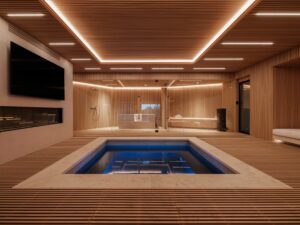
As the home spa rises in popularity, design matters more than ever.

It’s an amenity that many aren’t willing to compromise on, even looking to build full-floor health and wellness centers at home to replicate their experience abroad. “I always get calls from clients that want their home to feel like the Aman they went to,” says Aaron Kirman, a real estate agent based in Los Angeles. “A lot of savvy developers have really taken that strategy and made it work for them.”
At the moment, Kirman has the solution: A hillside mansion designed by Paul McClean that he’s co-listing with Tomer Fridman. Included in the 24,000-sq-ft amenity package is a wood-clad home spa that’s kitted out with a hot tub, a steam shower, and an infrared sauna. A massage room, a private basketball court, and a gym are located in separate, adjoining rooms.

This level of customization and square footage wasn’t always commonplace. In the past, home spas were tucked away, rather than showcased across an entire floor. “They used to be integrated or retrofitted in bathrooms, or wherever we could fit them,” says Francis Nicdao, principal and chief creative officer at interior design firm Pembrooke & Ives. “Now, they’re part of the initial conversation regarding the scope of the house.”
See also: The Biggest Wellness Travel Trends Set to Shape 2026
When designers sit down with clients, they often come with a long list of wellness-centric must-haves, whether it’s a cold plunge pool, a dry sauna, or even a float tank. These are important, of course, but they’re not the most critical element. “The biggest non-negotiable is making sure it’s a haven for them,” says Nicdao. “It has to be a destination.” Otherwise, a spa can feel like an uninspired checklist, rather than a space you’ll actually want to spend time in.
Quality time here is more than just sitting alone in a steam room, too – over the last few years, home spas have evolved into social spaces. “[Clients] aren’t building them out just for themselves, but for their friends and family who are coming to their compound and using the space,” says Cathy Purple Cherry, founding principal of Purple Cherry Architects. It’s something designers weigh heavily when piecing together a layout. Often there will be a seating area off to the side, or a handful of chaise longues near the pool. It’s indicative of a broader cultural shift toward visiting luxe bathhouses and wellness centers with friends, rather than staying out late drinking and clubbing.

Naturally, if you want visitors to feel at home in your personal spa, then it needs to feel like an escape – materials are a key part of telling that story. Often, designers will take inspiration from a home’s location, a practice that has become part of design firm Liaigre’s visual identity. Its spa projects are inspired by “bathing rituals from Roman antiquity and ancient Greece,” says Bertrand Thibouville, the brand’s senior creative director. “Each space is conceived in response to its specific context.” A spa in Aspen, for example, might be clad in granite to evoke the mountains; an escape in St. Moritz may use natural woods in combination with patinated metals.
See also: The Best Wellness Retreats in the US
Lighting also plays a major role. Since spas are typically located on lower levels, it’s important to be realistic about how much natural light your space will get, and how you can supplement it. Nicdao recommends illumination that “you can program to react to time of day and sunlight.” The right amount of light can add to a spa’s overall sense of tranquility, so installing options that are dimmable and flexible is key.

Don’t consider a spa in isolation, either – the adjacent rooms are just as important. A basketball court is a bit of an anomaly, but it’s not uncommon for fitness to be intertwined with wellness. “99 percent of the time they are in close proximity to the gym,” says Purple Cherry. “We do a lot of massage rooms too, where clients are doing massages once or twice a week.” These activities flow into one another. After a morning workout at the gym, you can shuffle over to your cold plunge pool, or unwind in the steam sauna.
These technical elements are critical, but nothing supersedes the feeling that a home spa creates. “How do you create joy out of it, and how do you create things that are wanted and used?” says Glenn Pushelberg, co-founder of design studio Yabu Pushelberg. The firm’s client list includes a long list of luxury hotels and condominiums, including their current project, Miami Tropic Residences. Doubtless many have spent time in the spas that they’ve designed, only to return home, pick up the phone, and ask the designer in their life for something similar. “People have moved on from the basic massage and facial,” Pushelberg notes. “They want to live a longer life, and live it better.”
Добавить комментарий