She speaks exclusively to Elite Traveler about the bold new vision she’s bringing to the LVMH house.

Fashion loves nothing more than a debut. And the key one from LVMH was in Milan last week, with Maria Grazia Chiuri now at the helm of Fendi.
Probably the most important feminist designer working today, Chiuri is known for working with female artists, craftspeople, and collaborators, and prized for turning the brands she leads into commercial hits.
In 2008, she and Pierpaolo Piccioli took over at Valentino, growing the business threefold in just seven years. Subsequently she was named the couturier of Christian Dior, tripling revenues to €10bn (approx. $11.7bn) before departing last year.

After a brief break, when she opened her own pocket theater in Rome across the street from the ancient capital or Campidoglio, she was appointed creative director of Fendi, LVMH’s most famous marque in Italy.
The world’s most influential fur brand, famed for inventing knitted fur and the Baguette bag, Fendi is the luxury goods label of Rome, its facing double F logo invented by Karl Lagerfeld who was there for some 60 years until his passing. LVMH chairman and CEO Bernard Arnault acquired Fendi in a series of deals over a few years for around €800m (approx. $938m). Underlining the importance of Chiuri’s debut, Arnault was present with his wife, Helen, as was LVMH Fashion Group CEO Pietro Beccari.
See also: The Up and Coming Designers to Watch from London Fashion Week
Fendi, which celebrated its centenary last year, has created the clothes for Once Upon a Time in America, Evita, and The Royal Tenebaums. The brand’s continued pulling power was evident from the front row, where Uma Thurman and Monica Bellucci joined Iris Law and Korean-Australian superstar Bang Chan. All of them wearing Fendi looks designed by Chiuri.

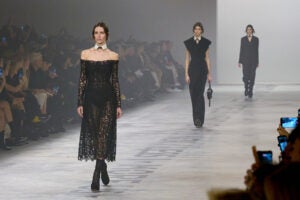
How did Chiuri perform? Admirably. The Rome-born designer showed softer shapes and silhouettes for both men and women, with matching blazers. “I wanted one wardrobe, not two,” she said in an exclusive pre-show interview with Elite Traveler.
Above all, she took the skills she’d learned at Valentino and Dior and injecting them into a new seductive Latin look at Fendi – some 70 percent of the collection was in black.
“I am tired of looking at colors on Instagram,” she told me. “Fashion is not entertainment. Fashion is a job. I am a worker in fashion. So, I want to do clothes that the people love to use. I don’t want to do entertainment.”

She also placed big cats – lions and leopards – on mink scarves and stoles, which also read “Sisters.” Expect that look to ignite a major trend, just as her fabric totes for Dior became worldwide best-sellers. And don’t forget that her rock-stud shoes and bags boosted Valentino from a sleepy couture house to a billion-euro marque. Chiuri is known for taking risks. Early shows at Dior celebrated the student marches of 1968 and militant feminism of that decade, appalling many bourgeois Parisians. But when the Me Too movement suddenly emerged, Chiuri’s stance seemed prescient. And brilliantly timed.
See also: The Best Street Style at New York AW26 Fashion Week
In Milan, models walked a catwalk stenciled in giant letters that read Meno Io, Piu Noi – Less Me, More us – wearing mid-calf negligée dresses and semi-sheer cocktails in lace or perforated leather. It was another savvy collaboration with female artist SAGG Napoli with whom she worked at Dior, while the jewelry was developed with the estate of a late great Italian artist Mirella Bentivoglio.

Post-show, a clearly enthusiastic and relieved Arnault embraced Chiuri. Fendi had stalled badly in the past three years under her predecessor, British-born Kim Jones. Despite the fact Arnault attended Donald Trump’s second inauguration in Washington last year, few companies have been hurt as much by the US president’s tariffs as LVMH.
The collection marked a return to the house for Chiuri, who began her career in Fendi in 1989, working with the five Fendi sisters whose parents founded a small leather goods shop in the Eternal City back in 1925.
“They were my mentors. They gave me my career. And I felt part of their teamwork. I would like people to remember all that they created at Fendi. It’s about time we mentioned someone else besides Karl Lagerfeld,” she said.
Добавить комментарий