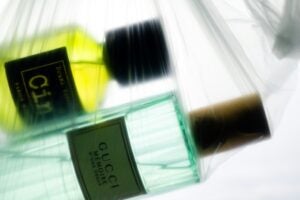
Ready to reinvent your signature scent? Here’s how industry insiders do it.

Fast forward to 2026, and the notion of a singular signature feels almost reductive. Today, individuality is expressed not through one bottle, but through a blend. Smelling unique isn’t just about claiming a singular signature scent, but in the art of layering multiple.
“I first became aware of fragrance layering while traveling in the Middle East, where it is deeply rooted in perfume culture, and after talking with people and friends from the region who shared their knowledge with me,” says Thibauld Crivelli, founder of Maison Crivelli.
It’s a shift being driven by a younger, more experimental consumer. According to a 2,000-person Unilever survey, 29 percent of Gen Z respondents layer multiple scents, while Pinterest reports a 125 percent surge in searches for ‘perfume layering combinations.’
“After launching the brand [in 2018], many customers started to ask me how to layer Maison Crivelli perfumes altogether, and I started to look at the different combinations which could work well.”

For Aurélien Guichard, perfumer and founder of Matière Première, fragrance layering can be gratifying. “I think it’s important to keep in mind that layering is personal,” he says. “It’s always easier to enjoy layering two things that you already like on their own. You might be surprised by how well they work together.”
How to layer perfume like a pro
But where do you start? What notes are worth pairing? Is there a limit to how many you can layer? Elite Traveler asked Crivelli and Guichard to share their tips on how to master fragrance layering, whether you’re new to the trend or not.
See also: How Henry Jacques is Revitalizing the Fragrance World
Start with a base scent
Think about your favorite fragrance note and start with the perfume that really champions that scent profile. This might mean moving away from more complex fragrances and opting for a niche single-note scents that aren’t as layered.
Guichard likes to start with the base note, which can be “the part of the fragrance that lasts the longest. If that’s the case, then you should use ingredients that are long-lasting, such as woods, amber, musk, or notes that have heavier molecules. If the base scent is meant to define the main identity of the fragrance, then it has more to do with the olfactory profile and your personal taste.”
Crivelli adds that, from his experience, “deeper and warmer ingredients such as woody and amber notes are a great base for layering. They are textured and can welcome the additional facets brought by complementary ingredients.”
Don’t overdo the layers

“Start layering by spraying a perfume extract and topping it up with a lighter eau de parfum,” says Crivelli. “It’s a rule I always follow.
“Vivid notes (e.g. spices or citrusy florals) make a perfect top up as they add a hint of freshness,” he adds.
Guichard, meanwhile, argues that “you shouldn’t combine things that are too similar or too complex, in order to maintain a modernity to your layering. I usually like to combine ingredients that are long-lasting with others that are more transparent.” Think: smoky notes under a white musk scent. He recommends layering two or three scents as a maximum. “Balance is essential,” says Crivelli. “The idea is to enhance and amplify the characteristics of each fragrance without overpowering one another.”
But if you’re worried about overcomplicating things, consider sticking to what you already like. “I also prefer to combine perfumes which have a common ingredient or facet, as I believe that it creates a thread between the two formulas,” Crivelli adds. So if your base is a floral scent, try cutting it with another floral one.
Have fun with it
Ultimately, fragrance layering is about experimenting, and Guichard believes it shouldn’t be taken too seriously. “Layering is all about being yourself and being unique – it’s about how you feel. For me, combining ingredients is very personal.”
Fragrances react to your skin chemistry when they’re first applied, so layers will smell different on you than they will on a fragrance blotter.
“Now I follow my intuition,” Crivelli says about how he goes about layering fragrances. “This gives me a unique approach based on knowledge shared by friends in the Middle East, but also infused with a very personal perspective.”
Добавить комментарий