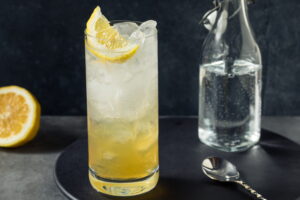
From mineral content to carbonation level, experts explain how choosing the right sparkling water can elevate your highballs, Martinis, and other cocktails.

“The style of sparkling water is actually really important – it can dramatically alter the character of a drink,” says Zoe Burgess, founder Atelier Pip , a drinks consultancy whose clients have included ArtFarm and The Fat Duck. “It impacts flavor and texture and can influence acidity and bitterness. Bubbles also play an important role in carrying aroma.”
Two key considerations when choosing a water are the level of carbonation and the mineral content or TDS (this is short for ‘total dissolved solids’ and is measured in mg/l and usually stated on the back label).
Naturally sparkling mineral waters tend to have a fizz that’s finer and softer – a classy example is Chateldon 1650 (1882 mg/l) which has been bottled in the Auverne in central France since 1650, and was a favorite of Louis XIV. Its subtle taste and luxurious texture would make a really elegant white-wine spritzer.

Artificially-carbonated waters – such as club soda – tend to have bigger bubbles with much more bite (the higher levels of CO2 also boost acidity and make the drink taste ‘brighter’). The Mexican brand Topo Chico (493-630mg/l) is naturally sparkling and carbonated for a really bold fizz – great in a thirst-slaking Ranch Water with tequila and a squeeze of fresh lime.
Waters with a high TDS will be more flavorsome – a great example is Vichy Catalan (3052g/l), which is packed with sodium and bicarbonates that give it its satisfying, salty taste.
See also: The Hunt for Paris’ Greatest Cocktail Bar
At Veau d’Or , a neo-bistro in New York City, they serve the house Martini with a ‘sidecar’ of Vichy Catalan, mixed with 2oz of González Dry Vermouth, a twist and the ice left over from stirring the Martini.
“Vichy is one of my favorite mineral waters,” says the sidecar’s creator Sarah Morrissey, “mainly for its salt/mineral content. It’s replacing the need for brine or an olive so that Dirty Martini drinkers can enjoy the Martini as well.”

The Japanese malt whisky Yamazaki makes a namesake sparkling water specifically designed for highballs, which comes from the same water source that supplies its Kyoto distillery. Suntory Yamazaki Premium Sparkling Water is a favorite of Tokyo’s Bar High Five: “It has bubbles that are small, gentle, and elegant – you can also feel some sweetness from the water,” says owner/head bartender Hidetsugu Ueno.
See also: I Spent a Week Tasting Tequila in Mexico – And Rated These Bars
The whisky-centric Apollo Bar, also in Ginza, carbonates all its water in-house, and adjusts the pressure of the fizz to the whisky that’s being served. “I think a light carbonation, that gives a sweeter taste, is preferable for a rich whiskey aged in sherry casks,” says owner Komatsu Hidenori. For a more refreshing highball he uses a gas pressure “the same as that of champagne.”
In Italy, spritzes are generally zhuzhed with water from a seltz gun – an innovation that made its debut in 1915 at Campari’s Camparino in Galleria bar in Milan. “At the time it was revolutionary,” says Camparino’s head of mixology Tommaso Cecca. “The continuous flow of chilled, pressurized seltz arriving directly from the cellars was something entirely unprecedented in Milan – and it helped turn Campari Seltz into an instantly recognisable experience, not just a recipe.”

He describes the effervescence as “very fine yet powerful,” resulting in a “compact, creamy foam and a lively texture. Rather than sitting ‘on top’ of the drink, the carbonation actively works within it, reshaping the mouthfeel and enhancing aromatic perception.”
In addition, Campari’s signature seltz glass has a concave base which encourages turbulent mixing of the ingredients, further enhancing the frothy head.
The old-school soda siphon has also been making a return. At the Italianate bar and restaurant Martino’s in London’s Sloane Square, the white-jacketed bartenders use glass-and-chrome soda siphons straight out of the Roaring Twenties. For more vintage examples, keep an eye on The Italian Collector or 1stDibs.
However you serve your fizzy water, make sure it’s really, really cold, says the founder of Crucible drinks research lab, Stu Bale. “That will help keep the CO2 locked in – ensuring your drink stays fizzy for longer.” And ensuring your highballs don’t fall flat.
Добавить комментарий