Securing your home no longer means a basement complex. Helen Madden explores how to do it right, and leave no trace.

When Matthias Fitzthum sits down with a new client for a risk assessment meeting, he’s often greeted with a common refrain: “They say: ‘We’re very safe. We have an intruder alarm system,’” he says. “I look at them and say: ‘So why do you think you’re safe?’” In truth, this preliminary measure only scratches the surface – something Fitzthum knows all too well as the CEO and founder of Bespoke Home & Yacht Security. “Some of us think we’re safe, but I can tell you, we’re definitely not,” he adds. “There are hundreds of different layers of security.”
Turning your home into a fortress is no small feat; it’s also a growing concern. More than half of the real-estate agents who participated in the most recent Global Luxury Real Estate Forecast by Christie’s noted that home security was an increasingly significant consideration for their clients. One of the first measures many consider is a panic room, which is usually thought to mean a concrete bunker in the basement where homeowners can safely hide away until the authorities arrive. This perception isn’t helped by pop-culture representations, such as the Jodie Foster vehicle Panic Room. The reality, however, couldn’t be more different. “Panic rooms are really old school,” notes Fitzthum. “Nobody does them anymore.”
See also: So, You Want To Build a Billionaire’s Bunker? Here’s Where To Start

Beyond the alarmist nomenclature, the traditional room just isn’t all that practical. If someone breaks into your home, it can be difficult to race down to the basement in time – and, in an emergency situation, time is everything. Instead, architects and security consultants have taken a different approach, calling these havens safe rooms, or serenity zones. “Instead of going into a bunker, pick a room that’s part of your daily life that can be transformed should the need arise,” says Peter Pelsinski, principal at Span Architecture.
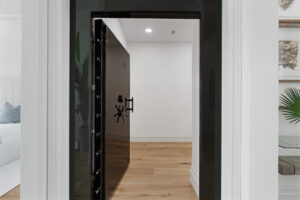
The bedroom is often the preferred option. While it may look like any other space, the walls are reinforced with a quarter inch of steel. The windows all have bulletproof or smart glass, which can transform from transparent to completely opaque with the touch of a button. Using a hefty, reinforced door on a daily basis would be cumbersome, however, so a hidden ballistic sliding door is activated at the touch of a button. For many, these features have become a standard amenity. “It’s been a consistent request since I started 25 years ago,” says Margie Lavender, partner at Kligerman Architecture & Design. “They’re probably in every house over 10,000 sq ft that I’ve done.”
See also: How to Build a Nightclub in Your Basement
Having a safe space is paramount, but so is knowing about an inbound threat as soon as possible. That’s where the alarm system comes in. “You have to be absolutely sure that when something goes wrong, there’s an automatic alarm chain that goes off, and that can’t be stopped,” says Fitzthum. “The way you create a fortress begins at the very exterior parameter.” Surveillance cameras are an obvious choice – you can also run motion detectors under the soil on your property grounds. These can detect movement and discern if it’s a pet or something more nefarious approaching.

Threat detection goes beyond the obvious entry points. If you live on a waterfront property, for example, then you’ll need an extra layer of protection, such as radar, for waterside aspects. Aerial attacks and access points are another consideration. “A lot of our clients also have helipads, and [for them] we insist on drone defense or detection systems,” says Fitzthum. “If a drone crashes into a helicopter that’s landing or taking off, then it can burst the plexiglass.” There are risks if you travel by car, too. When the gates to your property swing open to let a vehicle in, someone can quickly follow behind with a truck. The solution? Automatic bollards, which will rise out of the ground almost as soon as your driver cruises through. Ultimately, everything should be considered – even a dog door can be a security risk if an intruder is crafty enough.
Even things such as entry points are no longer simple. In the past, many turned to biometric scanners for complete security. However, the rise of artificial intelligence has made many question their efficacy – depending on how sophisticated your home system is, a fingerprint can be faked and accepted. Other methods, such as key-card scanners, are non-starters. “The worst thing you can do is tell a client to use a radio-frequency identification tag,” says Fitzthum. “Same thing if the locking device is attached to a mobile phone.” One lost or stolen key and your entire home could be put in jeopardy. Instead, numerical keypads remain a tried-and-true – just make sure yours doesn’t leave any fingerprints.
It can all sound a bit daunting, but with a good architect, engineer, and security consultant all of these elements shouldn’t be obvious – they should be invisible. On a day-to-day basis, you won’t notice them, or even remember that they exist. “Protection must not be controlling,» says Fitzthum. “We produce and install things, and hope they’re never, ever needed.”
Добавить комментарий