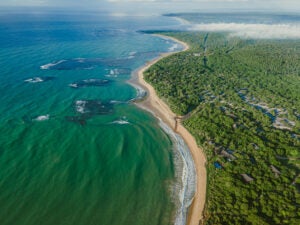
Could Trancoso be Brazil’s most underrated seaside destination?

Although initially developed by the Portuguese, who first set foot here in 1500, the Brazilian fishing town of Trancoso remained virtually undiscovered until a small group of Paulistano hippies came upon it in the 1970s and happily settled in. Although the installation of new roads and the arrival of electricity a decade later increased accessibility, the vibe was set: Trancoso remains a sleepy, bohemian beach destination.
Today, Trancoso, which is part of the ‘Discovery Coast,’ a trail of towns in southern Bahia, can be reached via a one-and-a-half-hour drive from Porto Seguro’s airport or a direct flight to Aeroporto Terravista, a private airport. Popularity is on the rise (thanks in no small part to CNN anchor Anderson Cooper’s pared-back beach house, Casa Anderson, which can be rented out), but according to locals the quietest period is between March and June.

The town’s heart is Quadrado, a central square anchored by a small white church called São João Batista, built during the 17th century. A makeshift soccer pitch sits in front of the church, lined by Trancoso’s signature colorful low-level houses. The entire square is now recognized as a Unesco World Heritage Site.
Occupying 15 of those houses is Uxua Casa Hotel & Spa. This was one of Trancoso’s first upscale hotels, opened in 2009 by Dutchman (and former Diesel creative director) Wilbert Das, in collaboration with local artists. Suites are spread across the cluster of houses (some of which date back to the village’s founding). Guests have access to the beach and to a spa that utilizes healing principles inspired by the local Pataxó people.

Divide your time in Trancoso between Uxua and a stay at Pousada Tutabel, whose 16 suites and one villa all overlook Itapororoca Beach. Breakfast here is served anytime, anywhere. And by breakfast, Brazilians mean fresh bread, tropical fruits, açaí, pão de queijo (cheese balls), and local coffee. There’s a spa and a gym at Tutabel but you can do that anywhere – don’t miss ceramic workshops with local artisans or whale and bird watching.
Adjacent to the hotel, there’s Tutabar, a lively restaurant on the sand where guests are served under charming tents. Like any local spot, the menu offers Bahia’s typical culinary tradition, a marriage of African, indigenous, and Portuguese culinary styles, featuring seafood, yucca, beans, olive and dendê oils, hot spices, and dishes such as moqueca, bobó de camarão, vatapá, and acarajé.

Also visit Fazenda Jacaré, a rustic restaurant located on a sustainable milk farm (Jacaré has another spot in Quadrado), and O Cacau, led by chef Dora Miranda, who moved to Trancoso in the 1990s and swiftly became one of the highlights of the gastronomic scene. Local nightlife is punctuated by the string lights suspended throughout town. True to its carefree, artsy character, Trancoso’s parties run late and involve plenty of caipirinhas.
The town is also famous for its artisanal craft heritage, most notably its basketry, which has been upheld by the quilombola community, who make hats, mats, and home decor from palm fiber. Galleries and boutiques are dotted across Quadrado’s houses – stop in at Divinos Trancoso, run by local designer Marie Stella.
Добавить комментарий