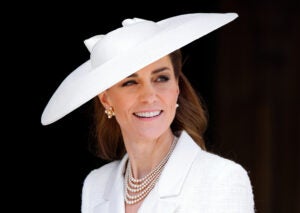
From Princess Catherine to the Queen Mother, Anna Murphy explores how the royals have long used fashion as a tool of influence.

It’s the end of fashion month. The usual quartet of New York, London, Milan, Paris – in that order – was joined by Rome, where Valentino has just staged a show-cum-homage to mark the passing in January of its founder, Valentino Garavani, at the age of 93.
A catwalk show is a fantasy, and there was none more fantastical than this one. Alessandro Michele, the house’s current creative director, is fully signed up to the froth- and frill-fuelled preferences of his illustrious antecedent. His was the ultimate palazzo-appropriate line up, its gaze firmly focused on the past.
But there have been some very different visions of contemporary luxury at other shows. Maria Grazia Chiuri’s mainly black, entirely restrained debut at another Italian brand, Fendi, for example, was the exemplification of less is more; of a rigorous modernity.
These opposing aesthetics – replicated to a greater and lesser degree throughout fashion month – have found an unexpected resonance for me in Justine Picardie’s fascinating new book Fashioning the Crown: A Story of Power, Conflict and Couture (Faber).

A riposte to anyone who argues that clothes are a superfluity, Fashioning the Crown tells the story of the British Royal Family in the first decades of the 20th century through the prism of their wardrobes, ending with the coronation of Elizabeth II in 1953.
These were often bumpy years. In the run up to World War I, when anti-German sentiment was at fever pitch in Britain, the family still went by the name Saxe-Coburg-Gotha, its lineage more Germanic than British. Rebranded as Windsor, the name was no longer a problem when World War II was declared, but there was still the small matter of a recent abdication by a Nazi-supporting king. What the Royals wore (or didn’t wear, on which more anon) aided their navigation of such turbulence.
Clothes are still part of the royal toolkit. The Princess of Wales’ sartorial serenity is currently helping the family through the Andrew Mountbatten-Windsor-related instability. Catherine may have stated last year that her office would no longer give the details of what she wears, the better to focus on what she does, yet, the two are – pun very much intended – interwoven. She is her image.
“The soft power of monarchy is always expressed through visual iconography, jewels and clothing,” is how Picardie put it to me recently. “For the key figures in the House of Windsor to navigate this latest crisis, they need to be as fluent in the language of fashion as their forebears. Given that they are not supposed to speak their minds, it’s their wardrobe that does the talking.”
The balancing act for a modern queen-in-waiting such as Catherine is how to come across on the one hand as, in Picardie’s words, “more democratic and sympathetic”, while also still channelling that essential “mystery” famously referred to by Walter Bagehot in his 1867 book The English Constitution. “We must not let in daylight upon magic,” he wrote. Alas, it’s not merely that there’s been too much daylight recently but too much darkness.
Picardie is especially compelling on another moment of royal darkness, the years in and around Edward VIII’s abdication in 1936. By way of his subsequent marriage to Wallis Simpson, two contrasting aesthetics came head to head. And the potential ramifications were considerably more profound than a pair of catwalk brands jostling for commercial dominance.
In the late 1930s the world order was in flux. It says something about how differently things could have ended – should he have been allowed to marry his bride and remain King – that everyone from the Nazi diplomat Joachim von Ribbentrop to Oswald Mosley, leader of the British Union of Fascists, expressed their unhappiness at Edward VIII’s abdication.
There was nothing more contemporary-looking, more future-facing than the ‘hard chic’ – as delivered by labels such as Schiaparelli and Mainbocher – of the woman who was rebranded, alongside her Duke, the Duchess of Windsor. Yet beneath her unquestionable chic, and her husband’s, were deeply questionable politics. The couple were unabashed supporters of the Nazis, a regime that also styled itself as modernity incarnate.
How clever then of the man who had never thought he would be King, George VI, to decide that his wife, the woman the Brits still refer to as Queen Elizabeth the Queen Mother, should lean into the exact opposite with her wardrobe; should conjure up the Elysian Fields of the past.
When the fashion designer Norman Hartnell was invited to Buckingham Palace in 1937, the King showed him the idealised, not to mention flouncy, royal portraits of the 19th-century German painter Franz Xaver Winterhalter. “His Majesty made it clear in his quiet way that I should attempt to capture this picturesque grace in the dresses I was to design for the Queen,” Hartnell recalled in his autobiography.
As Picardie writes, “This was a masterstroke – a superb visual riposte to the angular modernism embodied by Wallis Simpson.” Its apogee was reached in the all-white Hartnell-designed wardrobe that Queen Elizabeth the Queen Mother wore for the royal tour of France a year later.
What better way to counter the steel-edged semiotics of Nazism than with the marshmallow of a gown she donned, like a 20th-century Titania, for a garden party in Bois de Boulogne?
Hartnell and, later, Hardy Amies, would go on to craft a similarly fairy-tale image for the young Princess Elizabeth – at that point, like Catherine now, another queen in waiting.
Last September the Princess of Wales looked straight out of a Winterhalter herself when she wore a gold Chantilly lace creation by Phillipa Lepley – accessorised with the £1 million Lover’s Knot tiara, her heaviest – for a state banquet at Windsor Castle. She appeared transcendent; and, also, insurmountable. It was one of the greatest sartorial successes of her royal career, and also, it’s worth noting, about as far from ‘democratic’ as it’s possible to get.
Fashioning the Crown serves as a reminder that clothes can be the very definition of soft power. The palazzo fashion of Valentino in Rome last week fades into insignificance next to the palace fashion of our royals. It’s shaped their past, and it is part of what will forge their future.
Добавить комментарий