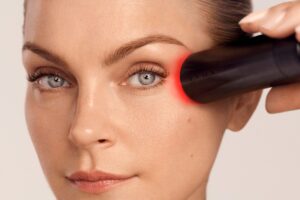
At home lasers have become the latest revelation in the weird and wonderful word of beauty tech.

It’s the kind of question that would have sounded absurd even a decade ago. Yet in the increasingly high-tech world of luxury skincare, devices promising clinic-level results from the comfort of home are becoming harder to ignore. LED masks such as the CurrentBody Series 2, microcurrent tools, and radiofrequency devices now sit alongside serums and moisturizers in many bathroom cabinets, blurring the line between everyday skincare and professional treatments.
At the top end of the category sits the Lyma Laser, a handheld laser tool promising long-term improvements in skin texture, firmness, and tone. The brand has attracted a number of high-profile fans, including Rhode skincare founder Hailey Bieber, Sienna Miller, and Kim Kardashian.
See also: Wellness or Woo-Woo? The Trending Experiences Everyone’s Trying
But with a price tag that rivals some aesthetic treatments in salons, it raises another question: how exactly does it work, and is the technology meaningfully different from the growing number of beauty devices already on the market? According to founder Lucy Goff, the device builds on technology that has been used in medical settings for decades.

“Low-level laser therapy has been used in medicine to rebuild cartilage, heal tendons, and speed up recovery for decades,” she explains to Elite Traveler. “Our story started when Professor Paul Clayton was treating a 62-year-old patient’s damaged knee. The byproduct of the treatment was that the skin on the treated knee looked about 20 years younger than the other. That was a revelation.” The discovery prompted a multi-year effort to adapt the technology into a consumer device safe enough for regular at-home use.
A key difference, Goff says, lies in the type of light used. Many popular skincare tools rely on LED light therapy, which emits low-energy wavelengths that sit relatively close to the skin’s surface. Lyma’s device instead uses a cold laser that delivers near-infrared light deeper into the dermis.
See also: Regenerative Skin Boosters That Top Aesthetic Doctors Actually Rate
“I’ll be upfront: Lyma is not an LED. It’s completely different technology,” Goff says. “Our cold laser delivers near-infrared light deep into the dermis, stimulating mitochondrial activity and essentially telling cells to behave younger.”
She adds: “Traditional hot lasers damage tissue inflammation, require downtime, and entire skin tones are excluded from using it.» In comparison, she explains that «Lyma is cold, damage-free, and FDA-cleared.”
Even still, the Lyma Pro Youth System is a serious investment. Sitting at almost $7,000, it pairs the brand’s handheld Lyma Laser device with a curated regimen of skincare and supplements, and is a long-term investment rather than an impulse beauty purchase.
“It is a serious investment – and I won’t shy away from that,” Goff admits. “But it’s not just a financial investment, it’s a commitment. Like anything worthwhile, you have to show up consistently. If you’re not dedicating yourself to the routine, you won’t see the full benefit.”
“When you consider what people are currently spending on clinic-based treatments, [an at-home device] starts to look very different,” she adds. “You’re getting those clinic-level results at home, on your schedule, with zero pain, damage, and downtime.”
Whether devices like this will become a staple of high-end skincare routines remains to be seen. But as beauty technology continues to evolve, and consumers grow increasingly comfortable bringing clinical treatments into their own homes, the idea of investing thousands in a single skincare device no longer feels quite so far-fetched.
Добавить комментарий