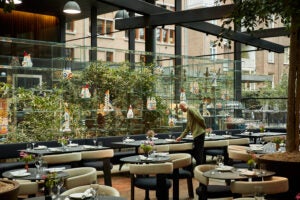
The cult chef is now operating inside the Mandarin Oriental Conservatorium. Elite Traveler was among the first guests in.

The Mandarin Oriental group recently swerved Amsterdam’s strict ‘no new hotels’ rule, by taking over the running of an existing five star property, the Mandarin Oriental Conservatorium. With the rebrand came the debut of one of the UK’s best-loved restaurateur-chefs: Yotam Ottolenghi.
Regular London diners know Ottolenghi’s food. After all, it was the British-Israeli chef that brought fresher – and predominantly vegetarian – Mediterranean and Middle Eastern dishes to the forefront, sharing the delights of zucchini, harissa, and za’atar. His vibrant delis quickly became a cheat code for crowd-pleasing dinner party menus.
In addition to those upmarket spots – several of which now have simple but popular restaurants attached – Ottolenghi opened Nopi in Soho in 2011, which, at the time, was the group’s first sit-down restaurant. The focus on vibrant ingredients and light-touch cooking remained, but we could now have it in a more formal setting. Rovi followed in 2018, taking Ottolenghi’s now-famous cuisine and treating it to the en vogue cooking methods of the moment: fermentation and live fire.
See also: As Dinner by Heston Blumenthal Prepares to Close, I Tried Its Most Playful Dining Experience

It’s this concept that has made it over to Amsterdam. “We’ve got an open-flame grill in the back,” our waitress tells me when I sit down for lunch a few days after opening. She seems far more clued up about how to order from the sharing menu than you’d expect of someone at a brand-new restaurant (“Are you happy for me to put through the dishes in pairings that I recommend?” she asks, as I order.) It turns out that a shipment of the Rovi team is also in town to help smooth the opening.
Even our waitress can’t smooth the bustle behind me, though: the glass-walled restaurant sits adjacent to the hotel’s lobby, where a horde of staff are setting up for a launch party that same evening – sound system and crates of champagne included. I’m impressed by how busy the restaurant is, regardless of the party prep: I sit early, and most tables are full by the time my drinks arrive.
See also: Are Gordon Ramsay’s Sky-High London Restaurants Worth the Hype?

In the standard Ottolenghi way, vegetables come first. I counted, and of the menu’s 20 dishes, only seven have meat (three of which are fish). Instead, the likes of leeks, asparagus, chard, and celeriac eke out every bit of flavor.
Leeks are lightly charred, bringing out a soft sweetness, mixed up with tangy yuzu-spiked cream and crunchy almonds. Celeriac is treated like chicken to create the ‘shwarama’: smoked, chargrilled, and then gracefully stuffed inside a pillowy pita bread, with a side of fermented tomato dip. The humble-sounding kimchi and gouda fritters are a menu highlight: pause to watch as the melted cheese oozes out.

The meat that does make it to the menu is cooked carefully, and packs flavor. Slow-cooked lamb shoulder is sweetened with a rose and cardamom crust. You might be tempted with a side salad, but skip it (you’ve had your five a day) for the sake of the crispy-skinned roasted fingerling potatoes, dolloped with a lovage and lemon butter.
The accompanying wine menu isn’t huge but covers all bases. The house sparkling is Ottolenghi’s own German Pet-Nat (though the irony of a German house wine, in a Dutch restaurant, by a Middle Eastern chef, who made his name in the UK, isn’t lost) and the vibrant Louis Moreau Chablis goes down well. The cocktail list is creative, and riffs off classics – the martini with nori and preserved lemon is especially good.
Verdict: Worth the visit?
Absolutely. These are the Ottolenghi flavor we know, trust, and come to time and time again in London. The menu isn’t pushing the boat out for existing fans of the brand, but those unfamiliar will find a restaurant that challenges the meat-forward dishes that typically rule.
Добавить комментарий