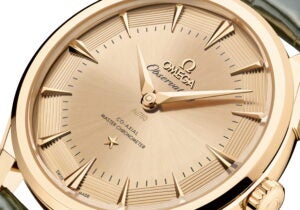
The collection is back – and sharper than ever.

At the start of the 1950s, Omega was quite a different company to the one we know today. It had yet to release the Speedmaster, Railmaster and Seamaster 300 – the trilogy of icons that arrived in 1957. The Seamaster existed, having been launched in 1948, but was a much more delicate number – more suited to mastering, or maybe just observing, the sea at a safe distance than venturing beneath the waves.
That’s not to say Omega hadn’t learned to make resilient watches — it had been the largest single supplier of watches to the British armed forces during World War II — but the great tool-watch boom of the late fifties and early sixties had yet to happen. Omega’s real calling card was accuracy: back then, the most ambitious watchmakers submitted their best timepieces to observatories in Kew, Geneva and Neuchatel for rigorous testing. Known as chronometry trials, they produced league tables of precision, and in a world long before the dawn of electronic or digital clocks, that meant something.
Omega had set multiple records at the trials since 1919 (and would go on to do so until they ended in the early 1970s). It had offered many chronometer wristwatches for general consumption, but had been slow to adopt automatic winding — something it rectified in 1948 with a special edition automatic chronometer to mark its centenary. It went down rather well, and the brand realised it needed something similar in its permanent collection. Hence, in 1952, the Constellation was born.
Named after the connection with the observatories responsible for carrying out the trials (astronomical activity was their primary role, as the name implies), the Constellation bore a medallion-style engraving on its caseback with a picture of the Geneva observatory underneath a starry sky. The collection became Omega’s flagship model, and as well as honoring precision, it embodied 1950s glamour, with faceted hour markers, a so-called ‘pie-pan’ dial (thought to resemble the underside of a cooking dish) and stylish lugs — often paired with extravagant gold bracelets.
Now, after 74 years, Omega has revived the original design in a new collection called the Constellation Observatory. Spotted by keen-eyed instagrammers on the wrist of Delroy Lindo at the Oscars this year, it certainly channels the elegance and opulence of the original – particularly in the all-gold iteration sported by Lindo, which pairs a yellow gold case and dial with a matching, textured ‘brick-pattern’ gold mesh bracelet. Other versions of the 39.4mm watch include three stainless-steel models with coloured dials, and references in pink gold, white gold and platinum, alongside a stainless-steel entry-level piece, with a black ceramic dial and rhodium-plated indices.
The Constellation Observatory builds out Omega’s dress-watch offering in response to current tastes and trends, but it is also faithful to its forebear when it comes to accuracy. Since 2015 Omega has worked with METAS, the Swiss institute of metrology to certify its watches as ‘master chronometers’, a standard it developed with METAS and opened up to the entire industry (to date, only Tudor has come on board). Over the intervening decade, Omega has rolled out master chronometer status to nearly all of its mechanical watches, but certifying the Constellation Observatory presented a stumbling block.
Typically, the method of assessing a watch’s accuracy involved taking precise photographs of the seconds hand at set intervals and comparing its position against what would be expected. The Constellation Observatory, in the style of a classic 1950s dress watch, does without a seconds hand entirely, so Omega needed to come up with a new method of testing. The result was an acoustic sensor which listens to the tick-tock of the watch throughout its entire 25-day testing process (during which the watch is subjected to changes in temperature, atmospheric pressure and position). This provides not only a more complete picture of the watch’s accuracy but pinpoint analysis of when and why any deviations occurred.
It might seem anachronistic, to say nothing of philosophically intriguing — how accurate do you need your watch to be when it can only measure to the nearest minute? — but it’s indicative of Omega’s persistence and determination that no matter what it will be used for, there should not be a single watch in its range that fails to meet its standards. So if you’re late for the Oscars, or whatever your next gala might be, you’ll only have yourself to blame.
Добавить комментарий