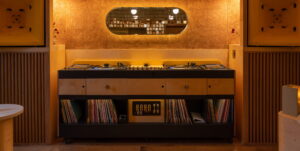
From London to New York, listening bars became a global blueprint for immersive sound.

“Listening bars are a reaction to people wanting to really re-engage with music,” Paul Noble, founder of Spiritland (one of the first venues in the UK to adopt the Japanese concept) tells me.
The idea dates back to the 1920s, when ongaku kissa, or ‘music cafes,’ began playing classical and jazz music, both as an escape from urban life and as part of a wider fascination with Western culture. By the 1950s, post-war Japan faced a scarcity of records and high-quality audio equipment, which gave rise to the pop-up of more dedicated listening bars, particularly concentrated in Tokyo’s Shibuya. Typically intimate – often with just six to eight seats – these venues were shaped by owners who were regarded as tastemakers in their own right; they curated the records (often focused on a single genre) and meticulously controlled the atmosphere.
By the 1980s, the rise of home stereos and CDs had reduced the demand for communal listening. Some venues consequently closed; others adapted and continue to operate today – a notable example being jazz kissa lion (or Lion Café as it’s now called), which launched in 1926 and is exclusively known for playing classical music.
See also: The Japanese Island You’re Not Visiting (But Should Be)
It wasn’t until the 2010s that the concept began to attract global attention, spreading to major cities like London and New York. Their Western boom was fueled by the decline of late-night club venues, a renewed interest in vinyl (and of collecting it), and a desire to recapture the “mystique, magic, and depth of engagement” that only a record can provide.
For Spiritland, Noble drew directly from the Japanese venues he had visited. “I completely fell in love with the bar culture there. It’s unlike anything in the world. I thought there must be room for this in the UK”.
Indeed, there was – although the Japanese blueprint had to be adapted for a different audience. “In Japan, it’s a very civilized environment where you sit in total silence and order [drinks] very quietly,” explains Paul. “Lots of them are open until very late – four or five in the morning – and you can smoke in them. It’s an intense listening experience [that] doesn’t translate culturally to a city like London.”
To thrive in bustling, screen-obsessed cities with shorter attention spans, the listening bar concept required a rethink. Noble notes that the essentials – vinyl-led programming, high-end speaker systems, and above all a “deep respect for music” – remain sacred, but are now often paired with design-led interiors and curated drinks menus. And crucially, unlike the original Japanese bars where even the slightest whisper could earn you a scolding glance, you can talk, laugh, even gossip freely.
See also: Sakura Season Is Brief – These Are the Drinks to Try While It Lasts
“When we opened a listening bar in London, it took some explaining – people would come in and ask, ‘Why are there tables and chairs in the middle of the dance floor?’” he recalls. “But the reaction has since been incredible.” The types of guests who visit, he says, are “egalitarian,” drawn primarily from creative industries – music, film, fashion, and tech. “These are all sectors with a musical thread running through,” he notes.
In the same way Japan’s original listening bars had carefully curated atmospheres, Noble, who worked in radio for 20 years, brought the same approach to Spiritland, which opened its first permanent venue in King’s Cross in 2016. “We have a record book where two days per week, guests can select any album from our collection for us to play,” he says. “Other than that, we don’t take music requests.”

Drinks, too, have become a defining feature in the evolution of listening bars, compared to the original venues where beverages were minimal and purely functional. At Spiritland, the drinks list is “straightforward, removing any novelty factors,” allowing the focus to remain on the experience. As Noble explains, the aim isn’t to “jazz anything up” artificially, but to let the drinks, like the music, speak for themselves.
Listening bars worth visiting
Public Records, New York
Public Records offers a distinctly New York–style experience, modern, immersive, and designed to cater to every kind of music fan. There’s multiple rooms, each with its own vibe, and the venue has carefully-curated program that brings together DJs, producers, and live acts,
Brillant Corners, London
Dalston’s Brilliant Corners, founded in 2013 by brothers Amit and Aneesh Patel, has earned a cult following for its impeccable audiophile setup, vinyl DJ sets, and a menu of izakaya-inspired dishes paired with natural wines. The venue features iconic 1970s Klipschorn speakers and plays a roster of music genres: jazz, house, experimental, and more.

Bar Neiro, Berlin
At Bar Neiro, music is played exclusively on vinyl, blasted out of a custom-built sound system made of vintage hi-fi components. The cocktails have been developed in-house, inspired by Japanese bar culture.
Eavesdrop, New York
Eavesdrop’s ethos is rooted in its community of listeners, artists, and curators, fostering an environment where listening takes precedence over dancing. Warm wood paneling and a thoughtfully arranged collection of bar stools complete the space.
Her, Melbourne
Taking walk-ins only, the Music Room at Her is Australia’s answer to the modern listening bar. The intimate, soundproof space hidden attracts a young, trendy crowd – it’s not hard to see why.
Добавить комментарий