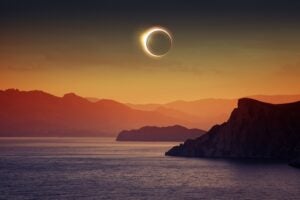
The country will be one of the best places in the world to experience the 2026 eclipse’s concluding moments.

Spain is preparing for a rare celestial spectacle: a sequence of three solar eclipses over the next few years that astronomers have dubbed the ‘Iberian Trio.’ The country will be one of the few in the world where two total eclipses and an annular eclipse are all visible within such a short period, offering keen astrology travelers a once-in-a-lifetime opportunity.
Total solar eclipses are exceptionally rare at any single location, and Spain will hold the unique distinction of being the only country worldwide where the final phase of a total eclipse can be observed. Occurring in the summer months, these eclipses also benefit from a higher likelihood of clear skies, ensuring optimal viewing conditions.
See more: Astrotourism: The Brands Taking Travelers Out of This World
What is a solar eclipse?

A solar eclipse occurs when the Moon passes directly between the Earth and the Sun, temporarily blocking some or all of the Sun’s light. During a total solar eclipse, the Moon completely covers the Sun, briefly turning day into night and revealing the Sun’s faint outer atmosphere, known as the corona. Observers see a progressive sequence as the Moon gradually obscures the solar disk, and, after the dark ‘moment of totality’, the Sun reappears as the Moon moves away.
A partial solar eclipse occurs when only part of the Sun is covered, while an annular eclipse, sometimes called a ‘ring of fire,’ happens when the Moon is slightly farther from Earth and appears smaller, leaving a bright ring of sunlight around its silhouette.
Experts stress the importance of safety: never look directly at the Sun during any eclipse without certified filters or eclipse glasses, as ordinary sunglasses do not provide adequate protection.
When will Spain’s solar eclipses be visible?
The Iberian Trio will unfold during the summers of 2026, 2027, and 2028. The first, on August 12, 2026, is a total solar eclipse – the first visible from the Iberian Peninsula in more than a century.
Where is best to view Spain’s solar eclipses?

Occurring at sunset, the path of totality will sweep from northwest Spain eastward, starting in Galicia, where A Coruña will witness the eclipse at 7:31 pm, and continuing across northern Spain to the Balearic Islands at 7:38 pm. Thirteen autonomous communities lie along the path, including Oviedo, Santander, León, Bilbao, Zaragoza, Valencia, and Palma.
In these regions, the sky will briefly darken to twilight, and the Sun’s corona will become visible, while observers outside the path of totality will see a deep partial eclipse. For the clearest view, it is best to choose a location with an unobstructed horizon, free from buildings, trees, or mountains.
The second eclipse will take place on August 2, 2027, this time visible across southern Spain, including Cádiz, Málaga, and the southernmost regions such as Ceuta and Melilla.
The series concludes with an annular eclipse on January 26, 2028, when the Moon will appear slightly smaller than the Sun, creating a dramatic ‘ring of fire’ effect visible across much of Spain.
Добавить комментарий