
Is it ego, completism, or a thirst for legacy? Is it a need to curate and to seek order amid the chaos? Or do we just like beautiful things? Aleks Cvetkovic analyzes the drivers behind an age-old desire.

For Noah Wunsch, a 36-year-old New Yorker, collecting is in his blood. His late grandfather was E Martin Wunsch, an engineer and prolific collector who accumulated more than 700 pieces of early American furniture, paintings, silver, ceramics, and folk art. These now form the core of the Wunsch Americana Foundation, which lends historical objects to museums and funds educational initiatives across the United States.
Wunsch himself collects contemporary design, furniture, and photography (he’s drawn to Robert Mapplethorpe, Nan Goldin, and Ryan McGinley, among others), and his motivations are layered. Collecting, he says, is about “cultivating a taste and aesthetic and kind of a worldview,” but also “an excuse to learn more and to follow my curiosity.” There is pleasure, too, in the chase: “If you feel like you’ve gotten one over on the market, it’s really exciting,” he admits.

Why do we collect things that are rare and precious, then? What motivates collectors to spend thousands, or millions, shaping troves of inanimate and sometimes bizarre objects across a lifetime? Is this an articulation of self, a bid for status, a form of custodianship, or simply a sophisticated way of keeping score?
According to author Luke Burgis, whose forthcoming book The One and the Ninety-Nine explores what it means to shape a stable identity in today’s fractured and noisy world, the need to collect has multiple drivers: “One bad, one neutral, and one good.”

“The bad motivation is mimetic warfare, driven by the need to acquire a certain sense of identity,” Burgis explains. “Once basic needs are met, desire doesn’t disappear; it just gets weirder. We start competing for rivalrous totems — objects that signal discerning taste or absolute status.”
Attend a major auction of rare objects or fine art and the combative atmosphere can often feel tangible. Record prices continue to be reached. In the theater of an auction room, it’s easy to see how collecting can become competitive or performative.
But Burgis is careful not to moralize too quickly. His ‘neutral’ driver for collecting is simply an acknowledgment of how capital behaves. There are four levers around wealth, he says: save, invest, consume, or give. “People often pathologize luxury consumption, but for someone with a massive balance sheet, a $50,000 watch isn’t an excess, it’s a rounding error. A billionaire buying a $1m vintage Ferrari isn’t any more mimetic than a minimum-wage employee buying an Apple Watch or taking out a high-interest loan for a Tesla just to look the part.”
See also: This Dutch Collector Turned His Home Into an Incredible Fossil Museum
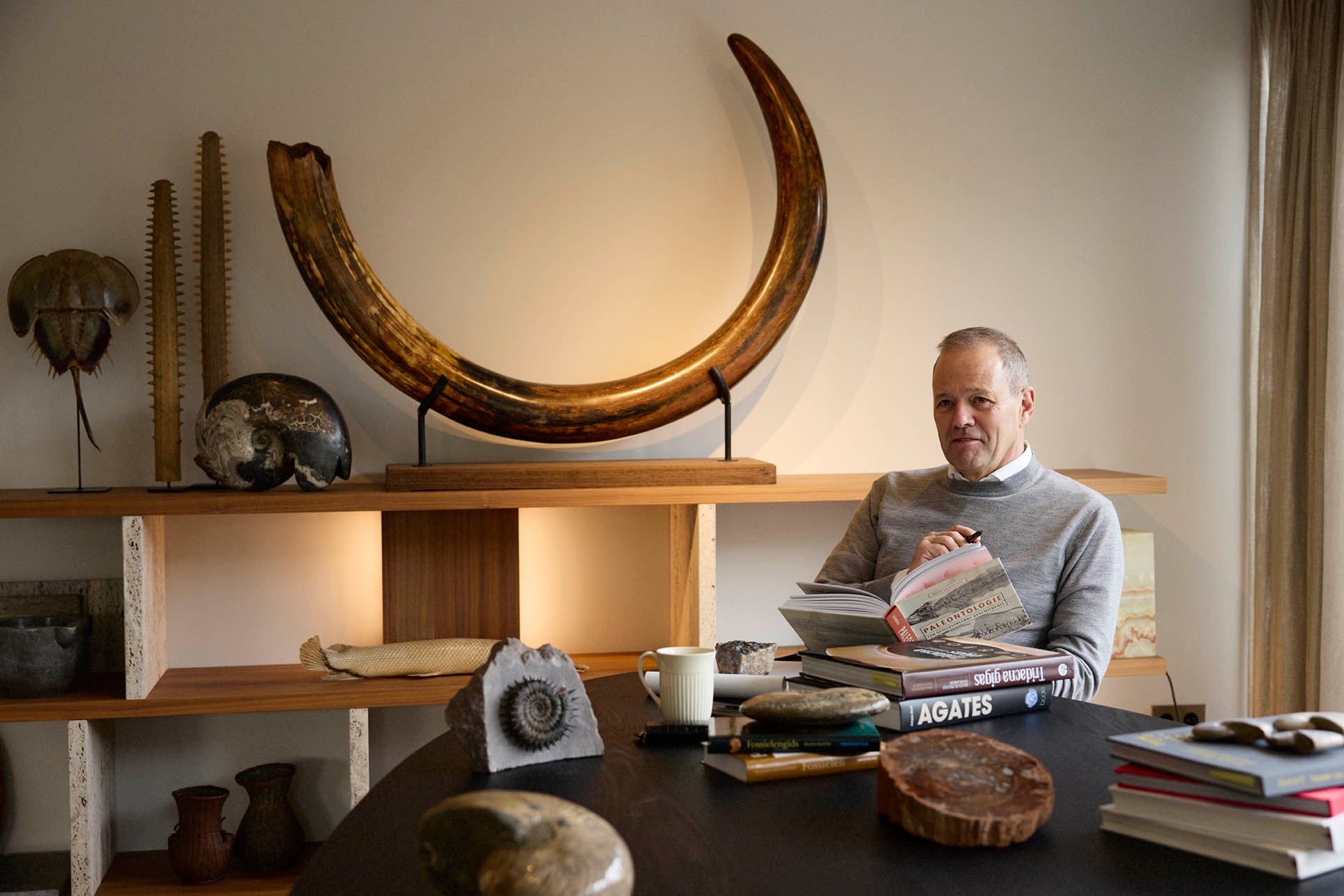
What differentiates collecting from consumption, then? Burgis’s answer lies in his ‘good’ motivation. “The good version of this is cultural stewardship,” he says. “The best reason to collect is to play an anti-mimetic role in the creation of culture. By acquiring a masterpiece or a generational timepiece, the collector stops being a consumer and becomes a steward.”
This idea resonates strongly with Mark J Bevington, an art collector based in Toledo, Ohio, who has quietly assembled more than 200 works, largely by emerging or under-recognized artists. He describes himself as an intuitive collector. “Most often, it clicks and I feel it,” he says. “Usually, I am responding to a work that gets me in the gut.” For him, collecting is “ultimately about fun,” but also about responsibility. “I see myself as part of the art-world ecosystem whose main elements are the artists, the collectors, the galleries, the institutions, and the auction houses.”
The art of collecting
Legacy, in Bevington’s mind, is measured less in market terms than in human ones. “A great legacy for me would be doing my part in supporting the art ecosystem generally and having an impact in enhancing the art ecosystem in my own community,” he says. After years of collecting, what it gives him now is “a sense of community” — friendships formed through shared passion rather than shared assets.
That sense of collecting as a practiced skill, rather than passive indulgence, is echoed by cultural strategist and author of The Sociology of Business newsletter, Ana Andjelic. Collecting, she argues, is something actively learned. “Collectors have their own lexicon, tools, and resources — communities they belong to, knowledge and information that grows over time. It’s a practice that gets refined, exercised, communicated, criticized.” The pleasure lies, she says, not just in ownership, but in mastery. “Like training one’s ear in music, this is training one’s eye, taste, and knowledge.”

For Geneva-based gallerist and art advisor Thea Montauti d’Harcourt Lyginos, collecting also evolves over a lifetime. “It’s probably a bit of both,” she says, when asked whether people collect to define themselves or to signal to others. “When collectors are younger, their choices can reflect inheritance, family taste, or the path set by the generation before them. As they grow and mature it usually becomes far more personal — an expression of their own eye, values, and identity.”
Living with objects, she adds, alters the psychology of collecting. “Once a work is on your wall it becomes part of your daily life,” she says. “The strongest collections are built without rigid strategy but through emotion — if a work truly moves you, it will likely move others in the future as well.”
This emotional attachment sits comfortably alongside the idea of custodianship. For Benoît Repellin, worldwide head of jewelry at Phillips, stewardship is central. “True collectors see themselves as temporary stewards of cultural patrimony, preserving objects for future generations,” he says. Increasingly, provenance, craftsmanship, and historical resonance matter more than brand names alone: “Pieces with documented heritage or that encapsulate a moment in time resonate deeply.”
Repellin acknowledges, of course, that competition remains part of the picture — “rarely does competition not shape the outcome,” he adds. But, even here, rivalry often reflects collective reverence, more than simple status-seeking — a shared recognition among the collecting cognoscenti that certain objects matter.

An exercise in judgment
Ultimately, collecting as a discipline sits at the intersection of personal ego and cultural meaning. Burgis puts it more plainly. Collecting, he says, represents “a primal human need for order and dominion […] we are all just trying to organize the chaos and leave a mark before the lights go out.”
Do collectors shape a collection with a view to completing something? In theory, maybe. Wunsch’s favorite photographer is Paul Graham and to own every image from his End of an Age series would be a dream come true. “If I can get every photo […] then I can probably stop,” Wunsch says, before conceding, wistfully, “but I don’t think I’ll ever be able to do that.”
Perhaps, then, in our ever-more-disposable society collecting, at its core, is an exercise in judgment — a personal decision about what deserves recognition for its rarity or beauty, and what, ultimately, deserves to endure.
Добавить комментарий