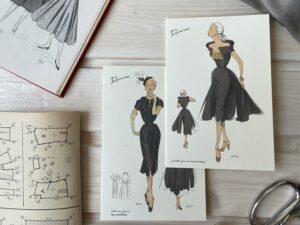
Two illustrators reflect on the art as machine-made imagery becomes part of the design process.

Fashion illustration has never simply been about recording clothing. Before photography, it was the main way fashion designers communicated ideas and how the public encountered new styles of dress, through early printed journals in 17th-century France and England.
But photography did not erase illustration. In many ways, it freed it. Once it was no longer bound to accuracy, in the 20th century, illustration moved toward stylization, abstraction, and interpretation, giving rise to some of the artform’s most recognizable names such as René Gruau, Erté, and Antonio López.
Fashion illustration occupies this unusual position in the industry as somewhere between design tool and cultural expression. “Fashion illustrators don’t design clothes; they help sell the dream,” is how Elyse Blackshaw puts it. As the London-based illustrator explains, in practice, that “dream” is rarely about garment detail but capturing a designer’s vision, whether through movement, mood or atmosphere.
And yet, it is precisely this interpretive, human quality that is now being tested by the rise of AI-generated imagery.

A growing number of platforms – including LOOK AI, a browser-based system that converts sketches into rendered garments, fabric simulations, and flat-lay imagery – position themselves as accelerators of the design process. They promise speed, iteration, and accessibility. But while LOOKAI maintains “final technical drawings and construction still require human oversight”, as Blackshaw warns, perception often moves faster than disclaimers.
For many illustrators like Blackshaw, that gap between assistance and replacement is less reassuring than it appears. Jacqueline Bissett, who has worked in fashion illustration for nearly four decades, is direct in her response to AI-generated imagery. “I hate it – it’s so flat and lifeless,” she says.
Blackshaw frames the unease differently, but no less sharply. “My biggest concern is opportunity, especially for emerging creatives,” she says. If brands begin to default to AI for speed and cost, the entry points that traditionally sustain young illustrators begin to narrow. The impact is not only fewer commissions but a thinning of the wider industry: fewer routes into publishing, editorial work, and brand collaboration, and ultimately a narrowing of visual culture itself. “AI is trained on existing imagery, which means it often reinforces the same aesthetics,” she adds. What emerges, she suggests, is repetition rather than invention.
Still, neither illustrator positions the technology as purely antagonistic. Blackshaw acknowledges that AI can serve a functional role, particularly in early ideation or administrative efficiency. But she contends that benefit within wider concerns, such as environmental cost and ethical ambiguity.
What AI cannot replicate, both argue, is the embodied nature of the work itself.

“Fashion illustration offers something that AI simply can’t replicate: a real human, emotional, spontaneous response,” Blackshaw says. It is not only the image that matters, but the conditions under which it is made – the immediacy of a live runway sketch, the unpredictability of movement, the atmosphere of a room, the presence of an audience. For Bissett, that dimension is inseparable from performance. “Working spontaneously in person – AI could never do that,” she says.
“Every mark made holds history and memory,” Blackshaw says. It is this accumulation of training, observation, repetition, and lived experience that gives real-life illustration its emotional density. Increasingly, it is also what clients respond to. Even within a digitally saturated industry, Blackshaw notes that hand-drawn work is often chosen over more polished or enhanced versions precisely because of its irregularity. Imperfection, in this context, reads as authenticity.
So where does fashion illustration go from here?
Neither illustrator predicts decline. Historically, moments of technological disruption have not erased illustration but recalibrated it. Photography did not end it; computers did not either. “It just pushed me to be better,” Bissett says of earlier shifts in the industry. Blackshaw is similarly optimistic, albeit cautiously so. If AI becomes visually ubiquitous, she suggests, human-made illustration may become more valued, not less – precisely because it resists automation.
Добавить комментарий