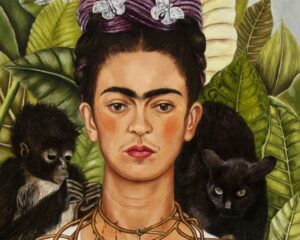
Tate Modern’s record-breaking exhibition and restaurant KOL have joined forces to offer their own interpretation of Frida Kahlo.

«Everyone grew up hearing about the love story between Frida Kahlo and Diego Rivera,» chef Santiago Lastra tells the room full of diners in the upstairs restaurant of London’s Tate Modern museum, who have just emerged from viewing Frida: The Making of an Icon. «They were the epitome of cool to a Mexican teenager.»
It’s an interesting way to open a meal, particularly given that much of Tate’s exhibition is dedicated to separating Kahlo away from her toxic and tumultuous relationship with the Mexican mural artist (they married twice), whose fame eclipsed her own during her lifetime. Instead, it seeks to examine how she became one of the world’s most recognizable cultural figures in the decades after her death.
My own introduction to Kahlo was similarly not through her paintings, but through the stories and iconography churned and left behind posthumously. Firstly, through her caricature-like reproductions, reducing and rendering her face to the monobrow, flower crown, and scarlet lipstick adorning everything from notebooks to tote bags. Then she would reappear as a feminist icon, a queer icon, and an artist whose chronic illness and injuries resonated with disabled communities. Somehow, one woman has become all of these things at once.

That impossible balancing act is exactly what Tate sets out to examine. Rather than offering another chronological survey of Kahlo’s paintings, it uses fewer than 30 works by the artist herself among more than 200 objects to examine how she became «Frida» – the cultural icon adopted by artists, activists, fashion, and commerce alike. Whether it achieves that has been lukewarmly received by some critics, but perhaps expectations were always skewed. Marketed with record-breaking pre-sales, many visitors will arrive anticipating a blockbuster retrospective of Kahlo’s paintings, rather than an exhibition about her afterlife.
The exhibition begins with the carefully constructed image Kahlo cultivated herself on the canvas and in front of the camera, before moving through the artists, activists, and communities who adopted her. Visitors eventually arrive at «Fridamania,» the commercial empire of Barbies, plush dolls, and devotional objects that turned an artist into a brand.
It’s an ambitious premise for Tate. Still, an open diary, childhood photographs, selections from her wardrobe, early sketches, and intimate family portraits reveal someone far removed from the flattened iconography that followed her death. Even the photographs – so often overshadowed by her paintings – become reminders that Kahlo was never simply the subject of images but an active architect of herself.

Yet the exhibition never quite escapes the paradox it sets out to examine. The final room, packed with merchandise and artistic appropriations, questions how the image of a forthright communist became a global commodity beyond her control. But as visitors immediately file directly into the Tate gift shop, stocked with the same able-bodied dolls, apparel, and simplified children’s books, the critique begins to fold in on itself.
If the exhibition occasionally feels muddled, that’s partly because its subject is too. Kahlo’s afterlife resists neat categorisation, and while the Tate can’t seem to entirely separate the woman from the myth, it makes you wonder whether anyone can.
Which is precisely the challenge facing Lastra upstairs. If an exhibition spanning hundreds of objects struggles to distill Kahlo into a single narrative, condensing her life into a five-course tasting menu might seem an even more daunting task.
See also: The Fascinating Marilyn Monroe Exhibition You Won’t Want to Miss

Born in Mexico City, Lastra has long explored the tension between authenticity and reinterpretation. At KOL, he translates the flavors of his home country through British ingredients, rewarded by becoming the first, and so far only, Mexican restaurant in the UK to win a Michelin star.
«Her favorite dish was mole,» Lastra tells diners. «It was her favorite because it was her husband’s favorite.» He recounts how Kahlo learnt to cook the sauce from Rivera’s first wife, Lupe Marín, even something as comforting as a family recipe becomes tangled in the complicated web of their relationship. But Lastra’s own version, a dry-aged duck served with a deeply savory koji mole and a corn tortilla, is rich and complex, too, enough to justify the story attached to it.

KOL’s signature langoustine taco is upgraded with caviar – an indulgence, Lastra jokes, he’s always wanted to serve but could never justify in his own dining room. Now backed by Tate rather than restaurant margins, he finally can. The short rib quesadilla, served on the bone beneath a generous shaving of truffle, borders on theatrical. Then again, so did Kahlo.
Not every dish quite lands. Thinly sliced tomatoes and small cubes of soft scallops form a bed for a painted blue tostada. Inspired by Kahlo’s and Rivera’s Casa Azul house in Mexico City, the corn taco is brushed with a thick layer of red cabbage, designed to change color with the addition of lemon from blue to pink – though I would say it’s closer to a shade of violet.

The meal ends with Viva la Vida, a take on Kahlo’s final painting constructed from tri-colored ice cream of yoghurt, sorrel, strawberry, and chamomile flavors, forming the pattern of watermelon. Another neat symbol for a woman who has been reduced to symbols all her life.
Neither the exhibition nor the menu quite succeeds in pinning Kahlo down. But, whether intentional or not, they make a convincing case that she was never meant to be.
KOL at Tate runs on 29 July and 30 July 2026.
Добавить комментарий