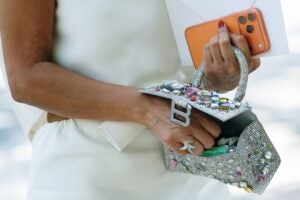
Research suggests Gen Z women are leaving handbags at home – so what does this mean for luxury fashion?

We’ve had girl dinner, girl math, and now there’s even a coined phrase for how women carry their belongings: girl grip. Dictionary.com defines the internet slang as «holding multiple items in one hand by grasping them between fingers» – but perhaps this skill (if you can call it that) for precariously juggling bank cards, headphones, sunglasses, and an iced matcha is less a meme than a sign of changing habits.
Research from Echo Falls found that almost a third of Gen Z women are going on nights out without a handbag, while 44 percent of under-30s described the accessory as «old-fashioned.” The age-old hunt for lost treasures at the bottom of a bag – the frantic fumble for Rolls-Royce keys, Dior lip balm, or whatever else has disappeared into the abyss – is no longer a ritual this generation is keen to embrace. Instead, essentials are being tucked into blazer pockets, phone cases, and anywhere that doesn’t require a full excavation.
Why so? According to fashion stylist Oriona Robb, “the problem that handbags solved has shrunk.” She affirms that “Gen Z grew up watching their phones become their wallet, their camera, their ID. A handbag was originally a solution to carrying things you couldn’t fit in your clothes, and now half of what used to live in a bag lives in your pocket instead.»
The past decade has also seen womenswear embrace oversized silhouettes, utility dressing, and menswear-inspired tailoring. Silhouettes borrowed from menswear have also brought with them something women’s clothing has historically lacked: genuinely useful pockets.
«When womenswear borrowed tailoring, utility, and cargo details from menswear, it borrowed the pockets too – and pockets are liberating,» Robb explains. «Function is finally catching up to a silhouette shift that’s been building for years.»
See also: Is Androgynous Dressing Suitable Cocktail Attire?

Yet declaring the handbag dead feels premature. If anything, luxury’s appetite for exceptional bags has only intensified. Hermès Birkins and Kellys continue to command eye-watering prices on the secondary market, while brands from The Row to Alaïa and Miu Miu have proved that climbing to the top of a waiting list can be just as desirable as the bag itself.
«These aren’t opposing trends; they’re the same trend from two angles,» notes Robb. «The handbag is moving from utility object to status object. You carry less day to day, but when you do carry a bag, it’s the bag – the Birkin, the Kelly, the piece that signals taste and access.
“Scarcity makes it more desirable, not less,” adds Robb, which may be why the conspicuous consumption once signalled by an It bag has, for some, given way to the quite obvious performance of effortless minimalism.

The most surprising twist, though, is that as younger women become more comfortable leaving theirs at home, men have never been more enthusiastic adopters. Designer totes, cross-body bags, and even traditionally feminine silhouettes have become commonplace in menswear. Jacob Elordi rarely seems to leave home without a Bottega Veneta bag (or three) slung over his shoulder, Timothée Chalamet has developed a taste for Hermès Kellys, while footballers like Erling Haaland have a handbag collection so extensive to even comment on without growing envious.
«Men are entering the accessory conversation just as women are stepping back from needing one daily,» says Robb. «Luxury has always been about signalling, and as menswear becomes more expressive, bags are simply the newest canvas for that.»
Добавить комментарий