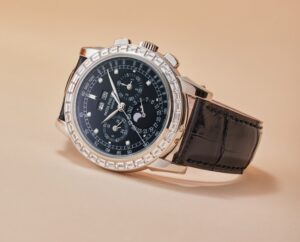
Collectors are increasingly embracing timepieces as a form of art, as an asset class, and as signifiers of taste.

“We’re selling passion – not a widget.”
So says Geoff Hess, Sotheby’s Global Head of Watches and Senior Vice President. He would know: after serving as CEO of Analog:Shift – now the pre-owned and vintage division of Watches of Switzerland – and later working at Phillips before joining Sotheby’s, Hess has handled more watches than most people will encounter in a lifetime.
There is certainly no shortage of that passion today. The pandemic, which redirected disposable income from experiences toward hard goods, brought a wave of younger buyers into watch collecting – though not always for the purest reasons. As the opportunistic frenzy of the pandemic years has subsided, however, many collectors see the market returning to healthier footing.
“I think there’s a bit of a sigh of relief in the watch community that so much of the speculative buying that we saw during the pandemic era has largely dissipated. It became commonplace to see people buying more for investment than passion. We’re seeing very little of that now and it’s such a joy,” says Hess.
See more: How a 28-Year-Old Collector Built One of the Rarest Vintage Patek Philippe Collections

But why buy a watch at auction in the first place? Aren’t these commercially available products – commodities, even – manufactured in large numbers across Switzerland, Germany, Japan, and elsewhere?
Sometimes they are. As you’ll know, watches such as the Rolex Submariner, now in production for more than 70 years, or Omega’s Seamaster and Speedmaster, introduced in 1948 and 1957 respectively, have been produced across decades. Yet unlike other manufactured goods, collectors prize the subtle production differences that distinguish one era from another. Tiny changes in dials, bezels, movements, or cases can transform an otherwise familiar reference into something genuinely rare, helping propel the vintage watch market to remarkable heights.
Alongside vintage watches, collectors have increasingly embraced another category: high-end independent watchmakers producing small numbers of timepieces in workshops staffed by only a handful of craftspeople – or, in some cases, a single watchmaker.
See more: The Psychology of Why We Collect

“With this newfound heightened focus on independent watches, people aren’t buying for speculative reasons,” says Hess. “Look at what happened with [independent makers] F.P. Journe and Rexhep Rexhepi and Simon Brette. People are buying these watches because they appreciate the craftsmanship, how movements are finished. They’re enjoying developing a relationship with the watchmaker and taking a deep dive as opposed to, ‘I’m going to buy the hype watch I saw on Instagram and flip it.’ As much as I love Rolex, I’m never going to meet the watchmaker that assembled my watch. It’s very unlikely that I’m going to be able to customize a dial in a way that you can with respect to an independent watchmaker.”
Those relationships extend beyond the watchmaker to the auction house itself. Hess agrees that there are parallels to collecting fine art: the more informed the buyer, the better the experience.
“The categories are similar in that these are expensive purchases – watches are growing more and more expensive as a category. And to some degree, the same lessons apply in that it’s helpful to have a relationship with a watch specialist. Auction houses are, in general, very happy to be transparent and share photographs and images and videos. I would certainly always suggest that somebody read the catalog, know what you’re buying. And I would also suggest that you do homework in advance. It helps to be educated.”
See more: Meet the Man Creating Custom Diamond Jewelry for the Rich and Famous

As to which brands and pieces Hess believes are important today, he tends to put less of an emphasis on true vintage (watches that date to before, say, the late 1980s) and more on neo-vintage Rolex, Cartier, and Patek (watches made between the late 1980s and early 2000s) and high-end independents.
“I think there’s a heightened focus on independence and craftsmanship. A newer collector buying independent watches might be looking for the ‘rookie card’ of those brands, which may be why, with respect to F.P. Journe, for example, we’re seeing these enormous prices for very early examples – the souscription models or even brass-movement models. These are commanding a premium because I think they’re becoming the new aspirational pieces. They’re becoming a bit of a goalpost for a younger collector.”
As for those with some more cash to spend – someone who’s been in the game for a while, or whose taste runs more classic? “This [emphasis on neo-vintage] doesn’t mean that prized vintage watches aren’t incredibly attractive and in demand. If Sotheby’s has a Patek Philippe ref. 2499 or a ref. 1518 perpetual calendar chronograph, there are going to be buyers. But we’re seeing more and more people attracted to this notion of neo-vintage sapphire-crystal watches and independents than we’ve seen in a long time. We’re seeing huge demand for [neo-vintage] ref. 3970s and 5004s. I’m seeing more people asking me for a 3970 now than an [older] 2499. It’s very interesting.”
See more: Gen-Z Buyers Are Shaping the Auction Market – and They’re Choosing Bags Over Art

Even with all this somewhat esoteric information bandied about, Hess insists newcomers shouldn’t feel intimidated by the expertise often on display in the auction room. “I do think that the watch category in the auction experience may be a little bit more lighthearted,” he says. “Watches enjoy this great sense of community. There is absolutely no reason to be intimidated. And you’re much more likely to have an enjoyable experience if you’re relaxed about it.”
That can be easier said than done when six- and even seven-figure watches regularly cross the block. Yet Hess argues that acknowledging watches as financial assets need not diminish the passion behind collecting.
“These are certainly expensive assets in general. As a result, it’s very fair for a collector to ask: ‘If I need to sell it or I want to sell it – maybe I want to trade up – is there a market for it? Am I going to be able to sell? Is this a safe place to put money?’ I would submit unequivocally that they are. And that’s why when people ask me if it’s a bubble, I say I don’t think it is. I think it’s the beginning of something really amazing. I think we’re at the very early stage of a serious period of growth where more and more people are discovering watches.”
See more: Can Billionaire Collections Keep the Art Market Alive?
Добавить комментарий