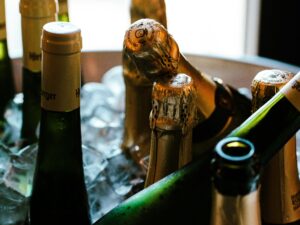
With frost, drought, and lower yields shaping the 2026 harvest, collectors are already wondering whether fewer bottles will make for a future classic.

Christmas. Weddings. Birthdays. A promotion or even just a bad day at the office. Is there an occasion that isn’t made better by the accompanying pop of a Champagne bottle? But what happens when there are fewer bottles to celebrate with?
Champagne is preparing to produce around 250 million bottles from its 2026 harvest, the region’s lowest commercial yield excluding the pandemic-disrupted 2020 vintage. Collectors tend to like scarcity, but Champagne is not your typical one-off Hermès Birkin bag or prized vintage Ferrari.
«The size of the vintage is not the prime influence in shaping demand,» says David Williams, deputy editor of The World of Fine Wine. «Quality – or a perception of quality – always comes first.»
Unlike almost anywhere else in the wine world, champagne growers and houses collectively decide how much fruit can be released to market each year, balancing expected demand with existing stock levels as well as what the vineyards have actually produced. The system is designed to protect the long-term health of the region rather than maximise production in any given year.
The Comité Champagne, which represents more than 350 houses and 16,000 growers, described this year’s decision as a way of gradually rebalancing stocks while preserving both quality and the economic viability of producers. It’s a model built around consistency rather than reacting to one particularly good (or bad) growing season.

That isn’t to say 2026 has been an easy one. Frost early in the season was followed by June heatwaves and the onset of drought. In April this year, the Comité Champagne reported that around 40 percent of buds had been lost to frost in some areas, while harvest is expected to begin between August 20 and 25 – roughly two weeks earlier than historical norms.
Marketable yields have fallen steadily in the past four years, down nearly 17 percent from the 12,000kg (approx. 13.2 tons) per hectare cap in 2022 to 8,800kg (approx. 9.7 tons) today. And earlier harvests and increasingly unpredictable weather are becoming all too familiar features of the growing season. If one difficult vintage can be dismissed as bad luck, four in succession begins to look more like a pattern.
However, if history has taught the region anything, it’s that a bad growing year doesn’t automatically produce a bad bottle – 2012 being a case in point. Frost, hail, disease, and relentless rain made it one of Champagne’s most difficult growing seasons in decades. Today, however, many of the wines are among the region’s most sought-after, thanks to careful vineyard management, rigorous fruit selection and favourable conditions later in the season.

Although collectors ready to place their 2026 preorders should proceed with caution, because even the experts know to be wary of making predictions before the wines have reached the cellar.
«High-end vintage champagne spends a long time aging before being released, a period during which market conditions are subject to enormous change,» says Williams. «The World of Fine Wine has just conducted a tasting of the 2019 vintage. Those grapes were picked in what feels like a completely different economic era, before Covid and before the geopolitical and economic uncertainty that has since reshaped the fine wine market.»
See also: After Orange Wine, What Is Gen Z Drinking Next?
«I would be a brave person indeed willing to predict what kind of market conditions await the 2026 vintage when it comes to market in the 2030s.»
By the time the 2026 vintage reaches collectors’ cellars, today’s headlines about weather forecasts and predictions will have been replaced by conversations about quality. Whether fewer bottles ultimately make the vintage more collectible will depend on far more than this year’s production figures.

That’s where Champagne’s collective approach becomes particularly important. By adjusting yields in line with demand rather than simply responding to what the vineyards produce, the region is attempting to protect something more valuable than a single vintage: its long-term reputation.
As David Chatillon, president of the Union des Maisons de Champagne and co-president of the Comité Champagne, puts it, the model allows Champagne to adapt to changing market conditions «without losing sight of what matters most: preserving the appellation’s value over the long term.»
Добавить комментарий