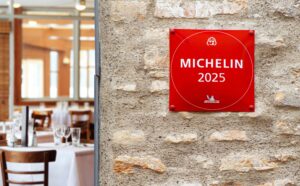
We reveal how restaurants achieve three-star status, as well as who decides to award them.

The way we hear about restaurants is always changing: whether it’s from the pages of magazines or an online article, a social media suggestion or even the long faithful word-of-mouth recommendation. Yet no matter how we discover them, the standard of how we measure them has remained the same for more than a century. Enter the Michelin Guide.
Since it was first launched in 1900, the Michelin Guide has remained the benchmark for evaluating culinary excellence. The surprising story of its unlikely origin has bounded around the internet and dinner party tables for some time, going as so: the Michelin tire company launched a ranking of French restaurants to encourage people to drive more, and ergo, go through tires at a faster rate.
Yet despite its importance within the industry, the guide remains shrouded in mystery. Who decides which regions are covered? What are inspectors looking for? And most importantly, how does a restaurant get one or more of those all-so-coveted Michelin stars?

See also: Next-gen Chefs in the Michelin Guide
Despite its global expansion to become the industry staple that it is today, there are still a large number of culinary-rich countries and cities not covered – a fact often hailed as the guide’s biggest downfall. New York and Tokyo, both of which have long been considered fine dining capitals, only achieved inclusion in 2005 and 2007 respectively. It may go without saying, but if your restaurant is not in the covered region, it doesn’t matter how good the food is, you won’t be getting that star.
It’s important to clarify that restaurants are awarded Michelin stars, not chefs. There is no such thing as a ‘Michelin-starred chef’; if the head chef leaves a restaurant, the star does not go with them. That being said, the success of many of the world’s leading restaurants is synonymous with the chef at the helm, and it’s increasingly common for a star to be reminded the next time the inspectors come knocking following a big-name departure. For example, it is universally agreed that California’s The French Laundry‘s three-star status is thanks to the talent of chef/owner Thomas Keller.
See also: See Elite Traveler’s Top Restaurants Ranking Here
How are Michelin stars awarded?
The Michelin Guide still uses similar methods to rate restaurants as it did when it launched. To allocate its coveted stars, the Michelin Guide employs thousands of inspectors, who will travel around the world to sample the finest cuisine on offer. The highly trained inspectors will visit hundreds of restaurants a year in order to identify the best of the best.
Michelin inspectors are always anonymous to ensure they don’t receive any preferential treatment during their meals. Inspectors book, dine and pay for their meals in the same way as the average guest; if their experience was different from that of anyone else the integrity of the guide would be undermined. The inspectors’ anonymity is valued so highly that they are advised to not even tell their closest friends and family about their role.
Once each restaurant in consideration has been inspected, the Michelin Guide director meets with the worldwide teams for what is called ‘star sessions’ where the rating of each restaurant is debated. These sessions often last days, with each establishment considered one by one until a unanimous decision is reached. The results are then published in a country-specific guide.

What do Michelin stars mean?
Restaurants can earn a maximum of three stars (as well as some additional awards, but more on that later). Michelin quantifies one star as being “high-quality cooking, worth a stop”; two stars are awarded for “excellent cooking, worth a detour”; and finally, the prestigious three stars represent “exceptional cuisine, worth a special journey”.
Reportedly, what elevates a restaurant from two stars to three is emotion, with inspectors seeking completely unique dining experiences that last in the memory long after the meal has finished. Demonstration of a chef’s distinct style or personality in their cooking is another key criterion.
The final rating is never decided based on just one visitor or inspector. Instead, a collective of inspectors will individually visit restaurants on multiple occasions in order to ensure the quality is consistent. The rating will then be reassessed based on yearly visits, with some decisions factoring in several meals.
Although the exact criteria are kept low-key in order to avoid chefs embarking on a tick boxing exercise, it is widely known that inspectors base their selections on the quality of ingredients, culinary techniques, taste, consistency and value for money.
Crucially, the anonymous judges are instructed to take no notice of a restaurant’s décor or the service they receive when deciding the star rating. A restaurant may be stunningly fitted and the wait staff meticulously trained, but if the food isn’t up to scratch it won’t be receiving a star. Likewise, a restaurant with understated settings but exceptional food may still be eligible for the full trio of stars.
See also: A Guide to All Three-Michelin-Star Restaurants in the UK
How many Michelin star restaurants are there in the world?

Globally, there are just over 3,000 Michelin-starred restaurants, spanning more than 40 countries. The majority hold one star, with a far smaller number achieving two or three stars. While the total fluctuates slightly each year as guides are updated, Michelin recognition remains one of the most selective accolades in global dining.
While the Michelin Guide has expanded its global reach in recent years, earning a star remains a rare achievement. One-star restaurants account for the vast majority of listings, recognizing kitchens that demonstrate strong technique and consistency, while two- and three-star establishments represent a far smaller, more exclusive tier. For chefs and restaurateurs, inclusion in the guide can be career-defining, often transforming a restaurant’s international profile and placing it firmly on the global culinary map.
Are Michelin stars annual ratings?
Michelin stars are reviewed and awarded annually. Restaurants are reassessed each year and may gain, retain or lose stars based on consistency, quality, and execution. This annual evaluation is part of what gives the Michelin Guide its authority: stars are not lifetime achievements, but a reflection of current performance.
See also: Michelin Star Recipes You Can Make at Home
Who are the Michelin inspectors?
Michelin inspectors are anonymous, full-time professionals employed by the Michelin Guide. Trained to assess restaurants using strict criteria, they dine unannounced and pay for their meals like any other guest. Their anonymity is closely guarded to ensure impartiality and consistency across regions and cuisines.
What is the highest Michelin star rating?

The highest possible accolade is three Michelin stars. Reserved for exceptional restaurants worth a special journey, three-star status represents the pinnacle of culinary achievement and is held by only a small number of restaurants worldwide. In London, just six establishments have earned this distinction, including Core by Clare Smyth and Restaurant Gordon Ramsay, each celebrated for their technical precision, depth of flavour, and consistently exquisite dining experiences. Meanwhile, the US has 14 three-star restaurants.
See also: A Guide to All Three-Michelin-Star Restaurants in the USA
What is the difference between one, two, and three stars?
A one-star restaurant is recognised for high-quality cooking. Two stars indicate excellent cuisine, often defined by technical mastery and refined flavors. Three stars signify extraordinary cooking, where precision, consistency and originality combine to create an experience worth travelling for.
What chef has the most Michelin stars?
Historically, Joël Robuchon remains the most decorated chef, having held a total of 32 Michelin stars across his career and global restaurant portfolio. His legacy continues to influence modern fine dining long after his passing.
“There are many awards that I have been fortunate to receive, but the first time I received a Michelin star, with Jamin in Paris, that was very important and an incredible feeling,” Robuchon told Elite Traveler in 2017. “Michelin back then, more than 30 years ago, was really the one guide, the one measure of excellence. Receiving that first Michelin star is something I still cherish.”
See more: The Chefs with the Most Michelin Starred Restaurants
What is the most expensive Michelin star restaurant?

The title of most expensive Michelin star restaurant is ever shifting, but Ginza Kitafuku in Tokyo has a consistent reputation as one of the world’s most expensive Michelin-starred dining destinations. Tucked discreetly into the Ginza district, this three-Michelin-starred counter restaurant has an uncompromising devotion to one extraordinary ingredient: Echizen snow crab.
At the pinnacle of its offering is the legendary Echizen Crab Kiwami Course, an experience where price is dictated by scarcity of the ingredient. Guests are seated at the counter, where the crab is presented whole before being meticulously prepared using time-honored Japanese techniques.
Alternative Michelin awards
While the Michelin stars are its most famous awards, they are not the guide’s only recognition. In addition to star ratings, Michelin has also awarded the Bib Gourmand since 1957, the Michelin Plate since 2016 and most recently, the Green Star, which was first revealed in 2020.
Not to be confused as a lesser award than the star ratings, the Bib Gourmand is a separate category that recognizes excellent cooking at more pocket-friendly prices. While a price limit on starred restaurants is non-existent (despite value for money being among the deciding criteria) Bib Gourmand restaurants must offer a three-course meal for less than a certain price, which is set by local averages.
The Michelin Plate recognizes good food that is not quite of the same caliber as that served in Michelin-starred or Bib Gourmand restaurants but is still worthy of recognition. The title is awarded using the same criteria by the same judges; establishments will often enter the guide at this level before moving up based on a later inspection.
How to get a Green Michelin star

The Green Michelin star is separate from all of the guide’s other distinctions and is awarded only to those restaurants going above and beyond to operate in a way that is both ethical and environmentally friendly. Only those restaurants already in receipt of another Michelin award can receive a Green star, be it Michelin star, Bib Gourmand or Michelin Plate.
With the launch of the Green star, the Michelin guide revealed that its inspectors do not follow specific criteria in awarding the title, given that each restaurant and region have unique conditions. However, the inspectors are likely to consider several factors including whether a restaurant uses local and seasonal ingredients, food waste levels and waste management, environmental footprint, and supplier credentials.
See also: A Guide to All Green Michelin Star Restaurants in the US
Добавить комментарий