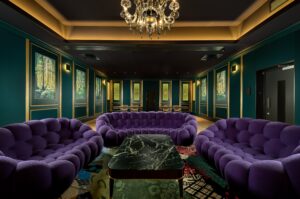
Like clubbing but don’t like the queues? Love to party but don’t like… other people?
What you need, says Helena Madden, is a full-spec nightclub in your own home.

She would attend events like Burning Man and Ondalinda with friends and party through the night, but upon returning home she kept running into the same issue. “Everything closes just when you feel like you’re about to have a great, long evening out,” she says. “And things can get messy during the wee hours of the morning at clubs — if they’re even open.” The only solution, naturally, was to design a private nightclub in her own home.
It’s not the first project of its kind that she’s been involved with recently. Kauffman is also working with a client on a screening room that can be transformed into a late-night party spot. A disco ball drops from the ceiling, and the modular, movie theater-style furniture can pivot into banquettes, leaving plenty of room for dancing. She’s attended many parties at other ‘home clubs’ too. “It’s a natural progression of private membership clubs,” she notes. “The trend comes from a desire to have complete authorship over the ambiance. So, curating the smell, the music, the drinks, and the lighting.”
Hers, for example, has a distinct creative vision. It’s currently in its very final phase of development, but has already become the go-to after-party spot for her cohort. Rather than a sprawling dance floor, Kauffman sought to create a jewel box that can fit just 12 people. The color palette balances smoky grays and blacks, with a fur carpet that allows for barefoot dancing — or a shoe shuffle in a pair of custom slippers. A trained metalsmith, she’s creating her own coasters, as well as canisters for candles. There will, of course, be a signature scent.
See also: Interior Designer Shalini Misra’s Take on Private Jets

Any club lives or dies on the quality of the sound system, and, given the nature of these venues, soundproofing is essential in order to comply with local noise ordinances and avoid disturbing grouchy family members past midnight. Kauffman chose the room for her club because the walls were solid concrete, so what happened in the club would stay in the club, sound-wise at least. In fact, noise issues were another part of the impetus. “I love to host dinners,” she says. “I live in Laurel Canyon. It’s a dense community. I would have a party outside, and people would complain.”
There are specialists who can ensure that the beats do their thing without traveling beyond your four walls. ImmersiFi, based in London, work with interior designers to ensure home nightclubs sound as good as they look. One example is a project that packed almost 50 speakers and subwoofers into a small room. The tricky part? Unlike most of these spaces, the room was upstairs, not in the basement, and the home itself was in central London.

Working with an acoustic consultant ensured that everything was soundproofed; the speakers were all concealed behind panels in the wall and ceiling. This approach allowed ImmersiFi to layer on other top-of-theline gadgets, such as smoke machines, and lighting that morphs with the mood of the music. It’s perfectly private, secluded, and replicates the feeling of a real nightclub. All that’s missing is a world-class DJ. But there’s a workaround.
“We know clients who are flying the likes of Tiësto, Diplo, David Guetta, and so on to come and perform in their homes,” says Nick Fichte, business development director at the project’s speaker manufacturer, L-Acoustics. “People don’t necessarily want to be in a club with everyone else, because a VIP area isn’t that VIP anymore.”
What if you’re a celebrity DJ yourself? Back in Los Angeles, Hollywood’s interior designer of choice, Martyn Lawrence Bullard, designed a massive ballroom for the home of drag queen and television host RuPaul Charles. “He’s become a DJ, so the large cabinet in that room actually flips open to become a whole DJ booth,” says Bullard. “He’ll practice his DJing and do his sets there; he loves to have dance parties.” The piece de resistance is the cornucopia of disco balls — more than a dozen in total — that resemble a sculptural chandelier when not in use, but spin and come to life when it’s time to party. All of the tables and chairs were built on wheels so that they can be easily rolled to the side, creating room for raving.

The DJ booth itself plays a major role not just sonically, but also visually. Designers like Bullard can even make one-of-a-kind pieces that perfectly match your nightclub’s aesthetic. In Mexico, for example, architecture and interior design firm Ten Plus Three created a custom DJ booth for a party room. The piece is clad in parchment, with a highgloss finish and acrylic accents. It’s a natural fit for the client, who also owns a recording studio. “He invites all of the artists who come to record there to his house, and they play around,” says Mauricio Lobeira, architect and co-founder of Ten Plus Three. “Many DJs have played that booth.”
The final piece that will set a nightclub apart is a good name. Kauffman has seen the trend at a number of the homes she’s visited. Hers, for a long time, was Noir, but she’s now leaning toward L’Ombre. It’s another example of the complete creative control and privacy that these spaces afford. “People feel very safe to be themselves,” she says. “It fosters a greater sense of connection.”
Добавить комментарий