Ferrari launches its fully electric supercar with interiors by Apple’s former designer. An expert reveals what it means for collectors and buyers.

Ferrari’s red‑tailed grand tourers and race‑bred cars have defined inimitable luxury on road and track, shaped for collectors and connoisseurs around the world. But with global emissions regulations tightening and ultra‑wealthy clients increasingly interested in sustainable technologies, even the Prancing Horse must evolve. According to the International Energy Agency, global passenger car CO₂ emissions from internal combustion engines account for roughly 12 gigatonnes annually, while EV adoption could reduce lifecycle emissions by 40 percent or more as grids decarbonize.
See also: I Took Bentley’s $396,000 Continental GT For A Spin – Here’s What Stood Out

On February 9, 2026, Ferrari took a decisive step into electrification by announcing the official name of its first battery‑electric vehicle: the Ferrari Luce – Italian for ‘light.’
From a financial perspective, Antony Fragola, business director of Approved Motor Finance points out: “Any new Ferrari is always big news. A fully electric Ferrari is new territory from a funding perspective, particularly around forecasting longer-term residual values.” Here’s what the new launch could mean for collectors and buyers.
See also: In the Driving Seat of Ferrari’s 296 Speciale
Inside Ferrari’s first electric supercar

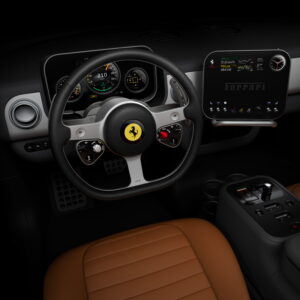
Rather than simply electrifying a conventional design, Ferrari has embraced an audacious creative collaboration: the interior of Luce was crafted alongside LoveFrom, the firm co‑founded by Sir Jony Ive and Marc Newson. Ive – famed for shaping Apple’s iPhone, iPad, and Apple Watch – brought a design philosophy centered on intuitive interaction and material purity.
In an era when many EVs default to sprawling touchscreens, Luce surprises. Its cockpit rejects a tablet‑dominant interface, instead offering physical buttons and tactile controls that echo the sensibilities of analogue motoring, yet feel refreshingly modern. The interior’s design isn’t merely aesthetic: it’s emblematic. For Ferrari to partner with industrial designers best known for consumer electronics underscores the importance of the EV pivot.

Fragola adds context for collectors: “Potentially, [electric supercars] hold their value differently, but it’s highly model and brand specific. As with most Ferraris, specification can play a big role in desirability – options, color combinations and provenance – which may influence values over time.”
See also: Why Porsche 911 Restomods Are Every Collector’s Dream
Performance, buyers and market evolution

Performance remains at the core of Ferrari’s identity. Technical details suggest Luce will be no slouch: a quad‑motor layout with more than 1,000 horsepower and a WLTP‑estimated range of around 330 miles. Ferrari plans to introduce Luce to the public in May 2026, with pre-orders available from March, according to chief executive Benedetto Vigna.
Fragola notes that early adopters will likely be established clients: “In many cases, existing clients and collectors will be early adopters. Given EVs can be attractive under current certain tax rules when acquired through a business [depending on location], we may also see a higher proportion structured via companies.”
The high-performance EV segment remains in its early stages. “The EV market continues to evolve quickly, with broader model choice and improving range each year,” Fragola observes. “It may take time to see how strongly drivers and collectors embrace it versus the character of traditional turbocharged and naturally aspirated engines.”
Добавить комментарий