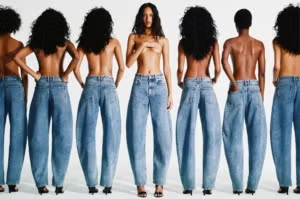
With a $1,000-plus entry point, the house has reimagined jeans as a high-fashion proposition rather than an everyday essential.

There are few fabrics more democratic than denim, but Alaïa has never seemed particularly interested in democracy. Precision, yes. Sensuality, always. Practicality? That’s newer territory. And yet, with the launch of its first dedicated denim collection, Alaïa makes a compelling case that jeans are no longer an off-duty fallback.
Under the direction of Pieter Mulier (as one of his parting gifts with the house before he steps down as creative director), denim has been reframed as a ‘second skin,’ engineered to hold, shape, and follow the body with the same intent as the maison’s famed knits. The collection presents six silhouettes: bootcut, straight, skinny, palazzo, fit-and-flare, and the intriguingly titled ‘round’.
Crafted in Japan, the fabric itself is treated with near-obsessive care: rope-dyed indigo for depth, hand-washing, and over-dyeing for nuance, laser work, and shaving for a finish that feels far from a mass-produced staple.

Denim, of course, is not new to Alaïa. It has lingered in the brand’s orbit since the 1990s, but was never quite the main event, let alone given its own dedicated line. Which is precisely why its arrival feels significant – and perhaps even more so considering the brand is far from alone in its renewed fixation on the fabric.
At Chanel, Matthieu Blazy has made denim an early signature of his tenure. As part of his debut show at the Spring/Summer 2026 couture collection, denim texture was printed onto sheer, silk trousers and sent down the runway, while stars Margot Robbie and Kylie Minogue covered the latest campaign in relaxed, wide-legged jeans paired with boucle jackets. There’s even a limited-edition denim-inspired beauty line, fronted by the internet’s favorite ‘It’ girl Lily-Rose Depp – a nod to the material’s cultural saturation.

Elsewhere, designers are circling similar territory. Erdem has flirted with low-slung, skater-adjacent jeans styled with silk, while New York’s Maria McManus has leaned into regenerative cotton denim via a collaboration with Agolde. Even houses not traditionally associated with workwear, from the likes of Balmain, Lemaire, and Akris, are reworking utilitarian codes in increasingly luxurious fabrics.
See also: An Expert Guide to Sourcing Vintage Jeans
And yet, the question that has been hovering over the industry for the past year comes back into the internet’s talking points du jour: Is this gravitation towards practicality a subtle recession indicator?
Historically, moments of economic uncertainty have often nudged fashion towards utility; towards pieces that feel justifiable, versatile, enduring. And there is a certain logic to the idea that consumers, even at the luxury level, are seeking garments that can do more, clothes that work harder.

But that reading only goes so far. Because what Alaïa, Chanel, and their contemporaries alike are proposing is not utility in the traditional sense. These are not ‘sensible’ jeans that are widely purchased as a staple for outfit rotations. They are painstakingly constructed, technically sophisticated, and, crucially, still priced within the upper echelons of luxury (the Straight jeans sit at the lowest end of the collection’s price, starting at $1,100, while at the opposite side, the Round jeans cost $1,500).
In that sense, these are pieces designed to earn their place in your wardrobe, to outlive fleeting trends (or an Instagram post). There’s also, perhaps, an undercurrent of realism. After years of fashion chasing novelty, there is something genuinely appealing about clothes designed to be lived in. The classic white T-shirt and jeans formula still holds (and is the go-to outfit of choice for some of tech’s biggest entrepreneurs, namely Mark Zuckerberg), but now those jeans come with artisanal Japanese fabrication and a silhouette that signals its pedigree.
And that’s where Alaïa’s denim lands most convincingly. Because for all the talk of practicality, these jeans are not an exercise in restraint. So, should we read this launch as a recession barometer? If so, it’s a decidedly fashion-flavored one.
Добавить комментарий