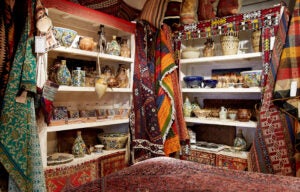
Tucked deep inside Liberty’s Tudor halls, a treasure trove of handwoven carpets prepares for its final chapter.

Beyond the perfumed beauty halls and the riot of florals lies something altogether more transportive: a hushed, labyrinthine space layered in color, texture, and history.
If you know Liberty, you’ll appreciate that it has long been synonymous with craftsmanship. Founded in 1875 by Arthur Lasenby Liberty, the store built its reputation on sourcing exceptional goods from across the globe, feeding a Victorian appetite for the exotic and the artisanal. Rugs, naturally, fit into that narrative. What began as a broader fascination with Eastern textiles evolved into a dedicated department – one that would soon become among the most respected in Europe.
For decades, the store’s Oriental Carpet Department, owned by Bruce Lepere, has been a secret wonder — an Aladdin’s cave of over 4,000 handwoven pieces. Now, with its closure slated for May 2026, it feels more significant than ever.

Located on the fourth floor of the Tudor-style building in London, the department is a striking contrast to the rest of the impeccably organized store. Rugs are piled high, draped over wooden bannisters and stacked in dense, tactile layers. Many of the pieces draw on long-established weaving traditions, from Persian medallion designs to Anatolian geometric patterns and fine silk carpets from Kashmir. Lepere personally sources each item from select locations: the sun-baked expanse of the Dasht-e Kavir, the bustling bazaars of Peshawar, and the rugged peaks of the Hindu Kush.
Unlike mass-produced alternatives, many of these rugs are hand-knotted over months, sometimes years, using techniques passed down through generations. Each item is unique, and some are antique.
The collection also spans curated decorative objects that Lepere has picked up on his travels – a Chinese elm stool, an 1880 carved teak Rajasthani elephant, and more. If you don’t find exactly what you’re looking for, the team is celebrated for sourcing bespoke pieces to order.

There is, too, a certain theatricality to the space. Rugs are thrown open mid-floor for consideration, layered atop one another like pages of a well-thumbed book. It’s not unusual to see a dealer unfurl a carpet with a practiced flick, letting it ripple dramatically across the floorboards. And yet, that is precisely what makes its impending closure so poignant; authentic spaces like this in London are becoming increasingly rare.
Still, for now, the rugs remain. Visitors can wander through stacks of history, tracing intricate motifs with their fingertips. Come May, Liberty will lose one of its most memorable departments. But for those who have stepped inside, even briefly, its magic should linger.
Добавить комментарий