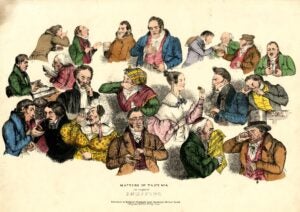
Once the ultimate status symbol of Europe’s courts, snuff boxes turned the simple act of taking tobacco into an 18th-century display of taste, status, and theatre.

Kylie Jenner at Coachella, Carolyn Bessette Kennedy in Love Story, Charli XCX, well, everywhere: it’s been declared that smoking is officially cool again.
Except, is it? While it feels like every celebrity of the moment has been spotted with a Marlboro between their fingers (check out @cigfluencers on Instagram if you think I’m exaggerating), the number of Americans with an affiliation for tobacco dropped to its lowest recorded level in 2024, according to the U.S. Centers for Disease Control and Prevention.
Long before this stop-start flirtation with nicotine – before the health warnings and moral handwringing – there was another, more elaborate way to indulge. In the early 18th century, a new kind of accessory had taken hold across Europe’s courts and drawing rooms: the snuff box. Small enough to sit discreetly in the palm, these cases were designed to hold powdered tobacco, known as snuff, to keep it fresh and close at hand.
“Snuff is ground tobacco, but it was flavored with lots of different resins, spices, and essences. It could be extraordinarily fragrant. And there were many kinds of recipes,” Matthew Winterbottom, curator of decorative arts and sculpture at Oxford’s Ashmolean Museum, explains.

By the late 17th century, as tobacco shifted from pipe-smoking to something more refined, more portable, and, crucially, more performative, the practical container similarly evolved. Rarely larger than four inches across, snuff boxes became showcases of extraordinary craftsmanship. Gold, enamel, porcelain, hardstones: no material too precious, no surface left undecorated. Miniature painters rendered intricate landscapes; jewelers set diamonds and colored foils to catch the light. Some boxes passed through the hands of a dozen artisans before they were complete.
Their value was as performative as their function. “If you’re a flash person who’s got a lot of money and you want to show off, a snuff box is something that can really do that,” Winterbottom explains. “It would have probably been the most expensive object on your person at that time. It’s like the equivalent of having a Lamborghini in your pocket.”
Their appeal stretched to Europe’s most powerful figures: “Frederick the Great of Prussia, he was a very warlike king but also a massive snuff taker. He commissioned all these extraordinarily beautiful jeweled snuff boxes,” Winterbottom says – there were 300 boxes reported in the King’s collection. “These were incredibly feminine when we look at them today; they’re extravagant and covered in diamonds, which might be at odds with our ideas of masculinity.”

To carry a snuff box was to signal taste; to use one was to be noticed. It offered a perfectly choreographed moment: opened mid-conversation, extended with intention, closed with a flick that could suggest anything from intimacy to indifference. In 1711, The Spectator magazine offered satirical lessons on the ‘exercise of the snuffbox,’ including ‘rules for offering Snuff to a Stranger, a Friend, or a Mistress according to the Degrees of Familiarity or Distance,’ distinguishing acts between ‘the Careless, the Scornful, the Politic [or] the Surly Pinch.’ In a way, it was the modern-day equivalent of sparking a conversation by asking for a light, knowing all too well there’s one buried deep in your pocket.
With the rise of other forms of tobacco-taking and the introduction of cigarettes in the 19th century, the act of taking snuff began to diminish. As Winterbottom puts it, “it makes you basically sneeze, gives you a kind of brown nose, and is sort of an odd habit. So it just fell out of fashion, really, in the Victorian period.”
Changing ideals of masculinity only hastened its decline. “The 19th-century men are becoming much more somber… so it would have been rather unseemly, I think, for a man to be carrying a very elaborate snuff box around on his person,” he adds.

Yet while the contents fell from favor, the boxes themselves endured: no longer tools of habit or social accessories, but collectors’ prizes. As early as 1908, The Atlantic magazine described a single Louis XVI snuff box as unremarkable in provenance, yet it still fetched $10,000 at auction in Paris (roughly $300,000 in today’s terms). Its value, the essay claimed, lay not in who had owned it, but in what it was: a small object capable of conjuring an entire vanished world of ‘brocades […] diamond-buckled shoes,’ and candlelit salons. That sense of enchantment has proved remarkably durable.
See also: A Secret World of Oriental Rugs Is Hidden Inside Liberty London
Royal collectors played no small role in preserving their legacy. “The late Queen’s grandparents, Queen Mary and George the Fifth, collected snuff boxes. They were very big collectors,” Winterbottom notes, adding that Queen Mary was “obsessed particularly with things that had been associated with members of the royal family,” acquiring boxes linked to figures such as Queen Charlotte and George IV. In London, he notes, a famed tobacconist in Haymarket was a popular royal supplier.

They were not alone. “People like Rothschilds, for example, had a big snuff box collection, because, again, they’re outward shows of luxury and glamour,” he says. “They’re not wearing them or using them, but they’ve just become collected objects.”
Today, snuff boxes sit less in waistcoat pockets than behind glass, prized not for their contents but for their craftsmanship. In fact, several of Fredrick the Great’s personal snuff boxes can be seen on display within the Rosalinde and Arthur Gilbert Collection at London’s V&A, while the Royal Collection Trust and the Ashmolean similarly boast several within their permanent exhibits. “They often have these amazing histories associated with fascinating historical characters,” Winterbottom explains. “And again, they’re small, so they’re not going to take up a lot of room.”

That practicality, combined with their opulence, continues to appeal beyond museum vitrines, but also within private collections. “They’ve always been associated with wealthy collectors, people who were collecting amazing old master paintings and porcelain… and while some of the other objects are no longer as fashionable as they were, snuff boxes seem to remain. They’re still fetching very high prices.”
Which perhaps explains why the fascination endures. Smoking, then, may or may not be back. But the desire to turn a simple act into something social, stylized, and faintly theatrical never really left. The snuff box simply did it with more sophistication.
Добавить комментарий