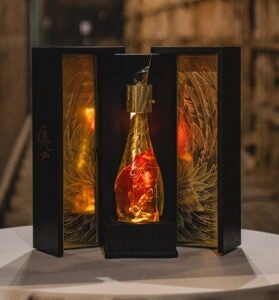
Buffalo Trace unveils Eagle Rare 30, the oldest age-stated bourbon it has ever bottled. We travel to Kentucky to try it.

The road to Frankfort is unremarkable. One of those American highways that weaves across state lines, seemingly endless, yet everyone is going somewhere. What is remarkable is my destination and, on this occasion, the reason for the journey.
Because Buffalo Trace isn’t just unveiling another whiskey. It is releasing the oldest age-stated bourbon it has ever bottled: Eagle Rare 30.
Thirty years in new oak. On paper, that shouldn’t work. The climate is too aggressive, the wood too dominant, the losses too severe. Bourbon, as a rule, doesn’t do decades. And yet, here I am, drawn in by the promise of something that sits well beyond the usual limits of the category. Buffalo Trace, as it turns out, is exactly the kind of place that would attempt it.

And Buffalo Trace is not just a distillery, but a pilgrimage. I arrive at 9am to a red-bricked campus and a queue already snaking around the car park. The pilgrims are easy to spot: head-to-toe in Buffalo Trace merch, clutching branded keep-cups of steaming hot coffee. Some have already raided the gift shop; one man is hauling a case of Weller Barrel Strength back to his F-150 like it is essential supplies.
And the reason this campus attracts so many loyal followers is because it is a cathedral for casks, its saints the names on the labels: W. L. Weller, Colonel E. H. Taylor, Elmer T. Lee. And, of course, the patron saint of bourbon, Pappy Van Winkle.
Sign up to the World of Fine Spirits newsletter for more stories.
The core range here is a study in nuance. Two mash bills, both closely guarded and not something master distiller Harlan Wheatley is about to divulge, distilled through the tallest stills in Kentucky (the “Harlan Globe Trotters,” as I’ve dubbed them), and matured in barrels all carrying the same level four char.
And yet the results are anything but uniform. The whiskey is refracted through time, wood and warehouse alchemy into a spectrum of identities. Buffalo Trace itself is steady and workmanlike; Blanton’s all polished swagger and single-barrel theatre; George T. Stagg a bruiser that kicks the door in. Weller and Van Winkle lean into wheated softness, while E. H. Taylor and Elmer T. Lee bring a firmer rye spine. Different personalities, same DNA; consistency expressed through variation.
And then, sitting somewhere between elegance and obsession, is Eagle Rare.
Eagle Rare is the quiet intellectual in the room; a label built around time as its defining ingredient. The range begins at 10 years old, already a confident age statement in bourbon terms. It draws from Buffalo Trace’s low-rye Mash Bill No.1, typically 10 percent rye or less, with corn and malted barley doing the heavy lifting. The result is a spirit with the structure to endure long aging, no small feat in Kentucky’s aggressive climate and under the influence of new oak.

From there, the range steps up through a newly introduced 12-year-old, the 17-year-old in the ‘Buffalo Trace Antique Collection’, and Double Eagle Very Rare at 20 years old. The portfolio was crowned in 2023 by a limited 25-year-old release of around 200 bottles that made clear the central philosophy of Eagle Rare: management of maturity as the key pillar for the label.
Because, in truth, bourbon isn’t meant to stretch this far. At a quarter of a century, you’re dealing with intensity and attrition in equal measure. The angels’ share stops being poetic and becomes punitive; a full-scale heist.
Push beyond that and the risks multiply. Oak tightens its grip, balance slips, and the whiskey can collapse under its own weight of age.
And yet the 25 held together. Dark chocolate, black cherry, a touch of cardamom keeps it alive. That was no accident. Much of that success comes down to Warehouse P, Buffalo Trace’s climate-controlled environment, opened in 2019 and designed to slow maturation and manage extremes. It’s an attempt to apply a more temperate aging model to Kentucky conditions, and crucially, it works.
The distillery has backed that thinking with serious investment, over $20m to date, part of which can be seen in another facility, Warehouse X, the distillery’s engine of innovation manifest as a small, purpose-built rickhouse holding just 150 barrels, designed to capture data on every conceivable aspect of maturation.

Which brings me back to the 30.
The 30-year-old isn’t simply an older whiskey. It’s the result of decades of intent and investment, of the master distiller asking whether bourbon could age like this. And then building the infrastructure to find out. As Wheatley puts it, “$20m can buy you a lot of things, but it can’t buy you time.»
And then, finally, it was time to try this hyper-aged bourbon. No grand unveiling. No theatrical pause. Just Wheatley, standing in front of Warehouse P, and pouring a measure of Eagle Rare 30 into my glass with a quiet composure.
Bottled at 50.5 percent ABV (101 proof), in the glass it is all deep mahogany, exactly as you’d expect. On the nose, it opens steadily: antique wood, certainly, but also orange peel, dark muscovado sugar, and a lifted herbal note, something close to eucalyptus. There’s precision to it, rather than sheer weight.
On the palate, it avoids the trap you’re expecting. Instead of dryness and tannin, there’s structure. Dark chocolate, black cherry, toasted pecan, and nut brittle. Some hints of blackcurrant. Layered, but held together by a frame that still carries tension. Thirty years in oak and it hasn’t grown tired. It hasn’t flattened out. It’s composed, and still evolving in the glass.
And this is all by design.
So too is how it’s being released. The first bottles, numbers one and two, are heading to Bonhams in London, forming the centerpiece of an online auction running from April 24 to May 8, 2026. Alongside them sits a curated selection of the Eagle Rare range, the 10-, 12-, 17-, 20-, and 25-year olds, along with private tastings, single barrel selections, and even a stay at the distillery’s private residence, Stagg Lodge.
Ultra-aged bourbon at this level is exceptionally rare, largely because the environment works against it. Few barrels make it this far, and this is not one for the car park pilgrims, but for those who follow the long arc of the category: collectors, curators, drinkers, and those who understand that time and patience is the ultimate luxury in whiskey.
Добавить комментарий