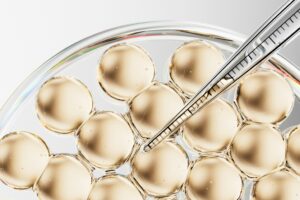
We speak to the experts to separate fact from fiction on stem cell beauty treatments, exosomes, and regenerative aesthetics.

For years, aesthetic treatments have been largely concerned with correction. Fill the wrinkle, soften the line, restore the volume. The goal was visible change, delivered quickly and with increasingly dramatic results.
But the beauty standard has since shifted, and rather than asking how to look younger, many patients are asking how to age better. Skin quality, longevity, and regeneration have become some of the industry’s biggest buzzwords, giving rise to a new category of treatments marketed under the banner of regenerative aesthetics.
See also: Regenerative Skin Boosters That Top Aesthetic Doctors Actually Rate
Alongside terms such as exosomes, growth factors, and cellular rejuvenation, one phrase appears again and again: stem cell therapy. But as interest grows, so too does confusion. What exactly are stem cell beauty treatments, and how much of what is being advertised is grounded in science?
What are stem cell beauty treatments?
At their simplest, stem cell restorative treatments are designed to encourage the skin to repair and rejuvenate itself rather than simply altering its appearance.
«The term ‘stem cell restorative’ generally refers to therapies that aim to stimulate the body’s natural healing and regeneration pathways, encouraging collagen production, tissue repair, and improved skin quality over time,» explains aesthetic doctor and surgeon Dr Jonquille Chantrey.
Stem cell-based treatments can take several forms depending on the clinic and technology being used. In aesthetics, they are most commonly delivered through injections, microneedling, or topical applications designed to introduce growth factors, exosomes, or other regenerative compounds into the skin to improve its texture, elasticity, and collagen production over time.
Regenerative therapies are also increasingly being used to support hair restoration, with some treatments designed to stimulate the scalp and encourage healthier hair growth.

The important caveat is that most aesthetic treatments marketed as stem cell therapies do not actually involve stem cells themselves. «Patients are not actually receiving living stem cells,» says Chantrey. «Instead, they’re usually receiving ingredients, growth factors, signalling molecules, or laboratory-derived products that are intended to mimic some of the regenerative effects associated with stem cells.»
This distinction is often lost in beauty marketing, where the term has become something of a catch-all phrase for a wide range of regenerative treatments.
Stem cells, exosomes, and growth factors: what’s the difference?
Much of the confusion surrounding stem cell treatments stems from the terminology itself. Exosomes, growth factors, and stem cells are often discussed together, despite referring to very different things.
«Exosomes are not stem cells,» says plastic surgeon Professor Tunc Tiryaki. «This is one of the biggest misconceptions in regenerative aesthetics.» As the plastic surgeon explains, stem cells are living cells capable of self-renewal and developing into other cell types. Exosomes, by contrast, are tiny extracellular vesicles released by cells that act as biological messengers, carrying proteins, growth factors, and other signals between cells.
«A useful analogy is that stem cells are the factories, while exosomes are the messages sent out by those factories,» says Tiryaki.
See also: Why Is Hollywood Reportedly Hooked on Peptide Injections?
Why are they becoming so popular?
Part of the appeal lies in what regenerative treatments promise: healthier-looking skin rather than a dramatically altered appearance.
«Many patients now want healthier, fresher-looking skin rather than obvious aesthetic intervention,» says Nina Prisk, founder of Update Aesthetics Clinics. «There is much more interest in treatments that improve skin texture, elasticity, and overall tissue quality over time.»

Social media has undoubtedly played a significant role in accelerating awareness. Treatments once confined to specialist clinics are now widely discussed online, often promoted alongside concepts such as longevity, biohacking, and preventative aging.
The downside, experts warn, is that social media can sometimes outpace the science. «Celebrity endorsements and social media have played a major role in popularising regenerative aesthetics,» says Chantrey. «The challenge is that social media tends to highlight dramatic before-and-after results while rarely discussing limitations, evidence quality, or appropriate patient selection.»
Do stem cell treatments actually work?
For all the excitement surrounding regenerative aesthetics, the science remains a work in progress. «The honest answer is: genuinely promising, but it’s still developing,» says aesthetics specialist Dr Liesel Holler. She notes that some of the strongest evidence currently exists for exosome-based treatments combined with microneedling, where studies have demonstrated improvements in skin texture, hydration, tone, and collagen production.
However, many of the studies remain relatively small, use different treatment protocols, and lack long-term follow-up. «We do not yet have the large, long-term, rigorously controlled trials that we would want before making definitive claims,» she cautions.
How much do stem cell treatments cost?

As with most aesthetic procedures, pricing varies significantly depending on the treatment itself, the clinic, and the number of sessions required. One reason regenerative aesthetics has attracted attention is the wide range of options now available. For example, according to Prisk, microneedling typically costs between £150 and £350 ($150 to $467) per session, while PRP generally ranges from around £300 to £700 ($400 to $935). Regenerative treatments sit at the higher end of the spectrum, with prices usually starting at around £300 ($400) and reaching £2,000 ($2,668) or more per session.
Treatments marketed as «stem cell-influenced» therapies tend to fall within a similar price bracket, typically costing between £500 ($667) and £2,000 ($2,668) or more per session, depending on the technology being used and the treatment area. For comparison, dermal fillers generally cost between £250 ($335) and £600 ($800) per syringe.
See also: Inside the Art of Getting ‘Snatched’
What are the risks?
As regenerative treatments move from science papers to specialist clinics and into the mainstream, experts say patients should pay as much attention to the provider and the product as they do the promised results. «As with any aesthetic treatment, there are risks that patients need to be aware of,» says Prisk. Depending on the treatment, these may include inflammation, swelling, irritation, and infection.
But the greatest risk that the experts caution against lies not necessarily in the treatments themselves, but in the marketing that surrounds them. Many products and procedures are promoted using the language of stem cells despite having limited clinical evidence or little transparency about what they actually contain.
Regenerative aesthetics may well represent the future of cosmetic medicine, but for now, experts say patients should focus less on the marketing language and more on the evidence behind a treatment. As Chantrey puts it, «‘stem cell-derived technology’ is often a far more accurate description than simply saying ‘stem cell treatment’.»
Добавить комментарий