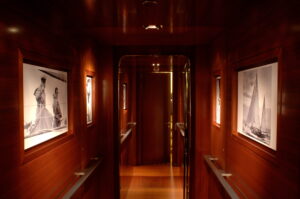
Experts reveal how to transform your ship into a floating museum.

Countless hours are spent poring over the cabling, what kind of wood will be used for the floors, and where to install a pool or add a movie theater. Once all that’s over and done, selecting art and décor can feel a touch superfluous. “It’s years of work, and the questions feel endless, so by the time it’s down to what’s going on the table, you’re exhausted,” says art dealer and collector Adrian Sassoon. “I often find people give more attention to the boat itself, and the objects tend to be a bit off the shelf.”
However, a beautifully designed yacht should feel like a mansion on the water, and that means every last detail must be carefully considered, down to the artwork you hang on the walls. It can feel like a daunting prospect, however, to bring priceless artwork onboard a moving residence that’s surrounded by the sea on all sides. That’s where an expert comes in.
See also: An Expert Guide to Yacht Shows Around the World

Eugene Layton, head of operations at Gander & White, has installed art on countless yachts during his 20-year run at the logistics company. Yet, no matter how much experience he possesses, each project proves to be a unique experience. “No two have been the same in terms of logistics, or even how to load onto the actual vessel,” he says. “We’ve had complications on access, on insurance, and the marina.”
The logistics company’s approach is a meticulous one, and begins with a site visit, where they’ll take measurements of every single aspect of the yacht – the team will spend more than a day there if necessary. Afterward, Layton and his team will devise a plan to load the artwork onto the ship, which varies based on the yacht itself, as well as where it’s located. One possible scenario is craning the artwork from Gander & White’s truck to a barge, where it’s then craned from the barge to a bridge deck. The art will be uncrated, installed, and then the crate will be moved back from the barge to the truck.
See also: What It’s Like On Board the Orient Express Corinthian, The ‘World’s Largest Sailing Yacht’
Great care will be taken to leave no trace. “Yachts are extremely high-end, and extremely fragile,” he says. “A lot of our process is about protecting the floors and making sure we have a staging area.” Everything the company uses for an install must be brand new, down to the drill bits used to hang a painting – older tools might cause splintering or leave debris behind. It’s an important consideration for projects both big and small. Layton recalls working on a second yacht for a client in Marseilles that was so large, his team had to use walkie talkies to properly communicate between floors and rooms.

Having a logistics expert to install the pieces is important, but bringing an art consultant on board early can help immensely in curating a beautiful collection. “It’s a big part of the original layout,” says Guillaume Rolland, principal of design firm Liaigre. “When we approach a space, it feels a bit like movie making.” In fact, aside from the technical considerations, he thinks of designing and curating art for a yacht as no different from working on a hotel, private residence, or a restaurant. “We’re architects,” he says. “We deeply believe everything is ruled by architecture.”
Much of the firm’s work complements the yacht’s surroundings, evoking a sense of adventure, but not distracting from the beautiful views that often surround. For example, a recent project had a long wall with a blue mirror stretching across it that almost resembled a window. Liaigre added five seascape photographs by Hiroshi Sugimoto to the wall as well. The mirrors would reflect the horizon, and the artwork would echo this vista, albeit in a different format: “It’s playing with the magic and the poetry of things,” he says.
There are, of course, a few natural concerns that may arise regarding certain art pieces in a space that’s so close to the natural elements. For Sassoon, however, there’s a simple solution. “If you as a human being are sitting in a room and you’re not too cold or too hot, and you’re comfortable, then most works of art will be comfortable too,” he says. “You don’t put a drawing on paper in bright sunlight, but you yourself don’t sit in bright sunlight either.”
See also: Why Rolls-Royce Veteran Torsten Müller-Ötvös Is Betting On Yachts

Movement can be accommodated for as well. Stabilizer systems ensure that most ships won’t jostle too much, but just in case, Gander & White use a special lock system when affixing art to a wall. It will keep paintings and photography secure and can only be undone via a wrench that’s given to the captain in case of emergencies. There is one major limitation when it comes to art on the wall, however: Most yachts don’t have particularly tall ceilings, so large-scale murals and drawings simply won’t fit.
It’s also an opportunity to pull some beautiful pieces from your personal collection and place them in an entirely new setting. “If somebody has something sitting in storage and they’re building a yacht, I’ll see what we can use,” says Sassoon. “They like them, they own them, they just haven’t got a space for them.” Pieces can cycle between your different properties as well. You might keep high-profile artworks in a city apartment and charming, sentimental ones in a country residence; a yacht might be a great home for paintings of coastal vistas, or sculptures made with natural materials that echo the surroundings.
So, while artwork might seem like a small detail at the end of a very long yacht construction process, investing in a good curator can help you give pieces in your collection a new home – or provide an opportunity to discover a new sculptor or painter whose work pairs well with the space. “They’re like a mobile home,” says Sassoon. “So why should a yacht be furnished in a totally different way than a home?”
Добавить комментарий