Henrietta Loyd has over 40 years’ safari experience – now, she shares her advice on traveling well.

Across a career spanning over 40 years, Henrietta Loyd has watched the safari industry balloon into just about the number one most coveted travel experience. In 1993, Loyd co-founded travel operator Cazenove & Loyd alongside business partner Suzie Cazenove. What began as a two-woman show has developed into being one of the world’s most respected travel companies, with a globe-spanning portfolio. As well as organizing special trips for clients, Loyd regularly hosts small group trips in up-and-coming and less-known regions around the world. Here, she reflects on four decades of witnessing how travelers behave, what they seek, and what might still be saved.

See also: Six Must-visit Destinations Travel Experts Say You Can’t Miss in 2026
How has the safari and the wider travel industry changed since you began your career?
The level of luxury. I started 40 years ago and it was all just about being in Africa, in the bush. The [standard] has changed massively and I don’t see how they could get any better. The quality is amazing. But it is leveling – I think the hospitality has reached its peak and we are moving back to people traveling to see the animals and to truly experience Africa. It’s lovely to have a nice room to go back to and to have a hot bath and a shower, but you spend so little time there. People are more and more interested in going back to that old type of safari.
In the current climate, what does ‘luxury’ mean in terms of a safari? Is it access, camps, guides?
It’s about solitude. It’s being alone, with your group and your guide and spending time with a lion pride or seeing that giraffe mother and calf, without the big groups and the other vehicles. The guiding is also incredibly important and is a huge focus for us – if the guiding isn’t up to standard, it can undermine the whole safari experience. It’s also about learning. You should return with new knowledge – about the people, the place, and the wildlife.

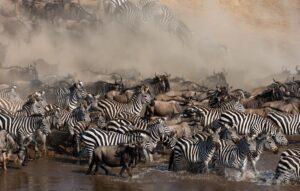
The recent videos of cars flocking crossing sites during the Great Migration have been jarring – have you heard anything on the ground from locals?
Truthfully, it has always been like this. We are just seeing it more because of social media. I have been going to Africa for 40 years and I have never truly seen the Great Migration – it’s not the standard to see it. You have to be in the right place at the right time. We try to move people away from traveling during that time and we never ever promise anything. In fact, I would recommend going away from where the Jeeps are in search of a quieter area. If you see something on the way back, wonderful, but don’t seek out the Great Migration.
Do you think social media could have a positive impact in raising awareness of overcrowding during the migration?
No I don’t – some people just want to go. The industry is massive and people will always want to see it, and there will always be people who take them to see it. It gets whipped up into a frenzy. I’m sorry to be depressing but it’s a fact.
How do you advise your clients to safari responsibly?
Do your research and pick a company known for its knowledge, longevity, and relationships on the ground. We’re known for safari as I’ve done it all of my adult life – we have a reputation. A lot of our clients are well traveled, but for a first timer we always send them somewhere with great game viewing. In South Africa, for example, we know the reserves adjacent the Kruger National Park are heaving with game. But again, we say nothing is guaranteed – that is how we deliver in a responsible way.

Beside safari, what destination have you been to this year that has been particularly?
I have been almost living in Bhutan this year. I have got to know it very well and I have become extremely fond of it. The people are lovely and the landscape is still pretty unspoiled – over 70 percent is covered by forest. I feel privileged to have spent so much time there. It is very much ‘slow travel’ and a generally slow way of life there.
How can Bhutan protect its integrity as tourist interest grows?
It is getting noticeably busy but their [tourism model] keeps numbers down: you pay $100 per day in tourism tax. The King has plans for a whole new town, which will be focused on mindfulness, but that’s ten years off, and there are no plans for any more big hotel groups. Between that and the daily levy, they’re not on a trajectory for it to become a crazy destination.
What location can you return to time and time again and always discover something new?
The Middle East fascinates me. I’ve been to Jordan six times, we’re doing lots more in Saudi Arabia and Bahrain and I love Oman. There’s so much to learn and each country is so different – I don’t think you could ever come away from the Middle East and feel like you’ve done it all, seen it all, or know it all.
Добавить комментарий