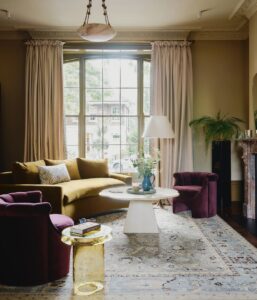
Here’s the materials, finishes, and design shifts shaping the next chapter of sustainable luxury living.

In 2026, the conversation has shifted away from novelty and visual excess towards longevity, material intelligence, and a deeper emotional connection to the spaces we inhabit. Sustainability is no longer a niche concern or a virtuous add-on; but seamlessly woven into aesthetics, craftsmanship, and comfort.
After years of heavy maximalism, Pinterest’s 2026 trend forecasting points to a growing appetite for interiors that feel grounded, tactile, and storied. Searches are rising for richly layered spaces, heritage influences, artisanal finishes, and designs that engage the senses rather than overwhelm them. This aligns with a broader cultural move away from disposable modernity towards interiors that feel collected over time – spaces that privilege air quality and emotional resonance as much as visual impact.
For today’s luxury homeowners, sustainability in 2026 is less about overt eco-signaling and more about discernment: choosing materials that age beautifully, investing in pieces that will outlast trends, and creating homes that feel deeply personal while remaining environmentally responsible. London-based interior designer Carina Harford, founder of Harford House, notes that today’s clients are increasingly informed, prioritizing health, provenance, and longevity as instinctively as they once prioritized square footage or statement finishes.
From operatic drama reimagined through heritage textiles to a renewed reverence for antique craftsmanship, these are the six sustainable interior design trends set to define luxury living in 2026.
Operacore
Operacore is emerging as one of 2026’s most evocative interior movements, but its luxury expression is far removed from theatrical excess. Instead, it manifests through atmosphere: deep red and wine-toned walls, sculptural lighting, antiqued mirrors, and generous drapery that frames a room rather than overwhelms it.
Sustainability plays a crucial role in this evolution. Heavy velvet curtains are increasingly sourced vintage or made from natural fibers, while timber details and reclaimed metals replace synthetic finishes. These choices bring both gravitas and environmental integrity, allowing drama to coexist with restraint.
Harford notes that health-conscious material selection is now integral to this approach. “There’s a lot more awareness around air quality and how it can be affected by different materials and finishes,” she explains. “Most of my clients are opting to use natural mineral paints, non-toxic upholstery, and are minimizing synthetic fibers where possible.” In Operacore interiors, mood is achieved not through excess, but through considered layering.
Mineral paints
Paint has become one of the clearest markers of design intelligence in 2026. Mineral and plant-based paints are now widely favored for their depth of color, tactile finish, and positive impact on indoor air quality. Unlike plastic-based emulsions, these paints allow walls to breathe, creating spaces that feel calmer and more nuanced.
Visually, the effect is unmistakable. Mineral paints absorb and reflect light unevenly, producing subtle tonal shifts that enhance architectural details and soften transitions between spaces. They work equally well in period properties and contemporary builds, lending walls a sense of permanence rather than polish.
For Harford, this shift is no longer optional. “Using high quality, non-toxic, non-plastic, mineral- and plant-based paints from companies like Edward Bulmer and Earthborn is a given now – I don’t offer other paints anymore at all.” In 2026, sustainability and aesthetic refinement are inseparable, and paint sits at the intersection of both.
Antiques
The return to antique and vintage furniture is one of the most defining sustainable interior trends of the year. Rather than treating older pieces as accents, designers are using them as anchors – grounding rooms with craftsmanship, patina, and material integrity.
Antique furniture offers an inherently sustainable solution: solid wood construction, enduring design, and a lifespan that already spans generations. These pieces reduce the need for new manufacturing while introducing individuality that cannot be replicated through mass production.
Harford has seen a growing willingness to prioritize these investments. “Clients are more and more willing to invest in vintage and antique furniture over modern low-quality options,” she says. “The older pieces are usually solid wood, made beautifully, and have already lasted 50–100 years.” In 2026, luxury is increasingly defined by what has endured, not what is newly made.
Decorative trims & moldings
Decorative detailing is enjoying a renewed relevance. Rather than ornate excess, trims, and moldings are being used to introduce texture and craftsmanship to interiors that might otherwise rely on surface finishes alone.
Wooden paneling, tiled borders, fabric trims, and bespoke joinery are all being reinterpreted to frame spaces and enhance architectural form. These elements add visual interest without demanding constant renewal, making them a quietly sustainable choice.
“My clients are all quite different,” Harford notes, “but decorative moldings and trims – wooden, tile, fabric, all sorts – are featuring across a lot of projects in different styles.” The appeal lies in their adaptability: details that feel rooted in tradition yet flexible enough to evolve with the home over time.
Natural fibers
Wool, linen, hemp, and silk are favored not only for their environmental credentials, but for the way they regulate temperature, soften acoustics, and age beautifully.
Rather than relying on pattern or color for impact, interiors are leaning into texture; bouclé upholstery, washed linen curtains, woven wall hangings. These materials contribute to healthier indoor environments by reducing synthetic fibers and airborne pollutants, while also enhancing comfort.
This move aligns with Harford’s observation that minimizing synthetics has become a priority. Natural fibers are no longer seen as rustic or understated; instead, they signal a refined understanding of comfort and longevity.
Collectibles
In place of singular statement pieces, 2026 interiors favor a more curatorial approach. Collectible design – from limited-edition lighting to studio ceramics – allows spaces to evolve gradually, guided by personal taste rather than trend cycles.
These pieces are often produced in small batches, using traditional techniques and responsibly sourced materials. Their value lies not only in aesthetics, but in the relationship between maker and owner, encouraging care, repair, and long-term appreciation.
This approach reflects a broader shift in how luxury interiors are conceived: as living collections rather than finished compositions. The most compelling homes are those that feel layered and intentional, where sustainability is embedded as standard.
Добавить комментарий