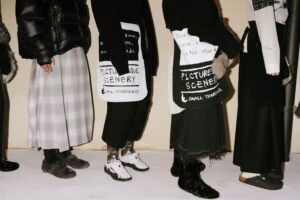
Introducing Hed Mayner, Shinyakozuka, and Soshiotsuki.

While most have come to visit the 750 brands on offer at the trade fair, there will be many excitedly anticipating the catwalk shows of the three guest designers invited to present their fall/winter 2026 collections.
In the past few decades, the guest designer slot has been filled by design juggernauts, such as Giorgio Armani, Raf Simmons, and Vivienne Westwood, as well as contemporary cutting edge designers like Martine Rose, Grace Wales Bonner (of Wales Bonner), and Stephen Daley (of SS Daley). Keeping an eye on who shows now will give you an insight into who will be the mainstream names of tomorrow, likely informing the type of garms you’ll be coveting in the future.
So, without further ado, find below this year’s cohort, and expect to hear more about them in the future.
Hed Mayner

The Israeli-born designer first became interested in fashion through pattern making and garment construction, but his design vision was refined when he moved to Paris to study at the acclaimed Institut Français de la Mode. He launched his eponymous label in 2015, and quickly gained traction for his unorthodox silhouettes that took inspiration from Jewish tailoring.
He first debuted on the Paris Fashion Week Men’s schedule in 2017, and then went on to win the Karl Lagerfeld Award at the 2019 LVMH Prize. Yesterday, Mayner showed his collection in the La Palazzina Reale (now home to the Architecture Society of Florence), his first in the Tuscan town as the main headline slot – following in the footsteps of Martine Rose and Grace Wales Bonner.
This season, Mayner designed under the principle of ‘so wrong it’s right’, emphasizing ‘off’ elements. Scarves were so long they skimmed the ground, blazers had oversized shoulders and a nipped-in waist that created a reverse triangle silhouette, and a houndstooth coat with cape-like shoulders finished with asymmetric hems opened the show.
Shinyakozuka

Despite its decade-long tenure and stockist list of 50 Japanese retailers and 20 international, Shinyakozuka, helmed by Shinya Kozuka, hasn’t shown in Europe before. That changed when he decorated the Magazzino of the Fortezza da Basso in fake snow and presented his fall/winter ‘26 collection.
Kozuka graduated from London’s prestigious Central Saint Martins in 2013 before returning to Japan and starting his own business. Since then, Kozuka has been exploring how fashion can be connected to memory, and has used his own experiences to inform collections. For fall/winter ‘24, Kozuka was inspired by a picture book he created as a student.
Shinyakozuka is often known for its utilitarian silhouettes and oversized fits, but what stood out in the collection, shown on Wednesday, were the prints. Snowfall laid across the shoulders of wool coats and on the trim of blazers, while wild deer, moose, wild crows, and campaniles formed scarves and cotton shirts. A singular glove – the other half to ‘the lost glove’ that formed the theme of the collection – was stamped onto an apron pocket.
Soshiotsuki

If you’re a fan of Giorgio Armani’s louche eighties tailoring and aren’t aware of Japanese designer Soshi Otsuki, you’re likely going to rate his work. His brand, Soshiotsuki, explores Europe’s tailoring influence on Japanese style. In 2019, it received the Tokyo New Designer Award. In 2025, Otsuki won the LVMH Prize, beating 2,300 applicants of 115 nationalities.
“Up until now I have been telling the story of the era when Italian suits flowed into Japan,” Otsuki told WWD before the show. “This time, I am approaching the collection with the intention of re-exporting that story back in the opposite direction.”
His first catwalk held outside of Japan is in the Santa Maria Novella Refectory – the limewash columns and walls providing a prime backdrop for a collection filled with earth-toned tailoring. Silhouettes were oversized (as to be expected), but traditional suiting elements were presented with a twist.
The knot and a point of the tie were hidden, only exposing the section in between, and a Mandarin collar shirt and trousers were combined to form a jumpsuit emulating two separate pieces. Modern prints are projected onto classic suit silhouettes, while a velour tracksuit top pokes out underneath a blazer. It’s youthful and playful while respecting old tailoring codes, and will no doubt get the attention of young suit enthusiasts in the making.
Добавить комментарий