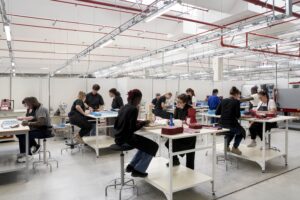
From Chanel to Bottega Veneta, the world’s top houses are betting on the next generation of artisans.

Big-name brands are investing in high-level academies and educational programs dedicated to training the next generation of specialists – and preserving a legacy of craftsmanship in the process.
It can take a few days, involving a technically complex process and that elusive virtue of patience, for a Bottega Veneta tote to be handwoven in the house’s signature intrecciato style. At Accademia Labor et Ingenium, Bottega Veneta’s academy of craft and creativity near Vicenza (Veneto), students are trained in these leathercraft processes by master artisans with decades of expertise.
Established in 2023, the academy’s workshops and courses offer both classroom and practical atelier-based learning, with skills ranging from prototyping to production. Like most of these high-end training academies, entry is competitive; only 50 students are accepted annually.

“As a young apprentice at Bottega Veneta, I learned from the expertise, passion and precision of more experienced artisans,” said Ruggero Negretto, one of the academy’s program leaders and a long-standing Bottega Veneta master craftsman.
At Tod’s headquarters in Italy’s Marche region, meanwhile, Tod’s Academy is a mentor-led ‘laboratory of ideas.’ The focus is on creative collaboration and reinterpreting the house’s ‘Made in Italy’ heritage through a sustainable lens. Students from international fashion schools are tasked with reimagining Tod’s design codes and signature products – from the Gommino loafer to the T Timeless logo – in projects combining Italian manufacturing traditions, creative expertise, and environmentally conscious materials like vegan leather and recycled rubber.

The lucky few (you can count them on one hand) who are accepted into Chanel’s Métiers d’Art Fellowship programs learn centuries-old secrets of European haute couture embroidery, pleating, featherwork, and millinery. Mentored by craftspeople from Atelier Montex, Lesage, and Lemarié – whose handwork on Chanel’s haute couture and Métiers d’Art collections captivates each season – students undertake intensive training programs learning time-honored skills such as plumasserie (feather embroidery), felt shaping, and appliqué.
In the Italian town of Casperia, 30 miles north of Rome, the Massoli tailoring academy is empowering Italy’s future artisans, with Fendi’s support. Dedicated to reviving what it perceives as «a neglected and heavily undervalued sector,» the academy is preserving the skills and knowledge that underpin a longstanding ‘Made in Italy’ heritage. These include tailored drapery, corsetry, patternmaking, hand sewing, and material studies.

While Italy’s culture of high jewelry predates the Renaissance, an emerging generation is learning the importance of balancing traditional techniques with technological innovation. Established in 2025 in partnership with TADS (Tarì Design School), Scuola Bulgari in Valenza, Piemonte is the maison’s first publicly accessible training school offering courses in goldsmithing and gemstone setting. Practical training is enhanced by state-of-the-art laboratory equipment for refining processes like modeling, welding, laser cutting, and fretwork.
European luxury houses are declaring it: tomorrow’s artisans are not only the custodians of practical skills and knowledge that has been passed on for generations, they are also a vital part of the evolving dialogue between heritage and innovation.
Добавить комментарий